
Abstract
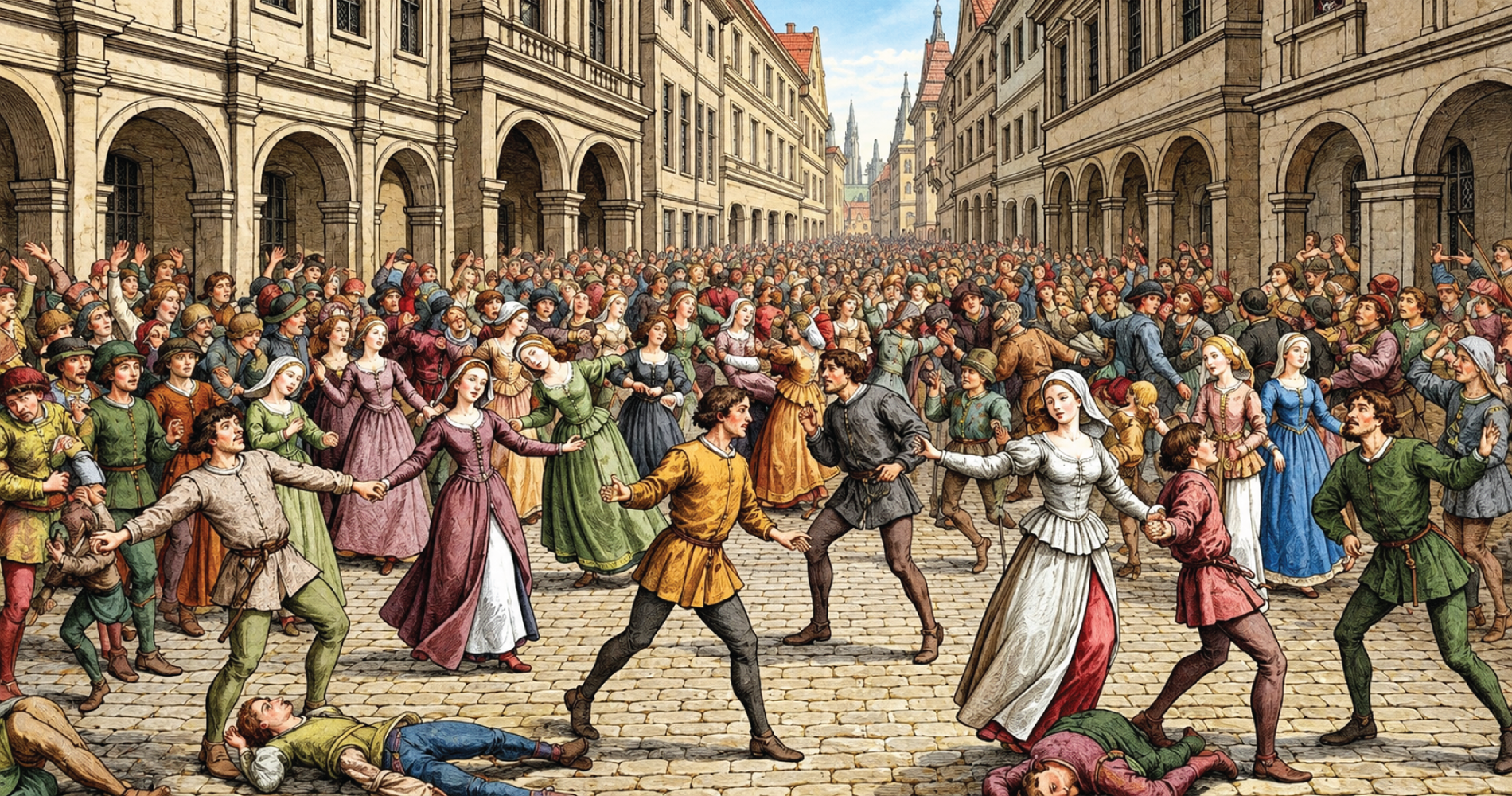
In 1518, an event took place in the European city of Strasbourg whose cause still cannot be determined with certainty. According to historical accounts, a woman suddenly began dancing uncontrollably in the street. Within just a few days, dozens of people joined her, and later accounts mention that around 400 people were affected. This event is called the Dancing Plague of 1518.
Historical reports exist of several people dying from extreme exhaustion and physical weakness. However, the actual death toll is disputed. To explain this mysterious event, scientists and historians have proposed various theories involving Mass Psychogenic Illness, Ergot Poisoning, religious beliefs, social stress, and the Nervous System.
Research published by historian John C. Waller in 2008 and a study published in the journal Public Health in 1997 suggest that it would not be appropriate to assume there was only one cause behind this event. Drawing on historical evidence, scientific hypotheses, and human behavior, this article explores a question that remains unanswered five centuries later—can the human brain compel someone to dance against their will?
1. Why did one woman’s dancing become frightening for an entire city?
Imagine it is a morning in July 1518. In the narrow streets of the European city of Strasbourg, people are busy with their daily routines. Someone is going to the market, someone is standing outside their home, and someone is getting ready to leave for work.
Then a woman begins to dance in the street. There is no festival taking place, no music playing, and no people around her celebrating. At first glance, this might have seemed like an unusual but minor incident. But the woman does not stop dancing.
Her body keeps moving continuously. She grows tired, yet her uncontrolled movements start up again. History identifies this woman as Frau Troffea. Within a few days, other people begin dancing in the same way. Before long, the streets of Strasbourg are filled with people whose physical movements appear to be beyond their control.
This raises the biggest question.
- What force could have compelled different people to behave in the same way?
- Was an illness spreading through their bodies?
- Was there a poisonous substance in their food?
- Or was this the kind of collective psychological phenomenon that people of the time could not understand?
To find answers to these questions, we must understand the world in which this event took place.
2. What was the Dancing Plague, and why was it called a plague?
Dancing Plague is the name used for incidents recorded in medieval and early modern Europe in which groups of people began engaging in unusual, continuous, and sometimes uncontrollable dance-like activities.
Historically, it was also called Dancing Mania, Choreomania, and sometimes St. Vitus’ Dance. However, these terms do not all refer to exactly the same illness in modern medicine. The biggest difference between ordinary dance and the Dancing Plague was control over behavior.
In ordinary dance, a person moves their body as they wish for music, enjoyment, religious ritual, or artistic purposes. They can stop when they get tired or change their mind. But in accounts of the historical Dancing Plague, many people appear caught up in activities they could not stop.
Some individuals appeared to jump, sway, or move their arms and legs continuously. Such behavior could lead to severe exhaustion, injury, and physical stress. Still, it is important to understand one distinction.
It was called a Plague in history, but that does not mean it was a contagious disease spread by plague bacteria. There is also no reliable evidence that it was spreading from person to person through a virus or bacterium.
A historical review published in 1997 by L. J. Donaldson, J. Cavanagh, and J. Rankin stated that such incidents may have had numerous social, cultural, and possible medical causes.
3. Dancing Plague of 1518: How Were 400 People Affected in One Month?
The timeline is important for understanding the Strasbourg event. July 14, 1518 According to historical accounts, Frau Troffea began uncontrollable, dance-like movements on a street in Strasbourg. Some accounts differ on the exact starting date.
Third week of July
According to historian John Waller, 34 other people joined in similar activities within about a week. Late July to August 1518 City officials arranged a place to dance and provided music. They estimated that letting people dance continuously might bring the problem to an end.
Late August 1518 One historical account mentions that about 400 people were affected. This is an estimate, not a verified figure like a modern census. August–September 1518 The authorities turned to religious remedies and sought help at a pilgrimage site associated with St. Vitus. Later accounts mention that the episode subsided.
This timeline is based on John Waller’s 2008 research and a historical study published in Dance Research in 2017. It is important to note that it has not been definitively established that 400 people were dancing in one place at the same time. This figure is a historical estimate of the number of people affected over the course of the outbreak.
But what made this event even more mysterious was that the city officials themselves were unable to understand the problem. And the solution they chose may have made the situation even worse.
4. Why did the authorities call musicians for the dancing people?
Today, if someone displays uncontrolled physical movements, their health, nervous system, and possible medical causes are evaluated. But in 1518, the understanding of medical science was completely different.
At that time, Humoral Theory was influential in Europe. According to this theory, the body’s health depended on the balance of certain bodily fluids. Some physicians in Strasbourg thought the affected people’s condition was related to excessive blood heat or heat in the body.
Based on this way of thinking, the belief arose that patients should be allowed to dance so that their condition would go away. The authorities arranged dancing in public places. Musicians and people to dance alongside them were also called in.
But if the problem was actually related to uncontrolled movements, mental stress, or a physical illness, encouraging people to dance continuously could have been risky. According to historians, this effort did not succeed, and the authorities later changed their approach.
This event highlights an important point:
a mistaken belief about an illness affects not only its treatment, but can also change people’s behavior and the entire social response.
5. Dancing Plague of 1518 Death Count: How many people actually died?
This is the most searched and most disputed question associated with the Dancing Plague. Many popular articles claim that around 15 people began dying each day while dancing. Some historical accounts and later interpretations mention the deaths of many people due to extreme exhaustion.
But it is important to know that no exact and verified number of deaths in 1518 is available. John Waller’s 2008 research mentions dozens of deaths based on historical sources. Meanwhile, a study published in 2017, analyzing accounts from that time, mentions the claim that up to 15 people died per day.
This does not mean that modern researchers have independently confirmed the death toll. Historical records contain three separate things that should not be mistakenly understood as one.
Can a person die from dancing continuously?
Excessive physical exertion can be dangerous in severe circumstances. Continuous activity can lead to dehydration, heat illness, electrolyte imbalance, and extreme physical exhaustion. In some vulnerable individuals, excessive exertion may also increase the risk of cardiac problems.
However, it would not be correct to regard these possible medical causes as the confirmed cause of every historical death in Strasbourg. This is because the people of 1518 did not have access to modern postmortem examinations, blood tests, or cardiac monitoring.
Therefore, the most scientific answer to the question of the death count in the dancing plague of 1518 is that there are reports of deaths, but the actual number and the cause of each death remain uncertain. This is where the second chapter of this mystery begins. If this was not a common infectious epidemic, then how did so many people show the same symptoms?
6. Was the Dancing Plague a Mass Psychogenic Illness?
One major modern theory explaining the 1518 event is Mass Psychogenic Illness (MPI). In simple terms, it can be described as a group condition in which several people experience physical symptoms, but those symptoms cannot be adequately explained by a shared infection or toxic substance.
This does not mean that a person is lying or deliberately pretending to be ill. In such situations, physical experiences can be real. Suppose one person in a crowd suddenly feels unwell. The people around them are already stressed and think that something dangerous is present nearby. After some time, other people also begin to feel unwell.
This example explains how fear, expectations, and the social environment can influence the experience and expression of symptoms. However, not every group event can be called MPI.
Why is this theory important in Strasbourg?
Historian John C. Waller argues that the people of Strasbourg were already facing severe social and psychological pressures. When incidents of uncontrollable dancing appeared in some people, fear of the same happening to others may have increased in their minds as well.
Religious beliefs were also important here. Many residents believed that certain saints could bring people into a state of uncontrollable dancing as punishment. In such an environment, seeing another person dancing was not merely an unusual sight. It could be felt as a sign that the same crisis might also befall oneself.
Thus, fear, cultural expectations, and social influence could together create a cycle. But remember, this is a historical interpretation. No modern psychological examination of the individuals of 1518 is available, so MPI cannot be called a definitive diagnosis.
7. Can extreme stress affect the body’s movements?
The human brain does not only form thoughts and memories. It also governs the body’s movements, emotions, and responses to surrounding circumstances. When a person senses danger, the body’s stress response may become active.
During this time, the heartbeat may speed up, muscle tension may increase, and the body may enter a heightened state of alertness. The effects of prolonged stress can also affect sleep, concentration, emotional control, and physical health.
But can stress alone cause someone to dance for several days?
There is no direct scientific evidence for this. Modern medicine describes conditions such as Functional Neurological Disorder, in which a person may experience real motor symptoms. In some cases, these may include involuntary movements, tremors, or difficulty walking.
However, it would not be scientifically appropriate to consider modern Functional Neurological Disorder and the 1518 Dancing Plague to be the same illness. The connection between the two may only be a possible explanatory similarity. This raises an important question. If the people of Strasbourg were already under extreme stress, what exactly was happening in their lives at the time?
8. What was the atmosphere of fear, hunger, and disease like in Strasbourg in 1518?
It would be an incomplete history to understand the 1518 event merely as a story about people dancing strangely. Life in Strasbourg and the surrounding areas was not easy at the time. According to historians, in the decades before 1518, the region faced poor harvests, food shortages, extreme heat and cold, social unrest, and various diseases.
In his research, John Waller mentioned severe food shortages around 1492, 1502, and 1511. The difficult conditions may have created a sense of insecurity in people’s lives. At the time, access to food, treatment for illness, and economic stability were major challenges for poor families.
Today, someone experiencing stress can seek psychological support, medical treatment, or social security. Such modern resources were not available in 16th-century Europe. People often understood their suffering and illnesses through religious and spiritual beliefs.
So when the uncontrolled dancing began in Strasbourg, it is possible that many people saw it not merely as a physical illness, but as a sign of some greater crisis. A study by Lynneth J. Miller, published in Dance Research in 2017, also noted that understanding the 1518 event requires studying the religious beliefs and social conditions of the time.
9. Did people start dancing because of poisonous bread? Ergot Poisoning Theory
The second famous theory explaining the Dancing Plague is Ergot Poisoning. At first glance, this theory seems quite interesting. Ergot is associated with a type of fungus, specifically Claviceps purpurea. It can infect rye and some other grains.
If infected grain is consumed, it can cause a toxic condition called Ergotism. Some toxic chemicals in Ergot can affect the body’s Nervous System and blood vessels. This can cause muscle spasms, unusual sensations, confusion, and, in severe cases, other dangerous symptoms.
Historically, because grain safety was not adequately controlled, there was a risk of such poisoning. For this reason, some researchers have speculated that the people of Strasbourg may have begun engaging in unusual physical activities after eating infected grain. A document from the US CDC on foodborne diseases describes the Convulsive and Vascular symptoms of Ergotism.
| Scientific Theory | What Does It Explain? | Main Limitation |
|---|---|---|
| Mass Psychogenic Illness | Similar symptoms within a group and the influence of social factors | The historical diagnosis has not been scientifically verified |
| Ergot Poisoning | Muscle spasms and certain unusual physical symptoms | Does not adequately explain prolonged collective dancing |
| Neurological Disorders | Involuntary or uncontrolled body movements | Difficult to explain why hundreds of people experienced similar symptoms at the same time |
| Religious and Cultural Influences | Patterns of behavior and collective social responses | Cannot independently establish an underlying biological mechanism |
| Combination of Multiple Factors | The complexity of historical circumstances and possible contributing factors | No conclusive evidence supports any specific combination of causes |
A historical review published in the journal Public Health in 1997 also suggests that multiple factors may have contributed to such incidents rather than a single underlying cause.
10. The Curse of St. Vitus: When Religious Beliefs Became an Explanation for Illness
Today, we look for medical and psychological causes behind unusual physical symptoms. But in 16th-century Europe, many people also understood illness through the lens of religious beliefs.
St. Vitus was a Christian saint whose name historically became associated with outbreaks of uncontrollable dancing. At the time, people believed that a saint’s anger or curse could put someone into a state of uncontrollable movement.
That is why Dancing Mania was sometimes called St. Vitus’ Dance. For the people of Strasbourg, this idea was more than just a story. It was part of their social and religious life. When people saw others dancing in unusual ways, some may have feared that they too could fall under the influence of the same curse.
This raises an important psychological possibility. How society interprets a physical experience can influence people’s fear of it and their behavior in response. Historian Waller considered this cultural environment an important potential cause of the Dancing Plague. However, this does not provide scientific evidence that a religious curse was real. It only means that the beliefs of the time may have influenced people’s reactions.
11. How Did the Dancing Plague End?
The authorities in Strasbourg now faced a serious problem. Music and the arrangement for continuous dancing had not succeeded in stopping the illness. The administration then turned its attention to religious remedies. According to historical accounts, those affected were sent to a pilgrimage site associated with St. Vitus.
This place is said to have been in the area around Saverne. Some records describe measures such as having those affected take part in special religious rites, pray, and wear shoes marked with holy oil. Historical reports indicate that the outbreak gradually came to an end.
But this does not mean that religious rituals were a proven treatment for the illness. If psychological and cultural factors were behind the event, people’s sense of safety, changes in their surroundings, and collective belief could have led to changes in symptoms.
It is also possible that the event ended over time for other reasons. Heidi Zmick’s historical research, presented at the University of Virginia in 2026, focuses in particular on the roles of the city administration and pilgrimage during the event. It shows that local institutions made organized efforts to assist those affected.
12. Did Dancing Plague events occur before 1518 as well?
The Strasbourg outbreak is certainly famous, but it was not the first event of its kind in history. During the Middle Ages in Europe, numerous accounts describe events involving groups of people dancing uncontrollably.
In particular, large-scale reports of Dancing Mania appeared around the Rhine and Mosel river regions in 1374. Accounts of events that began in Aachen and the surrounding areas also reached other European cities.
Some old religious accounts mention the event in Kölbigk in the 11th century. However, such ancient accounts should not be read like modern medical records. There were many similarities between these events.
People danced in groups, engaged in unusual activities, and their behavior was interpreted sometimes as religious punishment and sometimes as an illness. But not every event had the same character or historical evidence.
In 2008, John Waller discussed the geographical and historical connections between medieval Dancing Epidemics. This shows that the 1518 event did not arise suddenly from an entirely new social situation. The influence of pre-existing cultural beliefs may also have played a part.
13. Could an event like the Dancing Plague still happen today?
This question may sound frightening. But from a scientific perspective, the answer needs to be understood with caution. Even in modern society, certain types of physical symptoms can emerge collectively within groups. Stress, social influence, and shared beliefs about a possible danger can play a role.
Still, this does not mean that a Dancing Plague like the one in 1518 will suddenly break out in a city today. Modern medical science can now investigate the many causes behind unusual movements.
For example, a medical evaluation may consider possibilities such as Neurological Disorders, Toxic Exposure, Medication Effects, Metabolic Problems, and Functional Symptoms. These conditions cannot be distinguished from one another just by looking.
That is why, if someone suddenly begins having uncontrolled physical movements, it is not appropriate to assume that they are the result of mental illness, superstition, or stress alone. If such movements are accompanied by fainting, seizures, a high fever, confusion, or difficulty breathing, immediate medical attention may be necessary. The lesson from the 1518 event is that understanding unusual physical behavior requires a thorough investigation of medical causes as well as the social environment.
14. What Can Modern Neuroscience Learn from the Dancing Plague?
The mystery of the Dancing Plague is not merely a subject of history. It gives us an opportunity to consider an important question: How deeply are our brains, bodies, and social environments connected? The human brain constantly receives information from the people, events, and potential threats around us.
Our experiences do not depend only on external circumstances. Our memories, expectations, and cultural beliefs can also influence how we perceive a situation. For example, when someone experiences stress for a long time, they may develop sleep problems, muscle tension, and many other physical symptoms.
Similarly, the social environment can influence how seriously a person takes an unusual symptom. But we have no direct scientific record of the brain activity of the people of 1518. Therefore, it would be wrong to claim that the people of Strasbourg were dancing because of a particular brain region, neurotransmitter, or nervous system circuit. In the context of neuroscience, this event raises an important historical question; it does not provide evidence for any single neurological theory.
15. Was the Dancing Plague the most mysterious epidemic in history?
Some facts about the 1518 Strasbourg event still make it extraordinary today. It was a situation in which accounts describe hundreds of people being affected, but no specific infectious bacterium or virus was identified.
The event brought together human behavior, physical activity, social stress, religious beliefs, and medical ideas. The most interesting thing is that even five centuries later, no universally accepted scientific cause has been established.
However, calling it the most mysterious epidemic in history would be a subjective assessment. More precisely, it can be called one of the most unusual and still not fully understood mass behavioral events in European history.
16. Conclusion: Can People Lose Control of Their Bodies?
An unusual episode of physical activity by a woman that began in the streets of Strasbourg in 1518 became one of the most discussed events in history. Historical accounts describe dozens of people being affected after one woman, and then nearly 400 people in total.
But the most important thing about this entire event is not simply that people danced. The real mystery is what role the social fears, religious beliefs, and possible physical or psychological conditions of the time may have played together.
Historian John Waller’s research-based interpretation attempts to understand the event in the context of social tensions and cultural beliefs. On the other hand, theories such as Ergot Poisoning propose a possible biological cause. Still, no single theory has decisively explained all the historical accounts.
Perhaps the greatest lesson of the Dancing Plague is that looking only at the body or only at the mind is not enough to understand human behavior. We also need to understand the environment, history, and culture in which a person lives.
And that is the question that continues to fuel scientific curiosity today, centuries after 1518. Did those people’s bodies really slip beyond their control, or did the fears and beliefs of the time create a collective condition for which we still don’t have a complete answer?
Disclaimer:

Emanual Massey is a healthcare, lifestyle, and beauty content writer with over 7 years of professional experience. He specializes in writing SEO-optimized, research-based articles on health, wellness, nutrition, skincare, beauty, and Ayurveda. His mission is to simplify complex topics into practical, reader-friendly content that empowers people to make healthier lifestyle choices. Passionate about continuous learning and evidence-based writing, Emanual creates informative and engaging blogs that combine accuracy, readability, and search engine optimization.