
Abstract
As soon as we hear the word farming, images of fields, farmers, seeds, and crops begin to form in our minds. But have you ever wondered whether some small creatures besides humans also farm? It may come as a surprise, but some ants have been growing Fungi for food for millions of years. These ants are called Fungus-Farming Ants. They gather leaves and other organic materials, prepare special places underground, and let Fungi grow there. Not only that, they also use various methods to protect their crops from disease and harmful organisms.
Scientific research shows that Ant Farming began about 66 million years ago. This was the same time that the environment underwent major changes following a large Asteroid Impact on Earth. This ant farming is not merely a way of gathering food, but a unique Biological System that developed over millions of years.
Introduction: Have you ever seen ants farming?
It is common to see lines of ants around a house wall, garden soil, or trees. Sometimes they walk carrying a tiny piece of food, and sometimes they carry something many times heavier than themselves. Watching them, it seems as if they are all busy with some important task.
We often assume these ants are simply looking for food for themselves. But there are also some ant species in the world whose activities go far beyond gathering ordinary food.
They do not just search for food; they also grow their food and take care of it.
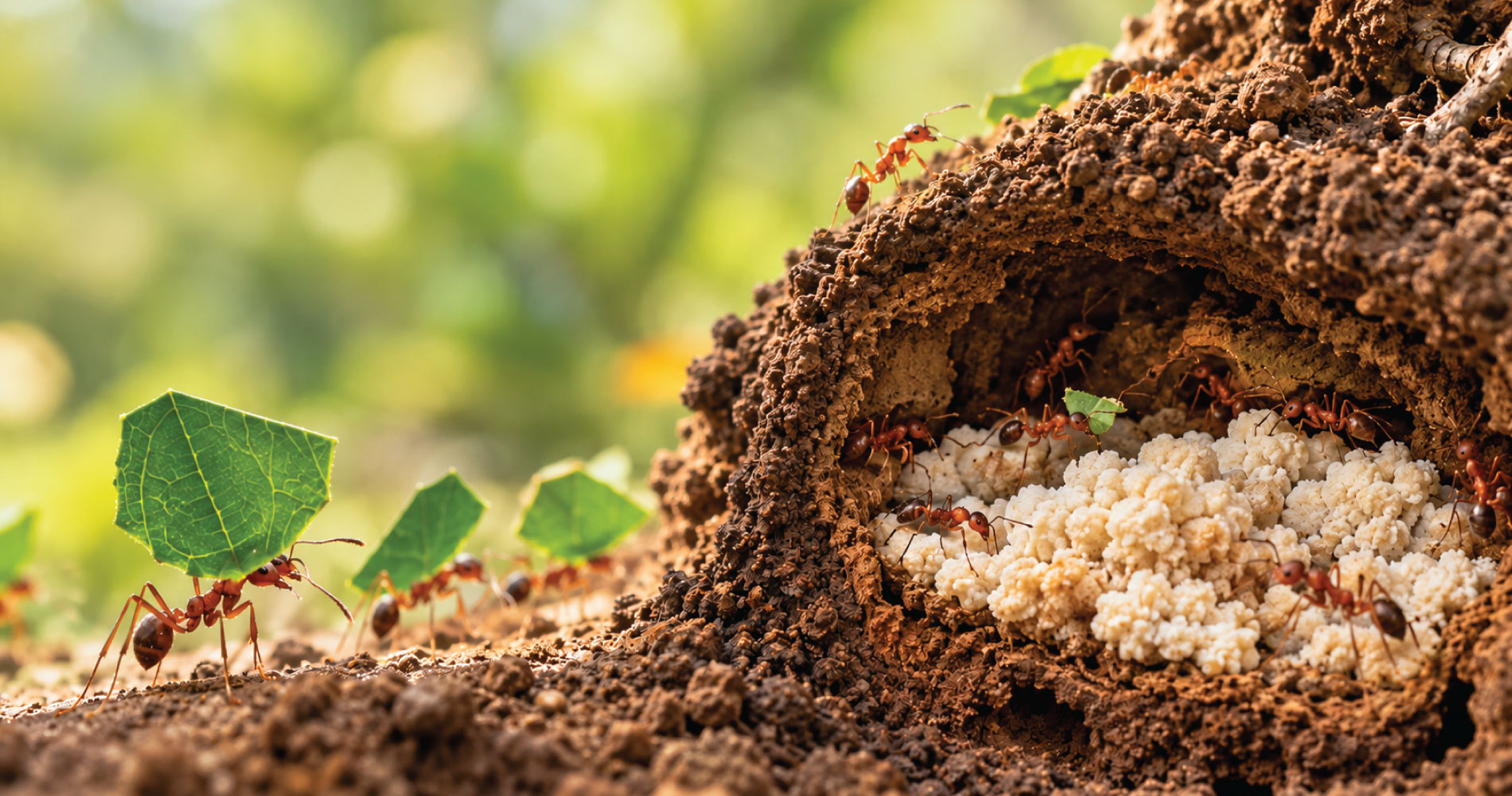
Among these, the most interesting example is Leafcutter Ants. They cut leaves from trees and carry them to their nests. At first glance, it seems they are going to eat the leaves, but that is not the case. They use the leaves to grow a special type of Fungi.
Their underground nests contain Fungus Gardens, where many farming-related activities take place continuously. This entire system involves food management, cleaning, security, and the roles of ants that perform different tasks.
So the question arises: how do such tiny ants farm without any tools or human understanding? How do they know which things are right for their crop? And what is the relationship between this farming, which has continued for millions of years, and nature? The answers to these questions are hidden in the scientific history of Ant Farming.
1. What is Ant Farming and what do ants grow?
Ant Farming is a natural process in which some species of ants cultivate Fungi for food. In conventional farming, humans prepare the soil, sow seeds, water them, and harvest the crop when it is ready. The system used by Fungus-Farming Ants is somewhat similar, but wheat, rice, or vegetables do not grow in their fields.
Their main crop is fungus. Fungi are a separate group of organisms that includes mushrooms, yeast, and many microscopic fungi. They are not plants. They do not have chlorophyll, so they do not make food through photosynthesis like plants do.
Instead, they obtain nutrients from other organic matter. Some ants take advantage of this trait. They bring leaves, flower parts, dried plant remains, and other organic matter into their nests.
Their special fungi grow on these materials. In return, the ants obtain food from the fungus.
In science, this relationship is called mutualism, meaning a partnership in which both organisms benefit. The ants get nourishment, while the fungus gets materials, a safe place, and care to grow.
According to the Smithsonian National Museum of Natural History, about 250 ant species cultivate fungi, many of which are found in the tropical regions of Central and South America.
2. Ants had become farmers long before humans even started farming
Humans began farming about 10,000 to 12,000 years ago. Farming gradually changed the way human societies lived. Permanent settlements began to form, and the way food was produced changed. But ants’ relationship with farming goes back tens of millions of years.
A study published in the scientific journal Science in October 2024 conducted a detailed analysis of the evolution of ants and the Fungi they cultivate. In this research, scientists used Evolutionary Data from 475 Fungal Samples and 276 Ant Samples.
According to the study, Fungus Farming began around 66 Million Years Ago, or about 66 million years ago. This was the same period when a large Asteroid Impact seriously affected Earth’s climate and life. This event led to the extinction of many organisms, including numerous species of dinosaurs.
The spread of dust and other particles in the atmosphere affected sunlight. The lack of light harmed plants and many Food Chains that depended on Photosynthesis.
On the other hand, the availability of large amounts of dead organic matter increased opportunities for Fungi to spread. According to scientists, these conditions may have helped some ancient ants and Fungi develop a food-based partnership.
However, this is a scientific Evolutionary Reconstruction, not a record of a direct historical event. The research also found that some Fungal Crops underwent Domestication about 27 million years ago. In other words, they became so dependent on their ant partners that it became difficult for them to survive independently. This discovery shows that farming is not an achievement exclusive to humans. Systems for growing food and protecting it had already evolved in nature long ago.
3. Leafcutter Ants: The Forest’s Most Unusual Farmer Ants
Not all ants farm. But among the species known for this activity, Leafcutter Ants are the most famous. Their name is linked to their behavior. They cut plant leaves into small pieces and carry them to their nests.
Often, large numbers of ants can be seen carrying pieces of leaves at the same time. It looks as if a moving green line has formed. Leafcutter Ants are mainly found in Central and South America and nearby regions.
They include prominent Genera such as Atta and Acromyrmex. These ants’ jaws are adapted for cutting leaves. Some Worker Ants cut large leaves, while others help carry them to the nest. But the most distinctive thing about their behavior is that they do not gather leaves primarily to eat them directly.
The leaves are used as Growing Material for Fungus Gardens. Inside the nest, they are turned into small pieces and given to the Fungal Crop. Over time, the Fungus uses this material to grow and provides nourishment for the ants.
It is important to understand one interesting distinction here. Not every Fungus-Farming Ant cuts leaves. Some species use dry plants, seeds, insect remains, or other organic matter. So Leafcutter Ants are certainly the most widely discussed example of Ant Farming, but not the only one.
4. How Do Ants Farm?
Fungus-farming ants complete their farming in several stages. Each stage is related to growing or protecting the crop.
First stage: Searching for raw materials Worker ants leave the nest and search for suitable organic matter. Leafcutter ants cut fresh leaves, while other farming ants may collect different types of plant debris. Choosing the material is important, because not every leaf or organic material is equally useful for their fungi.
Second stage: Carrying the material to the nest. After finding the material, the ants bring it to their nest. In some species, one ant cuts a leaf while another helps carry it inside. In this way, the behavior of ants working together helps maintain the food supply for the entire colony.
Understand the Complete Farming Process
Third stage: Preparing the growing material Inside the nest, leaves and other materials are broken into small pieces. Leafcutter ants chew and arrange this material before adding it to the fungus garden. This process helps prepare a suitable surface for fungal growth.
Fourth stage: Fungus growth Fungus grows on the prepared organic material. With the help of its enzymes, the fungus takes part in breaking down the complex components of plant material.
In this way, it forms fungal structures that the ants can eat. In some advanced farming systems, the fungus forms specially nutrient-rich structures called gongylidia. These are an important food source for many leafcutter ants.
Fifth stage: Cleaning the crop Farming alone is not enough. Other harmful Fungi or Bacteria can also enter the Fungus Garden. Therefore, Worker Ants regularly care for the Garden. They display behaviors such as removing unwanted Microorganisms or infected material.
Sixth stage: Arranging food and new crops When the Fungus has grown sufficiently, its edible parts are used as food for the ants and their Larvae. During this time, part of the Garden continues to grow, and new material is added after removing the old material. This is a continuous process. It does not require any human instructions. These behaviors developed over millions of years of Evolution and Natural Selection.
5. What is an ants’ farm like underground?
From above, an ants’ nest may look like only a small hole in the soil. But inside some Leafcutter Ant Colonies, there are complex tunnels and multiple Chambers. These Chambers are used for different purposes.
Some areas contain Fungus Gardens. Activities related to the development of the Colony take place in some sections. Waste Material is stored in other areas. These Fungus Gardens may often appear light white or cream-colored. Their texture is like a small Sponge or net.
This is not a crop standing in straight rows in the soil like an ordinary farm. Here, a complex structure of Fungal Mycelium develops. Inside the nest, temperature, moisture, and airflow affect Fungal Growth. The structure of the ants’ tunnels and their behavior may help maintain these conditions.
6. Ants Working Together: How does such a big task happen without any Boss?
- The most interesting aspect of ants’ social behavior is their Teamwork. Not every member of a Group of Ants does exactly the same work.
- Some Worker Ants search for food. Some carry materials. Some care for the Fungus Garden, and some are busy caring for Larvae.
- In large Leafcutter Colonies, differences can also be seen in the size of Worker Ants.
- This difference is often related to their work. For example, larger Worker Ants may be important for cutting leaves or protecting the Colony, while smaller ants may handle fine tasks.
But the question is, who gives them instructions?
16. Can Ant Farming teach us something about the future of farming?
- First, the relationship between microorganisms such as fungi and bacteria. In modern agriculture, the study of soil microbes and beneficial fungi remains consistently important.
- Second, the use of organic waste. The way leafcutter ants use plant material for fungal growth provides insights into biomass decomposition.
17. Some Interesting Scientific Facts About Ant Farming
- Not all ants are farmers: This behavior is found only in certain Evolutionary Groups.
- Leaves are not always food: Leafcutter Ants mainly use them to grow Fungus.
- The Queen can carry the crop with her: In some species, a new Queen takes a Fungal Starter Culture from the old nest.
- Different tasks are performed in the nest: Worker Ants take part in farming, cleaning, gathering food, and caring for Larvae.
- Ants protect their crops: Some species benefit from protection provided by beneficial Microorganisms.
- Fungi are not plants: So ant farming differs from ordinary Plant Farming.
- Ants are part of natural changes: Their farming can affect Soil Processes, Vegetation, and Nutrient Cycling. These facts show that ants’ lives are not limited to gathering food and building nests.
18. Some Misconceptions About Ant Farming
On the internet, there are often claims about ant farming that oversimplify scientific information.
Misconception 1: All ants farm.
Truth: Fungus farming is found only in specific groups of ants. Most ants obtain food in other ways.
Misconception 2: Leafcutter ants cut leaves and eat them directly.
Truth: They mainly use leaves as growing material for their fungal crop.
Misconception 3: Ants plan farming like humans do.
Truth: Their behavior is understood through evolution, chemical communication, and collective behavior.
19. Conclusion: The great science of farming hidden in the tiny world of ants
When we look at ants, their small size is often what catches our attention. But the lives of some species are so complex that they inspire scientists to ask new questions about topics such as Evolution, Agriculture and Social Behaviour.
Ant Farming is a remarkable example of this. Some ants are not limited to simply searching for ready-made food. They cultivate special Fungi, gather materials for them, care for their Gardens and, in some cases, even protect their crops with the help of beneficial Bacteria.
This system began millions of years before human agriculture. The most fascinating thing is that all this happens without any human technology, written plans or central control. Millions of years of Evolution have developed such a partnership between ants and Fungi that the lives of both can be deeply connected to one another.
It is also important to understand that ants do not farm by thinking like humans, and not all ants have this ability. Still, their natural farming shows that systems for food production, cooperation and biological protection are not limited to human society. The next time you see a line of ants carrying tiny pieces of leaves, remember that in some parts of the world, ants just like these run their Fungal Farms underground.
Disclaimer
This article has been prepared for general information and educational purposes only. The information it contains related to Ant Farming, Fungus-Farming Ants, Pollination, and Ecological Relationships is based on scientific studies and reliable academic sources. Ant behavior can vary according to their species, environment, and biological conditions. Not all ants farm, and the findings described here do not apply to every Ant Species. This article aims to explain scientific information in simple language.

Emanual Massey is a healthcare, lifestyle, and beauty content writer with over 7 years of professional experience. He specializes in writing SEO-optimized, research-based articles on health, wellness, nutrition, skincare, beauty, and Ayurveda. His mission is to simplify complex topics into practical, reader-friendly content that empowers people to make healthier lifestyle choices. Passionate about continuous learning and evidence-based writing, Emanual creates informative and engaging blogs that combine accuracy, readability, and search engine optimization.