Abstract
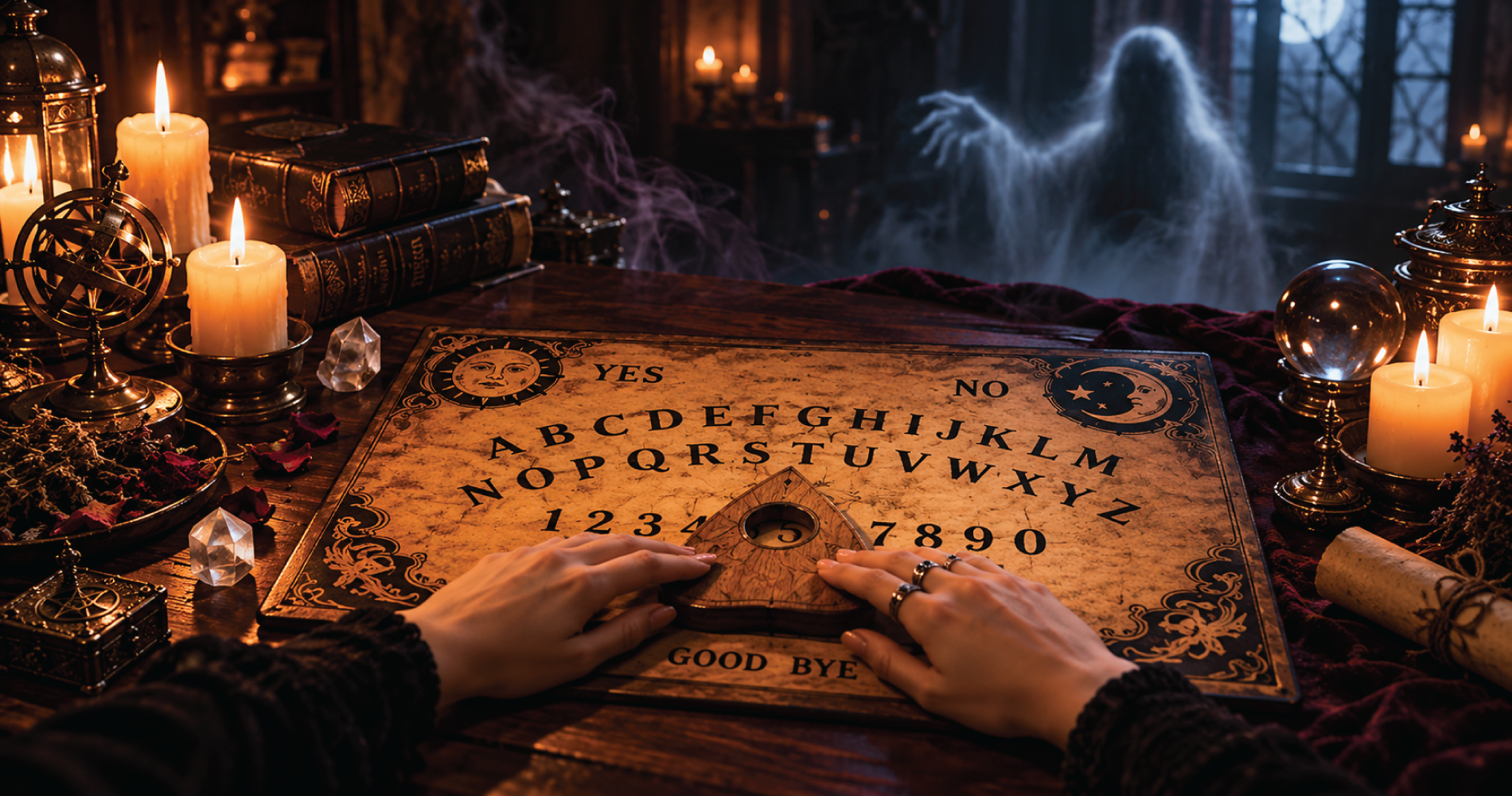
It is 12:46 am, and you are on a sleepover at your friend’s place with 3-4 more friends, and out of nowhere everyone decides to call out ghosts. In one corner of the room, the flame of a candle is flickering. Three friends are seated around an old wooden board. Their fingers are lightly resting on a small, heart-shaped object called a planchette. No one in the room is saying anything. No one wants to be the first to break the silence.
Finally, one of them asks, “Is there anyone here with us?”
For a few seconds, nothing happens. Then the planchette begins to move. Slowly, it glides across the board and stops at YES.
Everyone looks at one another. No one admits to pushing it. Then another question is asked, “Who are you?”
The planchette moves again and spells out the letters of a name that no one expected.
Was a spirit trying to contact them? Was it merely a coincidence? Or were the people seated around the board unknowingly moving it themselves?
The Ouija board has fascinated and frightened people for generations. Some regard it as a way to reach the world of spirits, while others see it as a psychological experiment disguised as a paranormal game. But when science enters this mystery, it becomes even more interesting. The board’s movements may seem mysterious, but psychology offers an explanation that challenges our understanding of our own actions.
So when the Ouija board spells out an answer to a question, who or what is actually moving the planchette?
Introduction: The board that makes you question your own mind
The Ouija board looks quite ordinary at first glance. It usually contains the English alphabet, numbers, words like YES and NO, and a GOODBYE section. The participants place their fingers on a movable pointer, called a planchette, and ask questions. They then wait for the planchette to move around the board and spell out answers.
Its rules are easy to understand. But the experience itself does not feel ordinary at all. For some people, the planchette moves so easily and smoothly that they feel there is no way they could have played any role in moving it. Others claim that the board has revealed names, dates, or information they did not know beforehand. In addition, there are stories of sudden messages, frightening answers, and sessions after which people begin to wonder whether they should ever touch the board again.
This is where the mystery of the Ouija board becomes interesting. It exists somewhere between paranormal beliefs and human psychology. Historically, people who believed in spiritualism have regarded the talking board as a means of communicating with the dead. On the other hand, psychologists have tried to understand how involuntary physical movements, expectations, and group behavior can create the illusion that some external force is controlling the pointer.
People’s experiences or fears should not be dismissed. But having an unusual experience by itself does not prove a supernatural cause.
To understand what may actually be happening, we need to know the history of this board, the science behind involuntary movements, and the reasons why our minds can turn even an ordinary thing into something extraordinary.
Where did the Ouija board come from?
Before the Ouija board became a familiar symbol in horror films, it was connected to a much larger cultural interest in communicating with the dead.
The rise of spiritualism
During the nineteenth century, spiritualism began to gain popularity in parts of Europe and North America. Its followers believed that the human soul survives even after physical death and that communication between the living and the dead is possible.
The movement received considerable attention in the 1840s. In particular, reports of mysterious knocking incidents associated with the Fox Sisters of New York increased public interest. Their experiences inspired people to try séances, mediums, and other ways of contacting spirits.
Around the same time, table-turning became a popular activity. In this practice, people would gather around a table, place their hands on it, and wait for the table to move or tilt on its own. Some people regarded these activities as messages from spirits.
Some other people began experimenting by arranging letters on a table. They hoped that complete messages could be written through the movements of the table. The idea was simple: if a spirit could influence an object, then perhaps it could also use that same object to communicate.
Amid this growing interest, the talking board gradually developed.
The commercial arrival of the Ouija board
The modern Ouija board was commercially introduced in the United States in 1890 by the Kennard Novelty Company. It provided a systematic way to receive messages instead of waiting for the table to move.
This board contained letters, numbers, and some common responses. A small planchette slid across its surface, believed to be guided by an invisible force or by the movements of the participants. According to a popular story, the board was asked its name and spelled “Ouija” through the letters. However, this story is not proof of its supernatural origin.
Over time, the board moved from spiritual circles into popularity among the general public as a game. Even so, its association with séances and communication with spirits remained. Horror films and paranormal stories further strengthened its mysterious and frightening image.
But its history only explains why people began using it, not who actually moves the planchette.
The ideomotor effect: Is your hand moving without your knowing?
One of the most widely discussed scientific explanations behind Ouija board activity is the ideomotor effect. This term refers to small, involuntary muscle movements influenced by thoughts, expectations, or mental images. These movements can occur even when a person does not consciously decide to make them.
In simple terms, you can move your body without fully realizing that you are the one initiating the movement. Imagine that you are holding a pendulum in your hand. You focus on the idea that it should move in a circle. Even without deliberately swinging your hand, you may begin to move the pendulum because of very small muscle movements. This motion may feel as though some external force is controlling it, whereas in reality your own muscles are also contributing to its movement.
The same principle can also help explain Ouija board activity.
How does the planchette move?
When several people place their fingers on the planchette, each person’s small physical movements can contribute to its motion. These movements may be so slight that they are difficult to identify individually.
This process may work something like this:
- Expectation builds: the players ask questions and begin to expect answers.
- Attention is focused: everyone watches the planchette and waits for it to move.
- Small movements occur: one or more participants may unconsciously make slight muscle movements.
- The movements combine: the pressure from different fingers together can move the planchette across the board.
- The result seems mysterious: because no one feels personally responsible for the movement, the group may interpret it as the work of an external force.
The most important thing here is that the participants do not need to be pretending. They can genuinely believe that they are not moving the planchette. That is why the experience feels so real. The movement of the planchette may feel independent, while in reality it is being influenced by the movements of the people touching it.
Why don’t players feel themselves moving it?
Usually, we associate any physical activity with our conscious will. If we pick up a glass, we know that we are doing so. If we open a door, we are aware of the decision that led us to do it.
But ideomotor activities are different, because the intention behind them can be very subtle or outside our conscious awareness. A person may expect the planchette to move toward a particular letter but may not have to consciously decide to push it.
The movement of the planchette is real. The illusion may lie in the belief that someone else moved it. This effect is not limited to Ouija boards. It has also been discussed in the context of dowsing rods, pendulums, automatic writing, and historical table-turning.
In all these cases, an object appears to respond to an invisible influence, while small human movements may contribute to that response.
Why does the Ouija board feel so real? The psychology behind the experience
If unconscious movements can explain the planchette, why do people sometimes feel so certain that a spirit is communicating?
The answer may involve several psychological processes working together.
Suggestibility and expectation
Suggestibility, that is, the tendency to be influenced by suggestions, shows how thoughts, expectations, and external information can affect a person’s experiences or their interpretation of them. Imagine that you enter a room and your friends tell you that several strange incidents have previously occurred with a particular Ouija board. You may not believe every story they tell, but this information can still influence what you expect to happen next.
When the session begins, every small movement starts to seem significant. A slight shift of the planchette may feel like the first sign of a presence. Its stopping may seem like a deliberate act. An unexpected letter may appear to be a specific message rather than ordinary activity. The board does not need to change. Your expectations can change how you understand the experience. This does not mean that people are consciously imagining everything. Expectations can influence our perception even without conscious effort.
Confirmation bias: Remembering the hits, forgetting the misses
Confirmation bias means that we often pay more attention to information that supports our preexisting beliefs while ignoring information that contradicts them.
For example, during a Ouija session, the planchette may spell out a name that resembles that of someone familiar. The group may remember that moment for years, but forget the letters and garbled responses that made no sense. In this way, a successful message becomes part of the story, while failed attempts disappear from memory. Over time, the story begins to seem more credible.
That is why personal accounts of paranormal experiences can be compelling, but they are not, by themselves, proof of a supernatural event.
Pattern recognition: When random letters become meaningful
The human brain is skilled at recognizing patterns. Even with incomplete information, it finds familiar faces, shapes, and words. Sometimes, because of this, we begin to find meaning even in ambiguous things.
For example, if the planchette writes letters that resemble a familiar name, participants may combine them to derive a meaning. This can happen even more strongly with emotionally significant questions. For instance, a person asking about a deceased relative may connect an incomplete message to their loved one, while someone asking a question for entertainment may interpret it differently.
Group psychology: Everyone influences everyone
Ouija board sessions are usually conducted in groups, where people can be influenced by one another’s expectations and reactions.
If one person is afraid or expects a particular answer, the others may begin to think in the same direction as well. Without intentionally pushing it, the participants can reinforce one another’s expectations. This creates a feedback loop:
- The group expects the board to move.
- The planchette shows slight movement.
- People react with excitement or fear.
- Everyone’s attention on the board increases further.
- Subsequent movements are also interpreted as meaningful messages.
This can make it feel as though one is communicating with an independent presence, while the group’s own reactions are also playing a role in it.
Can a Ouija board reveal information you don’t know?
This is where the discussion becomes even more complicated. Some people claim that the Ouija board has given answers that they were not consciously aware of. They mention a name, a date, or some such information that was later proven correct.
Could it be that our mind is accessing information, but we are not even aware of it? Psychological research has studied the concept of implicit memory to understand this possibility.
What is implicit memory?
Implicit memory refers to information that can influence our behavior without being deliberately and consciously recalled. For example, you may be able to recognize a song immediately but not remember when you first heard it. Similarly, in a familiar situation, you may respond correctly even though you do not need to consciously recall all the experiences that taught you to do so.
In some situations, information stored in our memory can influence our decisions, even if we cannot clearly explain where we got that answer from. This raises an interesting question: can information present unconsciously influence the movement of a Ouija planchette?
What did the 2012 Ouija board study find?
A study published in Consciousness and Cognition in 2012 by Hélène Gauchou, Ronald Rensink, and Sidney Fels examined whether ideomotor activities could reveal information that a person was unable to consciously recall.
The researchers compared two methods of answering general knowledge questions: verbal responses and the use of a Ouija board. When participants knew the answer, the accuracy of both methods was about the same. But when they were only guessing, verbal answers were correct at roughly chance level, whereas answers given through the Ouija board were found to be correct up to 65 percent of the time in this experiment.
The researchers suggested that ideomotor activities may sometimes bring out information stored in implicit memory. However, the study did not confirm communication with spirits. It only examined how unconscious activity can influence physical movement.
Does every study support this explanation?
Not entirely. In 2022, Gyorgy Moga and Zoltan Dienes conducted a similar study, but instead of a Ouija board, they used a pendulum. The researchers did not obtain the same benefit from ideomotor responses again. The guessed answers were correct at about chance level in both the physical and verbal methods.
This suggests that unconscious movements are not a reliable way to access hidden information. Their results may depend on the experimental conditions and methods. This research does not explain every Ouija board experience, but it does highlight the complex relationship between memory, unconscious movements, and conscious awareness.
The paranormal explanation: What do spiritualists believe?
For those who believe in communication with spirits, the ideomotor effect does not explain everything. According to the traditional belief of spiritualism, the Ouija board is a medium of communication between the living and the dead. According to this belief, a spirit can influence the planchette and use it to form letters of messages.
Some people consider the board a way to contact their deceased relatives. Others believe that it can attract unknown powers or energies. These explanations are part of spiritual and paranormal beliefs. They may have cultural and personal significance, but they have not been established as scientific facts.
Why do some people believe the board connects to spirits?
For many people, belief associated with a Ouija board is based on personal and emotional experiences. Suppose someone asks the board about a deceased family member and receives a message that connects with a private memory. For them, it may be difficult to dismiss it as mere coincidence.
There are several possible explanations for this experience. The person may unconsciously express remembered information or may associate an ambiguous message with an old memory. Group expectations can also influence it. Meanwhile, a person with a spiritual perspective may interpret it as contact with the deceased. However, the emotional significance of an experience is not scientific proof that it is supernatural.
Intelligent and residual hauntings
In paranormal discussions, two kinds of phenomena are mentioned.
“Intelligent haunting” refers to an imagined presence that can understand questions and respond.
Residual haunting is considered a repeatedly occurring impression of an old event, in which there is no dialogue or response.
However, these are paranormal beliefs, not scientifically verified classifications. Some people interpret messages from a Ouija board as communication with spirits, while others see them as ambiguous signals or information that emerges unintentionally. At present, there is no reliable scientific evidence that a Ouija board can contact spirits. Even so, the board attracts people because it symbolizes the possibility of communicating with something beyond ordinary experience.
Why does fear make a Ouija board session more intense?
A Ouija board session can feel frightening even when nothing unusual happens. The room is often dark, the participants are already thinking about spirits, and every movement becomes a possible sign of something unknown. This combination can make ordinary sensations feel threatening.
The brain is constantly looking for danger
The human brain is designed to identify potential threats. In uncertain situations, it can become more alert to sounds, movements, and changes in the surroundings. The creaking of the floor, the movement of curtains, or a sudden noise outside the room may seem more significant, especially when everyone is already expecting a paranormal event.
A sound that someone might ignore during the day can feel like a warning during a late-night séance. This is not proof that a spirit is present there. It shows how circumstances can influence our perception of an ordinary experience.
Fear can create a cycle of expectation
Once someone becomes frightened, they may start monitoring the room more closely. Every small event attracts attention, which can increase anxiety and make the next event feel even more alarming. For example:
- A participant hears a noise.
- They wonder whether something is in the room.
- Their attention becomes focused on unusual sounds.
- Another ordinary sound occurs.
- They interpret it as further evidence of a presence.
The experience can become increasingly intense even without any new information.
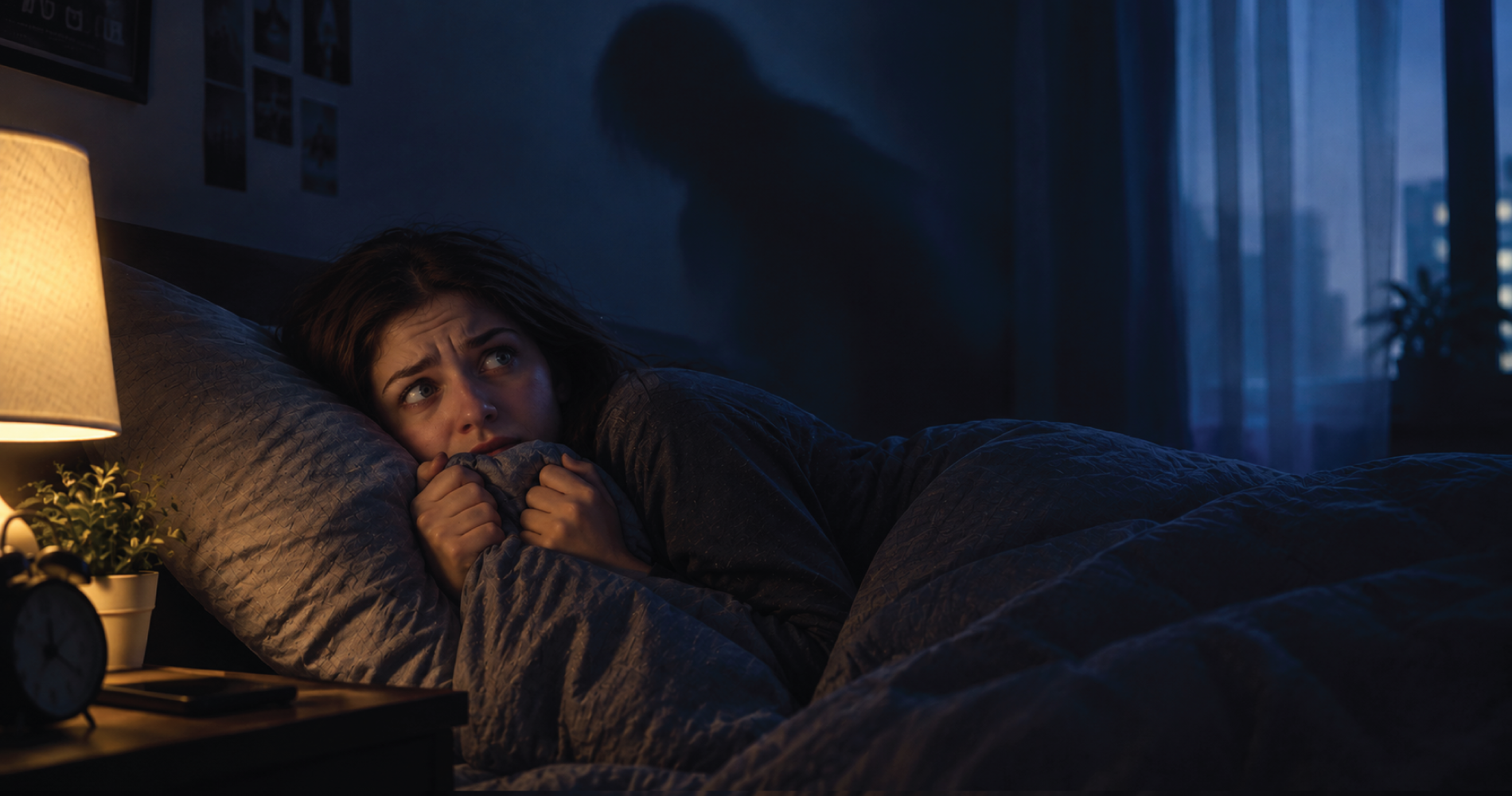
Can a Ouija session affect sleep?
A frightening experience can stay in someone’s mind long after the board has been put away.
They may replay the session, wonder whether the message meant something, or become uncomfortable sleeping alone. In some cases, fear and repeated thinking can make it harder to relax at bedtime.
This does not mean that the board has caused a supernatural attachment. It may simply mean that the experience has become emotionally stressful. If a session leaves someone distressed, taking a break from paranormal content, returning to a familiar routine and talking to someone they trust can help.
How horror movies turned the Ouija board into a nightmare
The Ouija board’s reputation has been shaped not only by spiritualism and paranormal stories but also by popular culture.
Horror films have repeatedly used the board as a symbol of curiosity turning into danger. A group of friends begins with a harmless question, receives an unexpected answer, and gradually discovers that the experience is no longer under their control.
Films such as The Exorcist and the Ouija horror franchise have helped strengthen the association between talking boards, possession, and dangerous supernatural forces.
These stories are designed to create suspense. They use darkness, silence, sudden movements, and frightening messages to make the board appear threatening.
Social media has added another layer. Videos of planchettes moving, alleged spirit responses, and late-night challenges can spread quickly. Viewers may not know how the footage was made, whether the participants are acting, or what happened before and after the recording.
The result is a mixture of folklore, entertainment and personal testimony.
It is worth remembering that a horror film is not evidence of how a Ouija board works. Fiction often exaggerates uncertainty because that is what makes a story frightening.
The real psychological explanation may be less dramatic, but it is arguably more interesting: the human mind can create a powerful sense of mystery without requiring an invisible force to move an object.
Can science explain every Ouija board experience?
The ideomotor effect provides a well-known explanation for how the planchette may move. Psychology also helps explain why participants can interpret those movements as messages from an outside presence.
However, science should be careful about making claims beyond the available evidence.
An experience that has not been fully explained is not automatically paranormal. At the same time, explaining a common mechanism does not mean every individual account has been investigated.
Anecdotes can be difficult to evaluate because they often rely on memory, personal interpretation, and details that were not recorded at the time.
For a claim of spirit communication to be scientifically convincing, it would need to produce results that can be tested under controlled conditions. Researchers would need to rule out ordinary movement, prior knowledge, suggestion, information sharing, deliberate deception, and other possible explanations.
For example, an experiment might prevent participants from seeing the board or knowing the questions being asked. Researchers could then examine whether the responses contain information that could not reasonably have come from the participants.
Even if an unusual result occurred, it would need to be repeated independently before a supernatural explanation could be considered.
This is the difference between an intriguing experience and reliable evidence.
The current scientific understanding gives us reasons to take unconscious movement and psychological influences seriously. It does not establish that Ouija boards can communicate with the dead.
Myth vs Fact: What should you actually believe about Ouija boards?
There are many beliefs and fears surrounding the Ouija board that people often accept as true. Let us understand these common myths and the scientific explanations behind them.
Myth 1: The planchette moves only when a spirit is present.
Fact: Small involuntary movements from participants can contribute to the planchette’s motion. The ideomotor effect offers a psychological explanation for why the movement may feel external.
Myth 2: Nobody can move the planchette without realizing it.
Fact: People can make small muscle movements without consciously noticing them. This is one of the central ideas behind the ideomotor effect.
Myth 3: Every accurate answer proves spirit communication.
Fact: An accurate answer may come from conscious or implicit memory, coincidence, or information already known by someone in the group. An accurate response alone does not establish a supernatural source.
Myth 4: Ouija boards can predict the future.
Fact: There is no reliable scientific evidence that Ouija boards can predict future events. Responses may reflect expectations, guesses, or information already available to participants.
Myth 5: The board can become permanently haunted.
Fact: This is a paranormal belief, not an established scientific finding. A board is a physical object, and there is no reliable evidence that it becomes inhabited by a spirit through use.
Myth 6: Only people who believe in ghosts experience movement.
Fact: Ideomotor movements do not require a person to believe in spirits. Expectations may influence the experience, but unconscious muscle movements can occur without a paranormal belief.
Myth 7: Feeling frightened means something supernatural has happened.
Fact: Fear can be a response to uncertainty, suggestion, and an unsettling environment. Feeling frightened does not establish that a spirit is present.
Myth 8: Science has proved that every paranormal story is false.
Fact: Science evaluates claims through evidence and testing. The ideomotor effect explains many reported movements, but it is not a direct investigation of every personal account.
What should you do if a Ouija board session frightens you?
Whether you approach the board as a game, a cultural object, or a spiritual practice, you should not feel pressured to continue an experience that makes you uncomfortable. If a session becomes frightening, consider these simple steps:
- Stop the activity: You do not need to continue asking questions or wait for another response.
- Turn on the lights: A familiar, well-lit environment can make the situation feel less overwhelming.
- Take a break: Step away from the board and do something unrelated to paranormal content.
- Talk about the experience: Discussing what happened with someone you trust may help separate observations from assumptions.
- Avoid escalating the fear: Repeatedly watching frightening videos or searching for alarming interpretations can make anxiety worse.
- Respect personal boundaries: If someone in the group does not want to participate, do not pressure them.
There is no scientific reason to believe that a person must perform a special ritual to protect themselves after touching a Ouija board. If a cultural or religious practice is personally meaningful and comforting, that is a separate matter from claiming that it is medically or scientifically necessary.
Most importantly, remember that you are allowed to stop. Curiosity should never come at the cost of your comfort or peace of mind.
Conclusion: Who really moves the planchette?
Return to that quiet room at 12:46 a.m.
The candles are still burning. The board is still on the table. The planchette has just spelled out a name, and everyone is waiting for someone to explain what happened.
One person insists they did not move it. Another is convinced that the answer came from somewhere beyond the room. Someone else wonders whether the group unconsciously guided the pointer.
The mystery of the Ouija board is not only about ghosts. It is also about how little we sometimes understand the movements of our own bodies.
The ideomotor effect shows that thoughts and expectations can influence muscle movements without conscious intention. Research into implicit memory suggests that physical responses may sometimes reflect information that people cannot easily recall. Group psychology, suggestibility, and confirmation bias can further shape how these experiences are interpreted.
For believers, the board may continue to represent a possible connection with the spirit world. For science, it remains an interesting way to study unconscious movement, memory, and human perception.
So, are you talking to ghosts, or is your own mind playing tricks?
The available scientific evidence supports psychological explanations for many Ouija board movements, but it does not establish that the board can contact the dead. And perhaps that is what makes the subject so fascinating: the most unsettling part may not be the possibility of something moving the planchette from the other side, but the possibility that our own minds can move it while making us feel as though we had nothing to do with it.
Disclaimer
This article is intended for educational and informational purposes only. It explores Ouija boards through historical, psychological, and paranormal perspectives. Paranormal beliefs and reported experiences are not presented as scientifically established facts. The psychological explanations discussed, including the ideomotor effect, describe possible mechanisms behind reported planchette movements and should not be treated as proof about every individual experience.
FAQs
1. What is the ideomotor effect in a Ouija board?
The ideomotor effect refers to small, involuntary muscle movements influenced by thoughts or expectations. During a Ouija board session, these movements may contribute to the planchette moving even when participants do not consciously realize they are guiding it.
2. Can a Ouija board actually communicate with spirits?
Some Spiritualist traditions believe that Ouija boards can be used to communicate with spirits. However, there is currently no reliable scientific evidence proving that they can contact the dead. Psychology offers alternative explanations, including unconscious movement and the influence of expectations.
3. Why does the Ouija board planchette move when nobody is pushing it?
Participants may make tiny muscle movements without being aware of them. When several people touch the planchette, their movements can combine and guide it across the board. This can create the impression that an outside force is controlling it.
4. Can Ouija boards reveal information stored in the subconscious mind?
Some research suggests that ideomotor movements may sometimes express information held in implicit memory. However, findings are not conclusive, and further research is needed. This possibility does not demonstrate that Ouija boards communicate with spirits.
5. Should I be worried after using a Ouija board?
There is no reliable scientific evidence that using a Ouija board causes a supernatural attachment or makes a person vulnerable to spirits. If the experience leaves you frightened, stop using the board, take a break from frightening content, and speak with someone you trust.

Content Writer with 3+ years of experience turning ideas into words people want to read, share, and remember. I create research-backed social media and lifestyle content that blends storytelling, creativity, and audience insights to make every piece feel fresh, relatable, and engaging.