
Abstract
Millions of plants and trees on Earth absorb Carbon Dioxide through Photosynthesis and release Oxygen. Perhaps that is why forests are called the Lungs of the Earth. But when it comes to the Amazon Rainforest, this name raises an interesting scientific question. Does the world’s largest Tropical Rainforest actually produce so much Oxygen that the entire Earth breathes with its help?
The Amazon Rainforest is a vast natural Ecosystem stretching across South America. It plays an important role in Carbon Storage, Rainfall Regulation, Biodiversity, and Global Climate Balance. However, scientific research shows that the popular claim that the Amazon provides 20% of the world’s Oxygen is misleading. The forest does produce Oxygen, but processes such as Respiration and Decomposition that occur there also use Oxygen.
In this article, we will understand why forests are called the lungs of the earth, what the Amazon’s real scientific significance is, how the Oxygen Cycle works, and why the future of this forest matters to the entire world.
1. Introduction: Does the Earth also depend on the Amazon to breathe?
Imagine standing in a dense forest. Tall trees surround you, sunlight filters through the leaves and reaches the ground, and you can feel the moisture in the air. Somewhere in the distance, a bird calls, while thousands of tiny creatures beneath the trees go about their lives. Now imagine that this forest is so vast that its area is nearly twice the size of India.
That’s what the Amazon Rainforest is like.
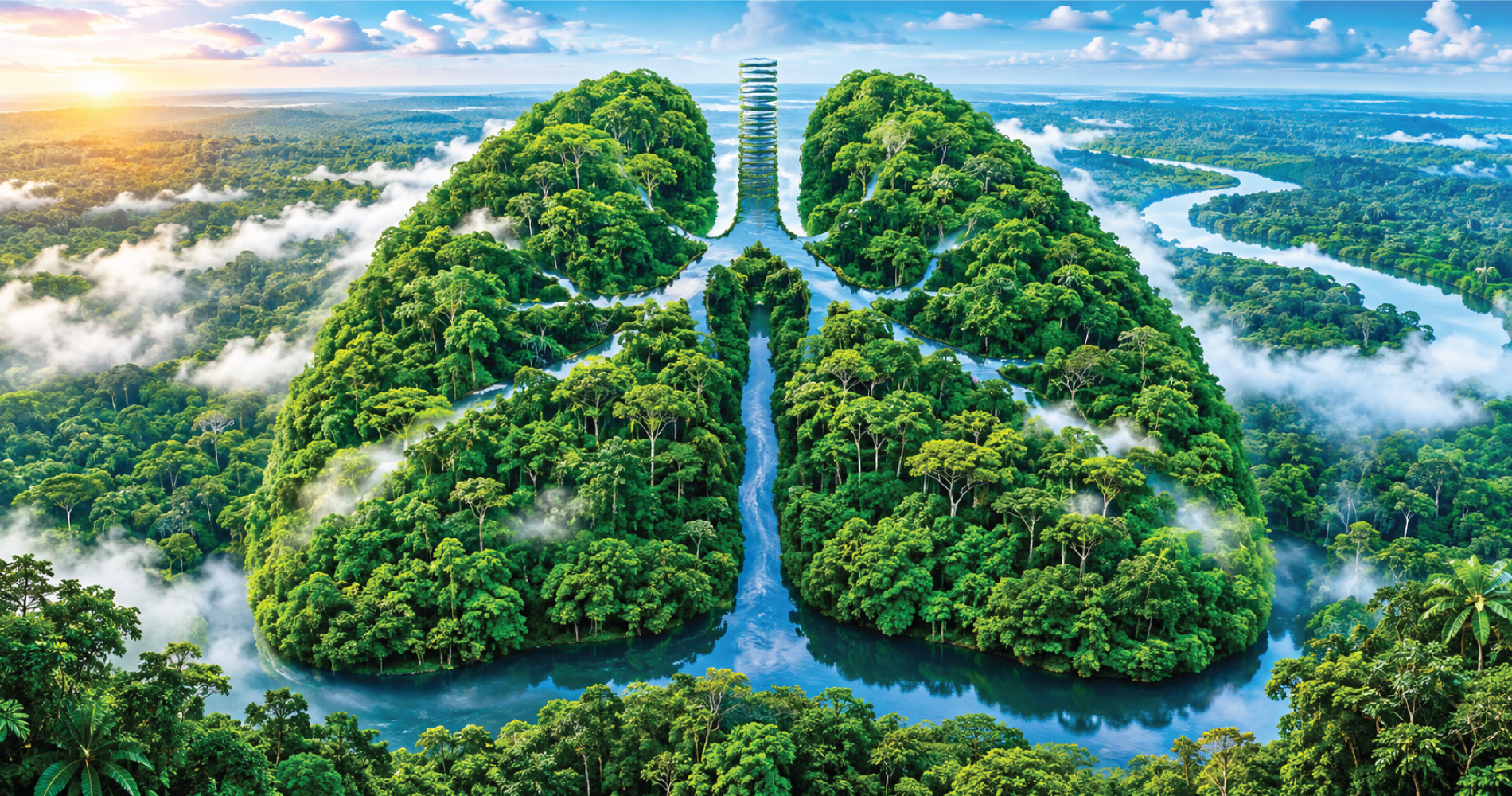
This forest, which stretches across South America, is often called the Lungs of the Earth. From schoolbooks to the internet, one claim is repeated again and again: the Amazon provides the world with Oxygen to breathe.
But here’s a question.
If the Amazon is the lungs of the Earth, will cutting down its trees mean there’s less Oxygen for us to breathe?
And if not, why is this forest considered so important?
The answer, in fact, has to do with more than just Oxygen. The Amazon is connected to the Earth’s Carbon Cycle, rainfall, temperature, rivers, thousands of species, and the lives of millions of people.
According to researchers at the University of Oxford, calling Tropical Rainforests the lungs of the Earth is not a scientifically accurate comparison. However, their importance to the climate, water cycle, and Biodiversity is extraordinary. It’s important to understand this distinction, because the forest’s true role is as fascinating as it is complex.
2. What Is the Amazon Rainforest? What exactly is the Amazon Rainforest?
The Amazon Rainforest is the world’s largest tropical rainforest. It stretches across the Amazon River Basin in South America and the surrounding areas. It is not just a vast group of trees. Countless rivers, wetlands, small streams, tall trees, plants with medicinal value, birds, mammals, insects, and microorganisms come together here to form a complex ecosystem.
The most remarkable thing about this forest is that the living things here depend on one another. Some birds spread tree seeds. Insects break down dead leaves and return nutrients to the soil. Trees store water and carbon within themselves. Meanwhile, rivers provide a habitat for millions of living things. Therefore, simply knowing the number of trees is not enough to understand the Amazon. It is also important to understand how the entire forest works together.
Amazon Forest Area: How vast is this forest?
According to WWF, the wider Amazon Rainforest covers approximately 6.7 million square kilometers. However, area estimates may vary because different organizations define the boundaries of the rainforest, the Amazon Biome, and the Amazon River Basin differently.
The largest part of the Amazon is located in Brazil. In addition, this region extends across Peru, Colombia, Bolivia, Ecuador, Venezuela, Guyana, Suriname, and French Guiana. The weather, soil, elevation, and types of vegetation are not the same throughout such a vast region. This diversity is what makes the Amazon environmentally distinctive.
3. Why Are Forests Called the Lungs of the Earth?
Since childhood, we have learned that humans take in Oxygen and release Carbon Dioxide, while green trees take in Carbon Dioxide and release Oxygen during Photosynthesis.This common comparison gave rise to the idea that forests are the lungs of the earth. But actual human lungs take in Oxygen, whereas green plants release Oxygen during Photosynthesis. So this comparison is a metaphor, not an exact description of physiology.
How do forests produce Oxygen?
A pigment called Chlorophyll is found in the leaves of green plants. It helps them absorb energy from sunlight. Plants take in water through their roots and absorb Carbon Dioxide from the air through their leaves.Then, during Photosynthesis, light energy is used to produce carbon-rich food, and Oxygen is released. This process can be understood through a general Chemical Equation: 6CO2+6H2O+LightC6H12O6+6O2
This is a simplified form of the Photosynthesis equation. The energy used in it comes from light. But one important point is often overlooked. Trees do not only produce Oxygen. They also need to use Oxygen to obtain energy in their cells.This process is called Cellular Respiration. In addition, animals, insects, Fungi, and Bacteria living in the forest also use Oxygen. Thus, a large portion of the Oxygen produced during Photosynthesis is used up within the same Ecosystem during various biological processes.
This is why a forest’s total Oxygen Production and its Net Oxygen Contribution to the atmosphere are two different things. Explaining this distinction, the Oxford Nature Network has noted that the net Oxygen increase from terrestrial Ecosystems may be close to zero.
4. Does the Amazon Rainforest really produce 20% of the world’s Oxygen?
The most frequently repeated claim about the Amazon is that it produces around 20% of the world’s Oxygen. This sounds impressive. If every fifth breath in the world came from the Amazon, protecting it would seem directly linked to humans’ ability to breathe.
But scientific studies do not support this claim. The claim gained widespread international attention during the 2019 fires in the Amazon rainforest.
Afterward, researchers and Fact-Checking organizations clarified the scientific truth behind it.According to a report updated by National Geographic on August 19, 2025, the claim that the Amazon contributes 20% of the world’s Oxygen Supply is greatly exaggerated. The forest’s long-term Net Oxygen Contribution may be close to zero.
According to reports, it has emerged that calling the Amazon rainforest “the lungs of the Earth” and claiming that it produces 20 percent of the world’s Oxygen is entirely false. The reality is that the Amazon absorbs (uses) as much oxygen as it produces through the animals and plants living there.
The Difference Between Gross Oxygen Production and Net Oxygen Production
Let’s understand this with a simple example. Imagine that a large amount of Oxygen is produced during Photosynthesis in a forest. But the trees, animals, and microorganisms in that same forest use almost as much of it through Respiration and Decomposition.
In such a situation, even though total Oxygen production is very high, the net contribution to the atmosphere may remain very low. That is the difference between Gross and Net Oxygen Production.
| Process | Effect on Oxygen |
| Photosynthesis | Produces oxygen |
| Plant Respiration | Consumes oxygen |
| Animal Respiration | Consumes oxygen |
| Decomposition | Consumes oxygen in many decomposition processes |
| Forest Fires | Consume oxygen and release carbon emissions |
| Net Oxygen Balance | Depends on the difference between total oxygen production and consumption |
This does not mean that forests do not produce Oxygen. It simply means that all the Oxygen produced by forests does not accumulate in the atmosphere as additional Oxygen.
So, would there still be Oxygen on Earth without the Amazon?
The current atmosphere contains a vast reservoir of Oxygen, which developed over a very long Geological timescale. Therefore, the destruction of the Amazon would not, by itself, cause Oxygen to run out immediately for humanity
But it would also be wrong to conclude from this that the Amazon is less important. In fact, the destruction of this forest could have serious effects on Climate Change, Carbon Emissions, the Water Cycle, and Biodiversity. The strongest scientific reason to save the Amazon is not fear of running out of Oxygen, but the stability of the entire natural system.
5. If Not the Amazon, Where Does Earth’s Oxygen Come From?
When people learn that the Amazon does not provide 20% of the world’s net oxygen, the next question is: where exactly does our oxygen come from?
An important answer lies in the oceans.Tiny organisms called phytoplankton are found in the upper layers of the oceans. These include many types of algae and photosynthetic bacteria.
Like plants, they also perform photosynthesis.
With the help of sunlight and carbon dioxide, they make food for themselves and release oxygen. According to NOAA, about half of the current oxygen production on Earth comes from the oceans. However, marine organisms also use a large portion of this oxygen.
Why are phytoplankton so important?
These microorganisms may be small in size, but they are the foundation of the marine food chain. They provide food for small fish and other marine organisms. In turn, those organisms become food for larger ones.Thus, phytoplankton are important not only to the oxygen cycle but also to the existence of marine life.
Their numbers keep changing according to sunlight, water temperature, nutrients, and ocean currents. NASA has also described phytoplankton as important to Earth’s oxygen cycle.Still, it is important to remember that the oxygen currently produced in the oceans and the historical accumulation of oxygen in our atmosphere should not be considered the same thing. The oxygen we use today comes from that vast reservoir in the atmosphere that has accumulated on Earth over millions of years It is the result of ongoing biological and geological processes.
6. Importance of the Amazon Rainforest:
This is where the real story of the Amazon begins. The importance of this vast forest cannot be measured by Photosynthesis alone. The Amazon plays a role in Earth’s Carbon Cycle, influences rainfall, provides Habitat for millions of living things, and helps maintain a natural balance between heat and moisture.To understand this, we need to focus on three important scientific processes.
The first is Carbon Storage, the second is Water Recycling, and the third is Climate Regulation. All three processes are interconnected. For example, when rainfall remains low in the forest for a long time, trees can experience increased Water Stress. This can affect their growth and Carbon Absorption.
If Oxygen Isn’t the Biggest Reason, Why Is the Amazon So Important?
If trees begin to die or a fire breaks out in the forest, Carbon that was already stored can return to the atmosphere. Similarly, large-scale tree cutting can reduce the amount of moisture released into the atmosphere, which can affect future rainfall. This connection makes the Amazon far more complex than an ordinary forest.
7. What Is the Relationship Between the Amazon Rainforest and the Carbon Cycle?
When we look at a giant tree, we usually notice its height, leaves, or branches. But to scientists, that tree is also a store of Carbon. When trees perform Photosynthesis, they absorb Carbon Dioxide from the atmosphere. Some of this Carbon is stored in their trunks, branches, roots, and leaves. For this reason, forests are considered an important natural means of Carbon Storage.
What Is a Carbon Sink?
When an ecosystem absorbs more carbon than it releases into the atmosphere, it is called a carbon sink. Conversely, when it begins releasing more carbon into the atmosphere than it absorbs, it is called a carbon source.
Many parts of the Amazon were important carbon sinks for a long time. But events such as forest fires, tree cutting, drought, and rising temperatures can change this balance.
According to a 2021 NASA report, tropical forests’ ability to absorb carbon dioxide is being affected by climate and environmental changes.
Why Is the Carbon Stored in the Amazon Important?
Imagine a huge tree that continues to grow for a hundred years. During this time, it takes in carbon dioxide from the atmosphere and stores carbon within itself.
If that tree is cut down and burned, a large portion of the carbon stored within it can return to the atmosphere.But if the same tree remains alive and continues to grow, carbon can remain stored in it. That is why protecting old forests is important for the environment.
According to a 2024 study published in Nature, an estimated 150–200 billion tons of carbon are stored in the Amazon Forest System. This amount is extremely significant in the context of the global carbon cycle.
It is important to note that a forest’s carbon storage and its removal of carbon from the atmosphere each year are two different processes. A forest can store a great deal of carbon, even if its net carbon absorption is very low in a particular year.
8. Amazon Rainforest Weather: Why does it rain so much in this forest?
As soon as you hear the name Amazon, images of dense trees, clouds, and constant rain come to mind.
But does it really rain here all the time?
Not exactly. The Amazon Rainforest is located around the Equator. The weather here is generally hot and humid, but rainfall amounts and the durations of the Wet and Dry Seasons vary across different areas.
According to the Science Panel for the Amazon’s 2021 Assessment Report, the long-term average annual rainfall in the Amazon region is approximately 2,000–2,300 millimeters. In some places, this amount can be much higher.
What factors influence Amazon Rainforest weather?
First, its geographic location is important. The areas around the Equator receive more solar energy. This provides energy for processes such as water evaporation and plant transpiration. The second important factor is moisture coming from the Atlantic Ocean. Moist air coming from the ocean reaches the Amazon. Clouds form and rain falls here due to atmospheric conditions.
But that’s not the end of the story. Amazon trees also release large amounts of water vapor into the atmosphere. This allows the forest itself to contribute to maintaining the regional rainfall cycle.
Does the Amazon make its own rain?
To some extent, yes. According to NASA, Amazon trees send large amounts of water into the atmosphere through transpiration. This moisture contributes to the process of forming rain again. A significant share of regional rainfall is associated with recycled moisture.
But this does not mean that all the rain in the Amazon is produced by trees. Moisture coming from the ocean, wind direction, temperature, and other atmospheric processes also affect rainfall. In other words, the Amazon’s weather is the result of constant interactions among the ocean, atmosphere, and vegetation.
9. Flying Rivers: Do invisible rivers flow above the Amazon?
It sounds like something from a mysterious story. We know that rivers flow on land. But scientists sometimes call the vast atmospheric currents of moisture rising from the Amazon “Flying Rivers.”
This does not mean that an actual river of water flows through the sky. The term is used to describe large moisture flows that travel with the wind from one region to another.
How do Flying Rivers form?
When Amazon trees release water vapor from their leaves, it mixes with the surrounding air. This moisture moves onward with the winds. Under favorable conditions, it can return to the ground as clouds and rain.
In this way, Amazon vegetation affects the regional water cycle. Some moisture flows reach distant regions of South America and also contribute to rainfall there. NASA Earth Observatory has described this process in the Amazon as important for South America’s Rainfall Patterns.
How could deforestation affect Flying Rivers?
Imagine that millions of trees are removed from an area. In such a situation, the pattern of moisture entering the atmosphere from that land through Transpiration could change. If this happens across a large area, Moisture Recycling and regional Rainfall Patterns could be affected. But the impact will not be the same everywhere.
It will depend on how many trees have been cut down, which region the logging occurred in, what the winds are like there, and how the climate is changing. That is why protecting the Amazon is not only about saving trees, but also about understanding South America’s Water Cycle.
10. Amazon Rainforest Biodiversity: Why are so many species found here?
Another distinctive feature of the Amazon is its extraordinary Biodiversity. Biodiversity means the variety of different types of organisms, their Genetic Differences, and Ecosystems found in a region.
Countless species are found here, from tiny insects to large mammals. According to WWF, about 10% of Earth’s known species are found in the broader Amazon region.
But how did so many species evolve in a single forest?
There are several reasons behind this. Warm and humid environment, Large parts of the Amazon remain relatively warm and humid throughout the year.
These conditions provide a favorable habitat for various types of plants and living organisms.
Different types of habitat
The Amazon does not have just one kind of forest. Here you can find forests on higher ground, forests that are seasonally flooded, riverside areas, wetlands, and various types of vegetation. The conditions in each habitat are different. For this reason, an organism living in one place may differ from one found in another place.
Evolution over a long period: The Amazon’s natural history has evolved over millions of years. Over this long period, changes occurred in geography, climate, river courses, and ecological conditions. These changes influenced the evolution of species and their geographic distribution. A group of small amphibians, some species of which have toxic skin chemicals.
Can the loss of one species affect the entire forest?
Some species play special roles in the ecosystem.For example, fruit-eating birds and animals can carry seeds over long distances. This helps new trees grow.
If important seed dispersers decline in an area, the composition of trees that grow there in the future may be affected.
This is why Amazon rainforest biodiversity should not be viewed merely as a count of species. It is an important foundation for how the forest functions.
12. What would happen if the Amazon Rainforest began to disappear?
Now let’s turn to the question that makes this entire topic most serious. What would happen if forests began to disappear from large parts of the Amazon?
First, it is important to understand that the disappearance of a forest is not an event that happens in a single day. It can be linked to ongoing processes such as tree cutting, fires, droughts, changes in land use, and Forest Degradation. In some areas, forests can grow back, while in other places, continued pressure may make natural recovery difficult.
First effect: Carbon Emissions could increase
When trees are burned or decay after dying, the Carbon stored in them can return to the atmosphere. If the forest’s Carbon Absorption also decreases, this could put double pressure on the climate.
Second effect: Rainfall patterns could change
A decrease in the number of trees and Forest Cover can affect Water Recycling. This could affect the Dry Season, Rainfall Distribution, and Soil Moisture in some areas.
Third effect: Wildlife Habitats could be destroyed
When forests are divided into small patches, the conditions for food, shelter, and breeding change for many species. Some animals may move to new areas, but not all species can adapt so easily.
Fourth effect: Local communities could be affected
Many Indigenous and other local communities living in the Amazon are connected to the forests, rivers, and natural resources. Changes to the forests could affect food, livelihoods, cultural traditions, and local life.
13. Amazon Tipping Point: Could the forest one day become unable to save itself?
One term often comes up in scientific research—Tipping Point. It refers to a situation in which pressure on a natural system becomes so great that it begins to shift from its previous state to another.
In the case of the Amazon, scientists are concerned that rising temperatures, prolonged droughts, forest fires, and continued Deforestation could cause major ecological changes in some areas.
Could the Amazon one day turn into Savanna?
Savanna refers to areas where grasses are abundant and trees are relatively sparse or scattered. Scientists warn that severe and persistent environmental pressures could cause some parts of the Amazon to shift from forest to a less tree-dense Ecosystem.
But this does not mean that the entire Amazon will suddenly become Savanna all at once. According to a study titled Critical Transitions in the Amazon Forest System, published in Nature in February 2024, by 2050, approximately 10% to 47% of the Amazon’s forest area could be exposed to several types of combined environmental pressures, increasing the risk of major Ecosystem Changes. This figure is an estimate of potential risk, not a prediction that the forest will definitely be destroyed in the future.
Why might the risk of a Tipping Point increase?
Suppose trees are continually cut down in an area.
Fewer trees may mean less moisture released into the atmosphere. Under some conditions, this could increase the likelihood of less rainfall and a longer Dry Season.
During droughts, trees do not receive enough water. Weakened trees may be more vulnerable to fires and other environmental stresses. If more forest is destroyed by fire, it could further affect natural Moisture Recycling.
This is understood as a Feedback Loop. But not all processes in the Amazon are the same. Therefore, scientists study this entire Ecosystem based on different regions and changing conditions.
14. Amazon Deforestation: What does the 2026 scientific report say?
There has been a steady stream of negative news about the Amazon, but the latest Monitoring Data also shows some positive signs. Brazil’s National Institute for Space Research (INPE) released figures related to tree clearing in the Amazon in October 2026.
According to these figures, approximately 3,335 square kilometers of Deforestation was recorded in the Brazilian Legal Amazon between August 2025 and July 2026. This was approximately 41.8% lower than the 5,731 square kilometers recorded in the previous Monitoring Period. INPE described it as the lowest annual rate in its Monitoring Series, which began in 1988.
15. What is the relationship between the Amazon Rainforest and human life?
Because the Amazon is located thousands of kilometers away, it may seem disconnected from our daily lives. But Earth’s natural systems are not divided by borders. Greenhouse Gases in the atmosphere can affect the climate in different regions of the world.
That is why the Carbon Storage and Climate Regulation provided by vast forests like the Amazon are globally important. In addition, the Amazon is directly connected to the lives of millions of people who live in and around it. According to WWF, about 47 million people live in the wider Amazon region, including more than 2 million Indigenous people.
Many local communities obtain food, natural materials and other resources from the forest. They also possess traditional knowledge related to plants, rivers, weather and wildlife. However, each community’s way of life and dependence on natural resources is different.
Therefore, protecting the Amazon does not simply mean separating the forest from human activity. It also requires valuing Indigenous Land Rights, local community participation and sustainable livelihoods.
16. Why Forests Are Called Green Lungs: Are all forests equally important for the Earth?
Now, an important question. When the Amazon is called the lungs of the Earth, does that mean other forests are less important? Absolutely not. Forests in different parts of the world provide different types of Ecological Services. Tropical Rainforests may have greater Biodiversity, while some Boreal Forests play a role in Carbon Storage across vast areas.
| Forest Type | Major Environmental Importance |
| Tropical Rainforest | Biodiversity, Carbon Storage, Rainfall Recycling |
| Temperate Forest | Wildlife Habitat, Carbon Storage, Soil Protection |
| Boreal Forest | Carbon Storage and Regional Climate Regulation |
| Mangrove Forest | Coastal Protection and Blue Carbon Storage |
| Urban Forest | Shade, Local Cooling, and Air Quality Improvement |
Photosynthesis occurs in all these forests, but their effects on Climate, Biodiversity, and the Water Cycle can vary.
17. Five Major Claims About the Amazon Rainforest: Fact-Check
| Claim | Fact-Check Verdict | Scientific Explanation |
| The Amazon Rainforest produces 20% of the world’s Oxygen. | Misleading | Most of the Oxygen produced by the forest is consumed through biological processes such as respiration and decomposition. |
| The Amazon is the world’s largest Tropical Rainforest. | True | It is the largest tropical rainforest on Earth. |
| All rainfall in the Amazon comes only from trees. | False | Moisture from the Atlantic Ocean and other atmospheric processes also play significant roles in rainfall formation. |
| Destruction of the Amazon Rainforest can affect Climate Change. | True | Deforestation can influence Carbon Emissions, the Water Cycle, and other important climate processes. |
| If the Amazon Rainforest disappears, Earth will lose all its Oxygen. | False | Earth’s atmosphere contains a vast reservoir of Oxygen, and other photosynthetic ecosystems continue to produce it. |
The basis for these findings is Oxford University, NASA, NOAA, and peer-reviewed scientific research.
18. How can the Amazon Rainforest be protected?
Simply planting more trees is not enough to protect the Amazon. The trees, soil, animals, and microorganisms in old-growth forests have developed over a long period. Newly planted trees can be useful in many circumstances, but they cannot immediately replace an old and complex Rainforest. Therefore, protecting existing Natural Forests must come first.
In addition, preventing illegal logging, reducing the risk of forest fires, restoring damaged areas, and implementing effective Land-Use Policies are important. The participation of Indigenous Communities is also essential, as many communities’ livelihoods and cultural identities are tied to this forest.
Scientists can monitor Forest Cover, fires, and environmental changes using Satellite Monitoring. But the future of the Amazon does not depend solely on local efforts. Reducing Global Greenhouse Gas Emissions is also important, because rising global temperatures can affect Heat Stress and Drought Risk in the Amazon.
19. Conclusion: Is the Amazon truly the lungs of the Earth?
Calling the Amazon the Lungs of the Earth is a compelling metaphor, but its literal scientific meaning is not entirely accurate. This forest produces Oxygen, but Oxygen is also used within the same Ecosystem. Therefore, claiming that every fifth breath in the world comes from the Amazon is scientifically misleading.
But clearing up this misconception does not diminish the importance of the Amazon. Vast amounts of Carbon are stored in this forest. Its trees release moisture into the atmosphere, contributing to the Rainfall Cycle.
Its Biodiversity supports the lives of countless organisms, and its natural resources are linked to the livelihoods of millions of people. Perhaps the Amazon’s most important feature is not how much Oxygen it produces for us, but how many of Earth’s natural processes it affects at once.
It is essential to protect the Amazon—not because our breathing will stop tomorrow without it, but because its decline could affect the balance of Earth’s Climate, Water Cycle, and Biodiversity.
20. Disclaimer
The information provided in this article is based on scientific research, environmental studies, and available reliable sources. Its purpose is to raise awareness of facts related to the Amazon Rainforest, Oxygen Production, Climate Change, and the environment. Some conclusions may change as scientific research and new studies emerge. The information provided in this article is presented for educational and general awareness purposes only.

Emanual Massey is a healthcare, lifestyle, and beauty content writer with over 7 years of professional experience. He specializes in writing SEO-optimized, research-based articles on health, wellness, nutrition, skincare, beauty, and Ayurveda. His mission is to simplify complex topics into practical, reader-friendly content that empowers people to make healthier lifestyle choices. Passionate about continuous learning and evidence-based writing, Emanual creates informative and engaging blogs that combine accuracy, readability, and search engine optimization.