
Abstract
After that night in December 1984, a long medical follow-up began in Bhopal. In the early days, the question was how to help people struggling with eye irritation and breathing difficulties. A few years later, the question had changed. How were the lungs of those who survived now functioning? Had their eye problems gone away? And what lay behind persistent fatigue, anxiety, or memory complaints?
In the previous article, we explored the difficulties survivors faced in their lives, employment, and rehabilitation. Now it is time to examine those same experiences in light of medical research. Recording a person’s suffering is important. To identify a scientific link between that suffering and past chemical exposure, researchers also need to ask some additional questions.
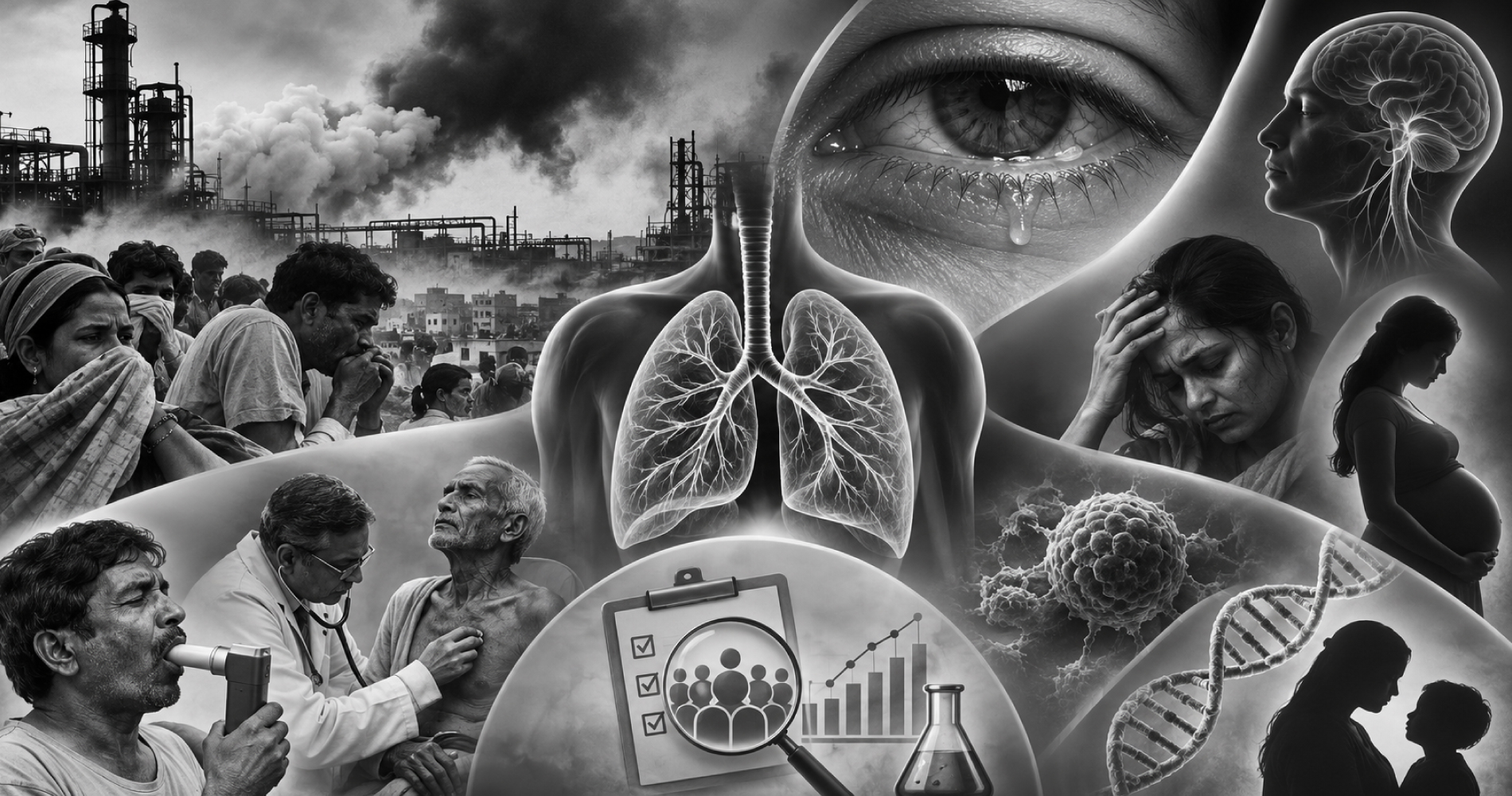
The available studies on the long-term health effects of the Bhopal Gas Tragedy do not present a uniform picture. Evidence of respiratory problems emerges most consistently. Long-term effects on the eyes have also been documented. To assess findings on other illnesses, reproductive outcomes, and the next generation, it is important to understand each study’s methods and limitations.
Why did the illness persist after the gas leak ended?
The end of exposure to a toxic chemical and the healing of the injury it caused are two different events. Think of a deep wound to the skin. Even after the thing that caused the injury is removed, the wound, scar, and problems in the surrounding tissue remain. The same distinction is important for understanding long-term effects of chemical injuries to the lungs and eyes.
Methyl isocyanate, or MIC, causes serious damage to the eyes and respiratory tract. The medical guidance of the U.S. Agency for Toxic Substances and Disease Registry mentions long-term respiratory and ocular problems after acute exposure. Therefore, ongoing symptoms in a survivor years later do not mean that the gas from that night is still present in the body unchanged. The initial injury and the changes that followed in the tissue are also important.
Another precaution is necessary when reading research on Bhopal. That night, people were exposed to an industrial release in which MIC was the main chemical. Therefore, it is not appropriate to treat every effect found in survivors as though it were caused by laboratory exposure to pure MIC alone. Disaster exposure and the toxicology of a single chemical are related topics, but they are not the same.
How did researchers detect exposure?
There was no individual measurement of how much gas each person inhaled that night. Later studies had to look for indicators of exposure. Some researchers looked at where people lived at the time of the accident and how far they were from the factory. Some asked people about their experiences that night. Large follow-up programmes created different exposure categories. Each method was useful, but each also involved some uncertainty.
For example, two people in the same area may have had different actual exposure. Whether they were indoors or outdoors, how much time they spent there, and their activities that night all made a difference. An address alone does not tell us the full dose.
A community survey conducted in 1994 sampled 454 adults living at varying distances from the factory. Along with asking about symptoms, researchers also measured lung function using spirometry. Combining exposure information with physical examinations meant the study was not limited to memories or complaints.
This makes it easier to understand the language of research. “The exposed group had more illness” is an important finding. But how much more, compared with which control group, and taking which other factors into account—these questions determine what it means.
Why is the most consistent evidence found for respiratory problems?
Respiratory problems repeatedly emerge in Bhopal’s long-term health research. One reason is the route of exposure. The toxic air came into direct contact with the respiratory tract. Another reason is that researchers studied both symptoms and lung function over time.
Persistent coughing, shortness of breath, or chest tightness describe patients’ experiences. Spirometry provides separate information about the lungs’ ability to expel air and the speed at which they do so. When both types of evidence are considered together, the picture becomes clearer.
What did several decades of follow-up show?
A study published in Public Health in 2020 analyzed respiratory morbidity data from 1986 to 2016. It included mildly, moderately, and severely exposed cohorts formed in 1985, along with an unexposed cohort. Researchers defined chronic morbidity as respiratory symptoms lasting more than three months. They also examined outcomes based on people’s age at the time of the disaster.
Respiratory problems in the exposed population persisted for several decades. Both the severity of exposure and people’s age at the time of the disaster proved important. In adult groups, the disease burden increased after the initial years and remained high for a long time; a decline was also recorded in later years.
This finding does not mean that every survivor’s health deteriorated at the same rate. Patterns differed across age and exposure groups in the study. Applying the results uniformly to everyone would erase the very differences that researchers were trying to understand.
What did lung function tests add?
In a respiratory study based on the 1994 community survey, those who reported gas exposure had more symptoms and lower values on several lung function measurements. These measurements included FEV₁ and FVC. FEV₁ indicates how much air is exhaled in the first second of a forceful breath out. FVC is a measurement related to the total volume of air exhaled with full effort.
These terms sound technical, but the clinical question is straightforward. Is there obstruction to air flowing out? Is the total measured volume of breath reduced? Compared with writing only “shortness of breath,” these measurements help clarify the nature of the problem.
Did every patient’s lungs continue to deteriorate?
A retrospective study published in Lung India in 2013 examined repeated spirometry reports for 252 exposed survivors with respiratory symptoms. Many of these patients showed a rapid decline in lung function.
But the study was hospital-based and included only those who had at least two spirometry reports available. The researchers also had no unexposed cohort for comparison. They themselves clearly described selection bias and other limitations.
Therefore, the percentage in that sample is not the percentage of all Bhopal survivors. The study’s significance lies in showing that symptomatic patients needed follow-up. It does not lead to the conclusion that every exposed person experienced the same ongoing deterioration.
Different respiratory patterns were still found in examinations decades later
A study conducted between 2018 and 2020 on a severely exposed cohort enrolled 916 people. Of these, 558 took part in lung function assessments. Among the 452 participants who completed acceptable spirometry, about 46% had a normal pattern, 26% an obstructive pattern, and 28% a restrictive pattern.
Researchers also used another technique called forced oscillometry. Some participants had normal spirometry, yet abnormalities were found in this examination. The study highlighted the usefulness of assessing small airways.
Here, an obstructive pattern means there is a blockage to airflow out of the lungs. Restrictive spirometry shows a reduced volume of air. But this label alone does not confirm a diagnosis of fibrosis in an individual. Different tests and clinical assessments each have their role.
The most useful point for readers is that respiratory injury did not take just one form. For some, the problem was more evident in their symptoms; for others, in their spirometry or another examination. Without understanding this diversity, writing a single medical story for all survivors would be incomplete.
What did research find after the initial eye irritation?
Eye irritation was among the most recognizable complaints that night. But the question in long-term research goes beyond the initial pain. Researchers wanted to know which effects on the eye’s surface, tears, and vision persisted.
A study published in the Indian Journal of Ophthalmology in 1987 examined the eyes of 1,140 people from the affected community. For comparison, researchers used a control group from an area unaffected by the gas, with a similar socioeconomic background.
The study documented chronic conjunctivitis, refractive changes, reduced tear secretion, and persistent corneal opacities. The cornea is the transparent part at the front of the eye. An opacity means a loss of that transparency.
Another study followed up with 93% of the initial participants across ten communities three years later. Exposed people reported more irritation, eyelid infections, cataracts, and reduced visual acuity.
These findings highlight the need for long-term eye care. Even so, declaring a cataract found in an elderly survivor today to be solely the result of that night would be a separate claim. Age, other risk factors, and medical history would also need to be considered. This distinction does not diminish the suffering. It makes diagnosis and attribution more precise.
How clear are the memory problems, headaches, and neurological findings?
In addition to respiratory and eye problems, survivors also reported neurological and psychiatric complaints. It is especially important to assess symptoms, examination findings, and the cause of illness separately in these areas.
For a study published in 1996, researchers collected health and exposure-related information from 474 people in January 1994. Respiratory and neurological testing was also conducted on a random subsample of 76 people.
Neurological and psychiatric symptoms were more common in the higher exposure categories. Some examination and testing results also supported this pattern. The authors concluded that the gradient observed with exposure suggested a role for gas exposure in some of the survivors’ respiratory and neurological morbidity.
But it is not right to turn a long list of symptoms directly into “permanent brain damage in all survivors. Headaches, difficulty concentrating, and fatigue are important complaints. Their clinical causes still need to be investigated.
Research is stronger when different tests point in the same direction. A complaint recorded in a questionnaire and confirmation of a specific neurological disease are not the same level of evidence.
The story of mental health beyond chemical exposure
Limiting Bhopal’s health effects to organ damage leaves out a major part of the disaster. For one person, chronic respiratory illness itself became a source of anxiety. For another, the death of a family member, loss of employment, or responsibility for the household weighed more heavily. Chemical exposure and the social consequences of the disaster coexisted in the same life.
In his 2014 research article, psychiatrist R. Srinivasa Murthy discussed post-disaster anxiety, depression, PTSD, and adjustment-related problems, along with mental health needs linked to changes in family and work life.
He also pointed to a serious gap. The findings of mental health research did not translate into adequate care. The need for community-based services, rehabilitation and ongoing dialogue remained.
So calling a survivor’s anxiety proof of chemical neurotoxicity is incomplete. Dismissing it as ordinary stress is also incomplete. A better assessment asks what the person has lost, how their body functions now, and what difficulties remain in their everyday life.
Why shouldn’t a finding of kidney disease be treated as proof of its cause?
Kidney disease is one of the most useful examples in this article because it clearly illustrates the difference between association and causation.
A study published in The National Medical Journal of India assessed 215 survivors from a severely exposed cohort. It found a prevalence of chronic kidney disease of 16.7%. In the same sample, diabetes was present in 20% and hypertension in 56.2%.
The researchers compared their findings with other Indian studies and reported that their CKD estimate was close to some of those estimates. The study did not include a matched, unexposed control group assessed at the same time. The authors noted the need for better-designed case–control research to investigate the possible role of gas exposure. The National Medical Journal of India
This finding can now be misread in two ways. First: “The gas caused kidney disease in 16.7% of survivors.” The study did not establish that. Second: “The cause is unclear, so there is no reason to be concerned about the kidneys.” That is not the conclusion either.
Whether a patient has the disease is a clinical question. How much past gas exposure contributed to the disease is a separate research question. It is not reasonable to wait for a complete answer to the second question before addressing the need for treatment and follow-up.
What is important to know before reading cancer statistics?
News about cancer often draws sweeping conclusions based on case counts. But an increase in total cases in a growing population and an increase in cancer risk due to an exposure are different things.
ICMR’s National Cancer Registry Programme established a Population Based Cancer Registry in Bhopal. It began operating in January 1986. A later Cancer in Bhopal report compared cancer patterns in MIC-affected and unaffected areas during 1988–2007.
The report also mentions analyses related to tobacco habits and the lack of this information for the entire study period. To understand what a cancer finding means, we need to ask which cancer increased, at what ages it increased, and how large the population was. What was the status of smoking or tobacco chewing? How much did access to diagnosis and registration change over time?
These questions are not meant to dismiss concerns about cancer. They help researchers go beyond raw numbers to understand risk. A registry finding for an area does not determine the cause of every individual cancer case.
What does research say about pregnancy and the next generation?
A little carelessness with terminology on this subject can turn into a very big claim. Pregnancy outcomes among women who were pregnant at the time of the disaster, the adult health of children who were in the womb, and inherited effects in future generations are three different research questions.
A comparative study published in 1990 found the proportion of spontaneous abortions among exposed pregnant women to be 24.2%, compared with 5.6% in the control area. Perinatal and neonatal mortality were also higher in the affected area. But the same study found no clear difference in the rates of stillbirth and congenital malformation.
This finding shows the severity of reproductive harm. It also shows why it is important to keep different outcomes distinct. Finding a difference in miscarriages does not, by itself, prove an increase in every kind of birth defect.
What new question did the 2023 in-utero study raise?
The 2023 BMJ Open study compared birth cohorts that were in the womb at the time of the disaster, using data from national surveys. Researchers combined birth timing and geographical proximity in their analysis.
They presented findings of disability affecting employment later in life, higher reported cancer, and lower educational attainment among the relevant male cohorts. The authors clarified that actual chemical exposure would have varied within the geographical exposure assignment. They also acknowledged that the lack of health, disability, and education services may have played a role in the long-term outcomes, alongside direct exposure. Original research
This study raises important questions about the far-reaching consequences of the disaster. But it does not mean that genetic damage has been proven in the children or grandchildren of every survivor. A child in the womb was present at the time of exposure. Their adult health and inherited biological changes in future generations require separate investigation.
The real difference between exposure, association, and causation
Understanding these three terms makes it much easier to read research on the Bhopal gas disaster. Exposure tells us that a person came into contact with a harmful substance or event. Several studies in Bhopal identified it using address, distance, reported experience, or exposure category.
Association means that two things occurred together more often. For example, a particular symptom occurring more frequently in a group with greater exposure. This is an important signal, but other factors still need to be examined.
The question of causation goes further. Did the exposure actually contribute to causing the disease or increasing its risk? To answer this, evidence such as the order of events over time, comparison groups, risk increasing with exposure, a biological explanation, and results from different studies must be considered together.
For example, respiratory injury that began immediately after exposure and was followed by persistent lung findings cannot be equated with a different disease found in a small sample decades later. Both observations are valuable, but the evidence behind them differs in strength.
What limitations should you keep in mind when reading long-term studies?
Good research reports its limitations. In a long and complex disaster like Bhopal, these limitations help ensure that findings are used appropriately.
The sample of patients who come to a hospital differs from a community sample. The number of people who are already symptomatic is higher there. Therefore, a high percentage of abnormal tests in a hospital study does not represent an estimate for the entire exposed population. Similarly, self-reported symptoms and measured disease provide different information. The complaint is real, but examination and tests are needed to determine its cause.
Over follow-up periods spanning several decades, people age, move to different places, and encounter other exposures. Some participants die, and some leave the studies. The picture of people still present at follow-up may differ from that of the entire group at the outset. These limitations do not mean that the research is useless. They mean that you should draw only the conclusions that the study’s design can support.
What do these findings mean for the care of survivors?
The practical need arising from these studies is quite clear. Survivors’ care should document their past exposure history, but every new symptom also needs its own clinical evaluation.
For persistent respiratory complaints, asking about symptoms alone is not enough. The available studies have shown the importance of lung function assessment. Persistent eye problems, mental health, and day-to-day functioning should also be part of follow-up.
At the same time, communication between research and patients’ lives is essential. A person should understand what their tests found, what remains unclear, and what will guide their care going forward. A single medical label or past exposure category does not describe all their needs.
The greatest value of these separate studies is that they can make care more specific. It is harmful to assume that all survivors have the same illness, just as it is harmful to disregard their exposure history entirely.
Conclusion
The health impact of the 1984 Bhopal Gas Tragedy did not remain confined to the emergency wards that night. Research on respiratory symptoms, lung function abnormalities, and long-term eye problems has gathered important evidence. Neurological, mental health, reproductive, and other findings present a broader picture of the disaster, but the strength of the evidence is not the same across every topic.
There is no conflict between taking survivors’ suffering seriously and carefully determining the cause of illness. Research has a responsibility to do both. The importance of Bhopal’s next health report will not lie only in new data. How much better follow-up, timely diagnosis, and clear medical information it provides will be just as important. For someone living with illness for decades, the most tangible meaning of research should ultimately be reflected in their care.
Disclaimer
This article provides information about published research. The cause of an individual’s illness or its treatment will be determined based on their exposure history, examination, and medical tests.

Emanual Massey is a healthcare, lifestyle, and beauty content writer with over 7 years of professional experience. He specializes in writing SEO-optimized, research-based articles on health, wellness, nutrition, skincare, beauty, and Ayurveda. His mission is to simplify complex topics into practical, reader-friendly content that empowers people to make healthier lifestyle choices. Passionate about continuous learning and evidence-based writing, Emanual creates informative and engaging blogs that combine accuracy, readability, and search engine optimization.