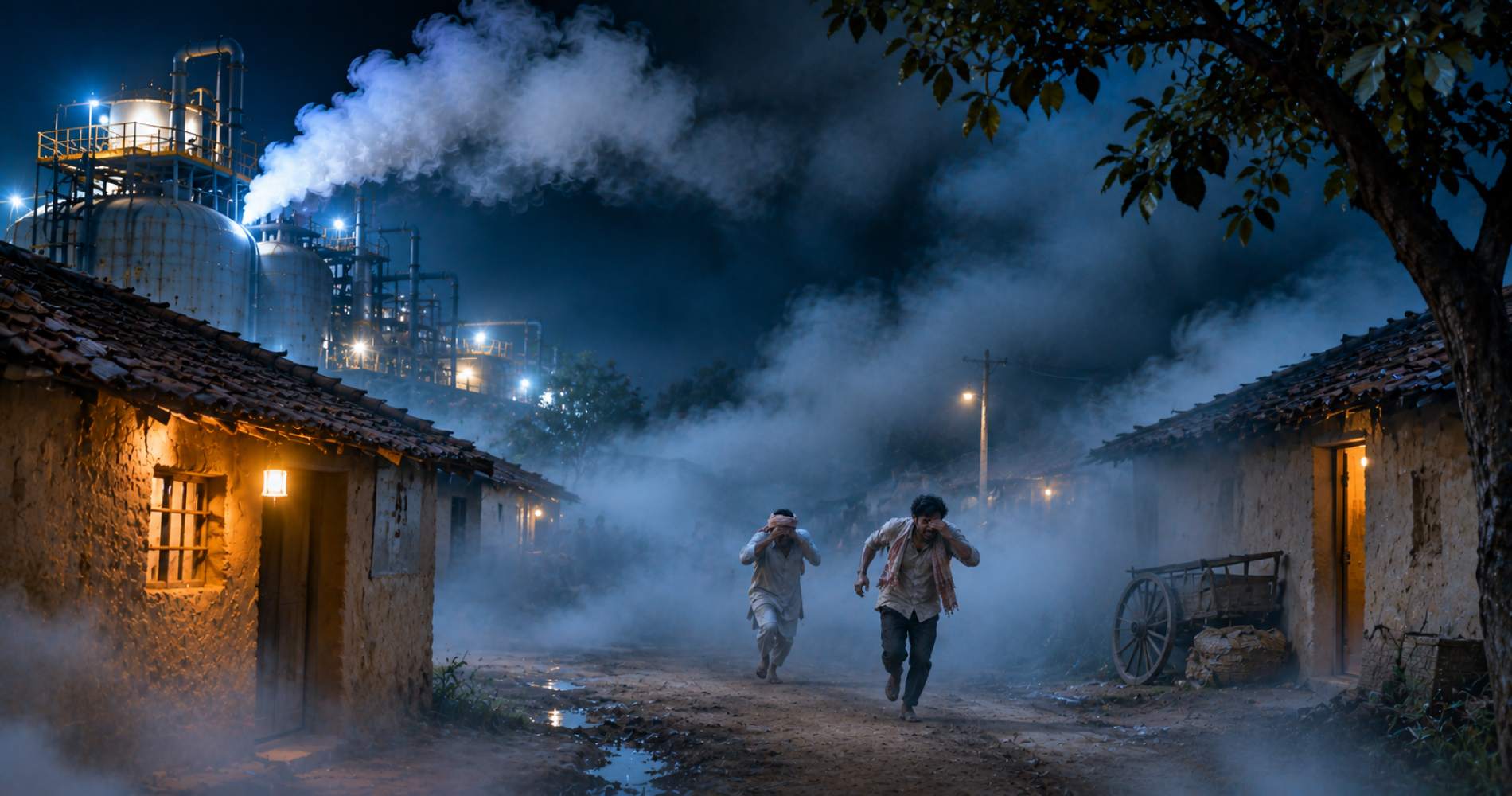
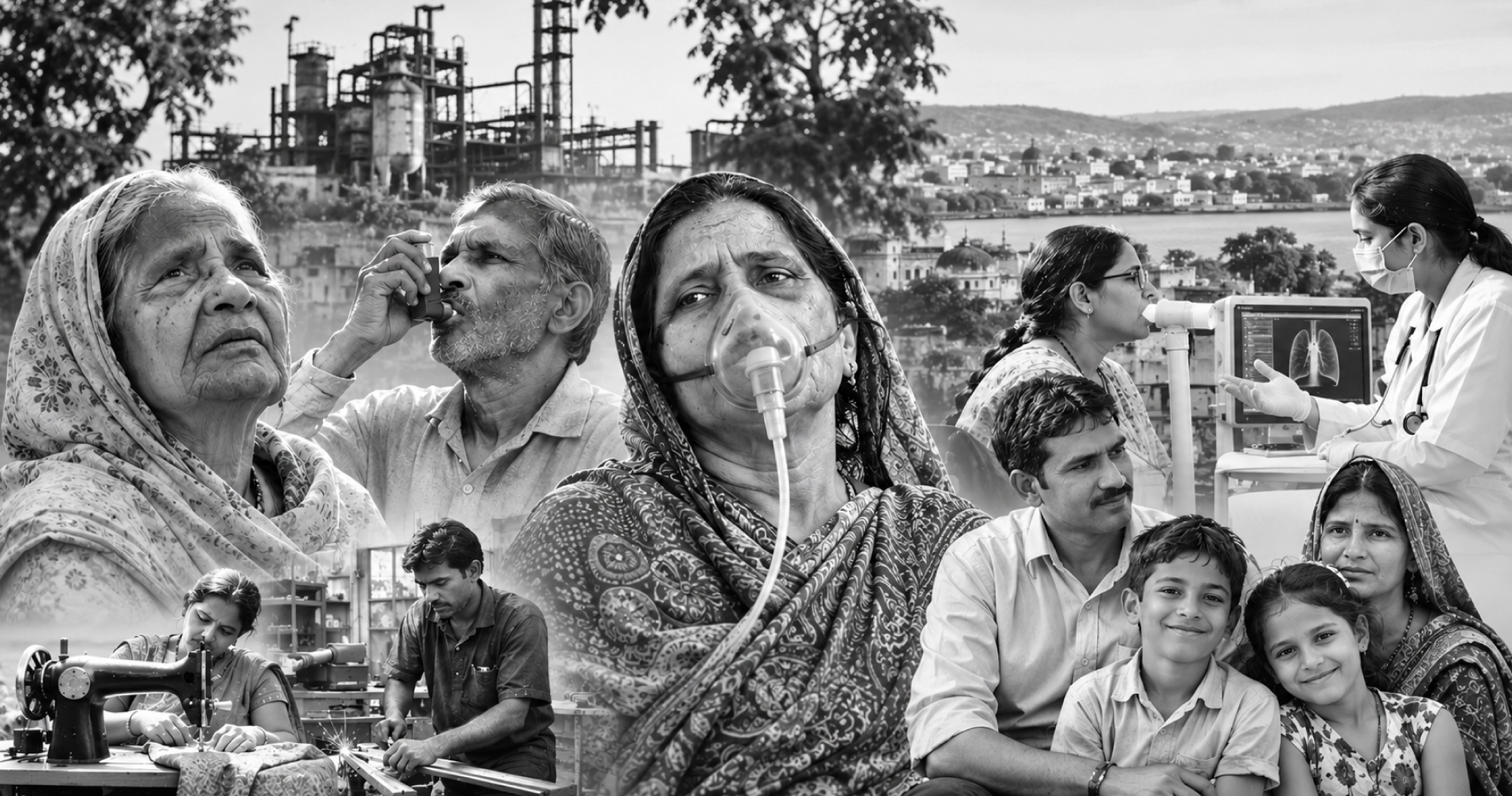
Abstract
Surviving the 1984 Bhopal gas tragedy and being able to return to life as it was before were two different experiences. For some, breathing problems continued for a long time; for others, their eyesight took away their former work, and some families had to manage both the cost of treatment and declining incomes. Meanwhile, survivors raised their voices for their needs through organizations, workers’ movements, and rehabilitation centres. This article examines that later life on the basis of published survivor accounts, medical research, and government records. All personal details are tied to their sources and the time they describe; no fictional dialogue is included.
A signboard artist could no longer do his former work
Rais Mohammad was a signboard artist in Bhopal. His work required good eyesight. After the gas tragedy, problems with his eyes affected that livelihood. In Amnesty International’s 2004 report, Rais Mohammad, then 62, said that after the disaster his eyes were no longer as they had been before and he could not return to his former work. amnesty.
His name was not included in the death toll. But that does not mean his loss was small. He survived, but the way he had earned a living did not. In the previous article, we examined the different death toll figures for the Bhopal gas tragedy.
Now we turn to the stories of those who survived that night. For them, the effects of the disaster remained even after they were discharged from the hospital; for some, it meant the cost of medicines and tests. For others, it meant taking time off work, depending on family, or worrying about caring for their children. Without understanding these experiences, the meaning of survival remains incomplete.
Coming out of the hospital was not a full recovery
Emergency treatment and full recovery are not the same thing. Even after getting through a critical condition, a person may continue to have symptoms, need follow-up care, and face difficulty with everyday tasks for a long time. In the Bhopal case, evidence of long-term respiratory illness is not limited to personal experiences. Medical studies conducted over time have also examined it.
Research found breathing problems persisted for decades
A study published in the Public Health journal in 2020 analyzed data from 1986–2016. Researchers found that chronic respiratory morbidity persisted for decades in the exposed population. Age at the time of the accident and the severity of exposure were associated with the pattern that followed.
The study’s data was based on symptoms people reported in regular surveys. Therefore, it should not be considered an individual clinical diagnosis for every survivor. Even so, it is important evidence for understanding long-term illness.
Not everyone’s condition was the same
People had different levels of exposure, initial injuries, and subsequent recovery. Some saw their difficulties lessen, while others needed ongoing care. Research published in 1999 found more respiratory symptoms and lower lung-function measurements among people who reported gas exposure.
There is also considerable variation among survivors. One person may have had difficulty with light daily tasks, while another struggled with more strenuous physical activity. To understand the health impact, it is not enough to ask only whether someone is alive or hospitalized.
Illness and income became intertwined in Bano Bi’s family
In December 2024, Down To Earth published Bano Bi’s experience. At the time, she was 72 years old. During the disaster, she lived in Jai Prakash Nagar, where the Union Carbide factory was directly across from her.
Her account describes being separated from her family when the gas spread, searching for her loved ones later, and then enduring years of illness and hospital visits. She also described losing her husband and other family members.
One person’s illness changes the whole household’s finances
In the same interview, Bano Bi described her son Ismail’s breathing problems. According to her, after working for one day, he would be forced to stay home for several days. This is her recorded account, not a separate medical examination report for Ismail. downtoearth.org.in
The link between employment and health is clear in this experience. When income depends on how many days a person can work, the cost of illness is not just a medicine bill. The days spent unable to work also reduce the family’s income.
Planning a month is difficult for a household like this. The need for treatment does not stop on a fixed date, but earnings remain uncertain. This is the economic implication drawn from an individual account; it should not be taken to mean that all survivor families are in the same situation.
Damage to eyesight also meant damage to livelihood
Rais Mohammad’s experience shows that health damage cannot be understood only by the name of a disease. Making signboards was tied to his skills and earnings. His eye problems affected both.
A 1990 follow-up study found higher rates of eye irritation, eyelid infection, and reduced visual acuity among exposed people. Researchers also drew attention to some long-term effects on eye health.
But this research should not be used to claim that all survivors experienced the same degree of vision loss. Group-level findings and an individual’s diagnosis are different kinds of evidence.
This distinction matters when it comes to returning to work. Even a problem that seems minor can be a major obstacle in a particular profession. If reading, seeing small letters, or doing fine work is part of a job, its cost cannot be fully understood from a single score on a medical test.
The struggle to work began at the rehabilitation centre
The story of Rashida B and Champa Devi Shukla brings another aspect of this tragedy to light. They needed not only treatment, but also work and a regular income. According to a November 2009 Mint report, after spending some time away following the disaster and then returning to Bhopal, both families were struggling with illness and a lack of employment. In November 1985, an opportunity arose at the stationery training centre of the government rehabilitation programme.
Where was the job after training?
Mint’s account describes three months of training, followed by telling the women to look for employment. The same account chronicles their struggle for regular work and fair pay. This was a difficult question of rehabilitation. Being enrolled at the Centre and receiving skills and opportunities that could support a family’s income were two different outcomes.
If a scheme stops after training, what comes next remains uncertain. Who will buy the finished goods? Will work be steady or occasional? Will a person with an illness be able to do as much work as is required to earn payment?
Women who received assistance became their own representatives
According to the Goldman Environmental Prize profile, Rashida Bee and Champa Devi organized stationery workers to demand better wages and working conditions. In 1989, a group of women walked from Bhopal to Delhi to present their demands. Goldman Environmental Prize
This was not simply a story of personal courage. Questions of health, work, and a respectable income were becoming a collective demand. Their work received the Goldman Environmental Prize in 2004. But winning the award did not fully resolve their demands. Questions of long-term care and financial support remained part of their campaign. Goldman Environmental Prize.
Many people bore the burden of illness at home
When a survivor has to go to the hospital repeatedly, the person accompanying them also has to give up their time. The division of household work changes. If the person earning an income falls ill, household income is affected; if a caregiver takes time off work, that brings a separate loss.
This is an everyday reality that is not fully reflected in any single category of official compensation. Illness changes not only a person’s physical abilities but also the responsibilities within a family.
Caregiving is work too
Caregiving includes managing medicines, remembering appointments, accompanying someone, and giving up other tasks when needed. Looking only at expense receipts is not enough to understand the impact of this work.
When reading survivors’ accounts, it is also incomplete to see the family merely as a source of support. If family members are themselves dealing with grief, illness, or financial pressure, their ability to provide help is affected too.
Every family has a different story
One household has endured the death of a family member, another long-term disability, and another recurring health problems. Combining these experiences into a single story erases the real differences.
That is why accounts by different individuals are presented here with their names and publication dates. No one survivor’s experience represents everyone, but it can reveal a need that gets overlooked in large numbers or the name of a scheme.
Mental-health injuries were not always visible
It is difficult to separate memories of the disaster, the deaths of loved ones, long-term illness and employment insecurity into distinct categories. One hardship can make another worse. Mental-health care is part of this interconnected life.
In 2014, R. Srinivasa Murthy’s review discussed the gap between the mental-health needs of Bhopal survivors and the services available. The author noted that the findings of early research were not adequately translated into ongoing care.
Not every hardship is a diagnosis
Reading about grief, fear or sleep problems and diagnosing oneself with PTSD or depression would be wrong. A clinical diagnosis requires an assessment. The review emphasized the importance of distinguishing between disaster-related psychiatric problems, the effects of subsequent socioeconomic changes, and mental-health needs associated with physical illness.
Make help accessible to people
An important recommendation in Murthy’s review was community-based services. It is not enough to see only those who come to clinics, especially when people may not be familiar with the need for or availability of psychiatric care.
It would be wrong to consider this an additional part of recovery. The connection between physical and mental health care is important for living with ongoing illness and fulfilling family responsibilities.
The difference between free treatment arrangements and access to treatment
Government records show that medical services are available for survivors. The Department of Health Research’s 2017–18 annual report states that the Bhopal Memorial Hospital and Research Centre aims to provide free healthcare to gas victims. dhr.gov.in
So it would not be accurate to say that no medical institution or support system was established after the disaster. But its existence and a patient receiving the necessary care on time are two different things.
Kammo Begum’s documented experience
In an NDTV report dated July 29, 2024, Kammo Begum described headaches, difficulty walking, and the challenge of waiting for hours at a government hospital. The report also showed her medical papers from a private hospital.
This is a record of her experience, not proof of her current condition in November 2026. Still, it helps illustrate a clear problem. For someone who has difficulty walking or sitting for long periods, waiting time becomes a barrier to accessing care.
The same NDTV report discussed staff vacancies at gas-relief hospitals. These figures are from reporting in July 2024; they should not be taken as an updated account of current staffing levels.
What was included in government rehabilitation?
Rehabilitation extended beyond treatment. Alongside healthcare, it also addressed employment, social assistance, housing, and basic services. A PIB release on the 2010 government Plan of Action mentions an allocation of ₹272.75 crore for medical, economic, and social rehabilitation. It also proposed marketing and placement assistance after training, employment opportunities, and pensions for widows.
The plan’s goal, not a completed outcome
The release describes future objectives. It should not be taken to mean that everyone mentioned got a job or that every proposed service was fully implemented. To understand a programme, it is necessary to separately examine what was sanctioned, what was implemented, and what benefits actually reached families. The training stories of Rashida B. and Champa Devi illustrate why this distinction matters on the ground.
Work should also suit people’s health
A person affected by illness needs more than just a job title. The work should also suit their abilities, treatment schedule, and travel needs. A useful question for assessing the plan’s success is whether it led to a regular, sustainable income. The number of people who completed training alone does not answer that broader question.
Survivors also created space to care for others
One tangible outcome of Rashida Bee and Champa Devi Shukla’s work is the Chingari Rehabilitation Centre. According to the Centre’s own information, the two survivors established it in 2006 with their prize money from 2004. chingaritrustbhopal.org
It offers services for children such as physiotherapy, speech therapy, occupational therapy and special education. The organisation works on the everyday needs and development of children with disabilities.
Rehabilitation is not only about medicine
For a child, being able to express themselves, improving their ability to sit or walk, and participating in school are important goals. Occupational therapy focuses on daily-living skills; special education accommodates different learning needs. The importance of these services does not depend on a major medical claim. The needs of the child and family are at the forefront, and care aims to increase their participation in life.
The cause of every child’s condition cannot be determined automatically
The Centre works with affected families and children from communities linked to groundwater contamination. But receiving treatment there does not, by itself, prove that a child’s particular condition was caused solely by the 1984 gas exposure. Medical causation requires separate evidence. Respecting the actual needs arising from a disability and exercising scientific caution about its cause must go hand in hand.
Did compensation bring life back?
Compensation was important. To call it merely a symbolic amount would be to underestimate families’ economic needs. But payment and rehabilitation are not equivalent achievements. According to the government department’s records, adjudication and disbursement of the original compensation began in November 1992.
A lump-sum payment is intended to help with immediate and past losses. When medical treatment, medicine, transportation, and lost income continue for years, needs remain even after that payment.
Bano B’s 2024 account reflects dissatisfaction with the inadequacy of the ₹25,000 compensation. This is part of her experience and assessment, not proof that all survivors received the same amount.
Do not limit Survivors’ stories to grief
In this history, illness and loss are real. Just as real is the role of speaking up for their needs, building organizations, and running care centres.
But it is also wrong to turn this into an inspirational story in which all difficulties vanish as soon as people show courage. The leadership of Rashida Bi and Champa Devi was no substitute for the responsibilities of treatment and rehabilitation.
Seeing a Survivor only as a victim overlooks their agency. Seeing them only as a symbol of struggle erases their everyday exhaustion and need for support. Recorded accounts offer a chance to hold both aspects together.
Conclusion
Life was never the same after surviving Bhopal. In Rais Mohammad’s account, there is the loss of his former profession. Bano Bi’s experience brings together illness, family, and concerns about earning a living. The journeys of Rashida Bi and Champa Devi Shukla extend from rehabilitation to work, rights, and caring for others.
These stories give recovery a concrete meaning. Patients should be able to receive treatment, families should be able to earn a living, children in need should be able to learn, and those providing care should receive support. Compensation, a hospital, or a training centre only takes on its full meaning when it reaches these needs.
To understand how useful the assistance was for a family, its illness, income, and care needs must be considered together. The total amount disbursed alone does not fully capture household recovery.
The survivors of the Bhopal gas tragedy must be understood by looking beyond that night. Their lives are not merely what remained outside the death toll; they are a central part of this entire history.
Disclaimer
Personal accounts are based on published interviews and reports; the article contains no fictional dialogue. Each account describes experiences from the period in which it was published. Not every illness reported by a survivor has been independently recognized as a gas-related diagnosis. Read the medical findings with the limitations of the relevant studies in mind.

Emanual Massey is a healthcare, lifestyle, and beauty content writer with over 7 years of professional experience. He specializes in writing SEO-optimized, research-based articles on health, wellness, nutrition, skincare, beauty, and Ayurveda. His mission is to simplify complex topics into practical, reader-friendly content that empowers people to make healthier lifestyle choices. Passionate about continuous learning and evidence-based writing, Emanual creates informative and engaging blogs that combine accuracy, readability, and search engine optimization.