Abstract
At every family gathering, someone or other will say, “Kids these days have a bleak future.” Your cousin will reply, Bro, you must have given your parents a hard time too. For centuries, every generation has looked at the next one and thought society’s game over was near. But are young people really more careless or emotionally weak? Studies in social psychology, memory research, and moral panic tell a different story. In this article, we’ll understand that psychological glitch and the real social changes behind the generation gap.
Introduction
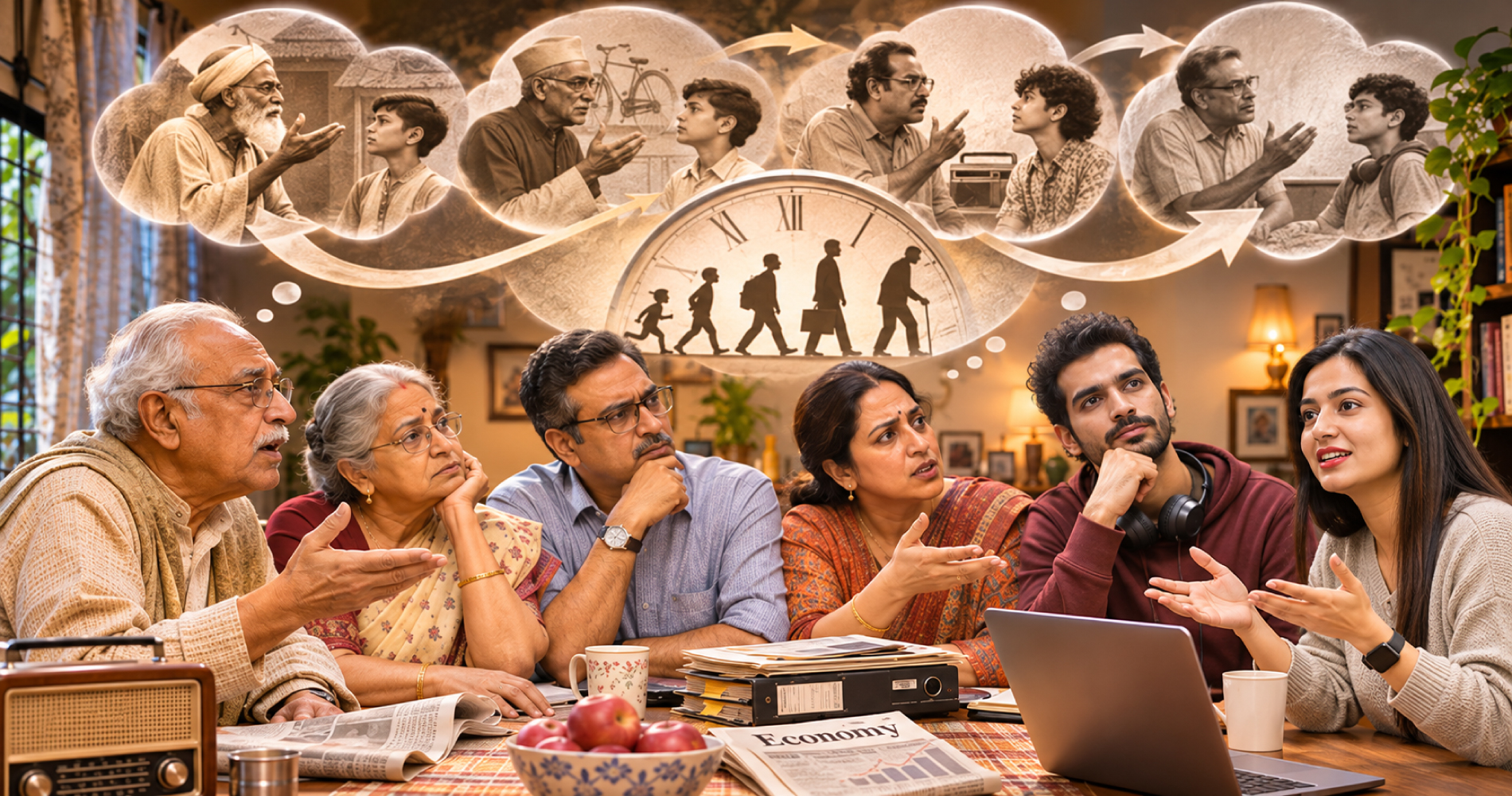
Imagine dinner is going on at home. You casually mention that your friend has quit their job and is taking a break for a few months. Dad’s reaction comes immediately: In our day, people wouldn’t even think of doing that. You say mental health matters too. Then comes the classic response: We’d never even heard the word depression. Two different realities are sitting at the same table, and both think the other is a little delulu.
The interesting thing is that this kind of worry about the next generation is much older than the smartphone. Technology kept changing, fashion kept changing, but the complaint template stayed almost the same. The question isn’t whether everything is perfect today. The question is why our own generation seems normal to us, while other generations seem suspicious.
“Kids these days” Drama
About 2,400 years ago, in Book VIII of The Republic, Plato described a society where young people did not respect their elders and students took their teachers lightly. It was a philosophical argument about a democratic society, not a modern survey. Still, its familiar tone makes it seem as though even in ancient Greece, people were debating kids these days.
Here’s an important fact-check. A long quote about children’s bad manners circulates online under Socrates’ name. It would be wrong to treat it as an authentic, word-for-word quote from Socrates. The actual historical text and the viral quotation are two different things. The irony is that while discussing complaints about generations, we end up getting caught in a chain of misinformation ourselves.
In 1960s Britain, there was also public panic over youth groups called the Mods and Rockers. In his 1972 book Folk Devils and Moral Panics, sociologist Stanley Cohen explained how the media can turn a few incidents into a story about a threat to society as a whole. Today, there’s just a viral clip instead of a newspaper headline. The panic has a new outfit, but the storyline is old.
What are the different generations?
Before understanding this debate, let’s clarify the basic question: what are the different generations? In the common classification, the Silent Generation was born around 1928–1945, Baby Boomers from 1946–1964, Gen X from 1965–1980, Millennials from 1981–1996, and Gen Z is considered to begin around 1997. Gen Alpha is often associated with the early 2010s, but there is no agreement on its boundaries.
Pew Research Center makes it clear that these labels are not scientific personality types. Birth-year lines are not universal, and historical experiences also vary by country. The post-war baby boom in the United States and the social climate in India after independence do not tell the same story. Economic liberalization, local culture, language, family income, and internet access will each leave a different mark on an Indian person’s childhood memories.
The “Kids These Days” Effect
The real plot twist is found in the psychology lab. In 2019, psychologists John Protzko and Jonathan Schooler published five preregistered studies in Science Advances. A total of 3,458 American adults took part. The researchers wanted to understand why older people think young people are less respectful, less intelligent, or less interested in reading.
Your Strongest Trait Becomes Everyone Else’s Weakness
The result was quite personal. Participants who placed greater importance on authority themselves perceived a greater lack of respect among young people. Those who rated their own intelligence highly had more doubts about young people’s intelligence. People who read more thought that children were giving up reading books. Here, the research did not prove a decline in the actual abilities of any generation; it captured a pattern in people’s judgments.
The researchers also examined memory. People were projecting their present-day qualities onto people from their childhood. Put simply, however disciplined you are today, your mind assumes your whole generation was always that way. The messy versions of childhood conveniently disappear from the archive. In popular discussions, this effect is called the “kids these days” effect.
Nostalgia Is an Unreliable Historian
Childhood rain, school holidays, old songs, and a Sunday without notifications. The moment you hear that, an aesthetic edit starts playing in your brain. But was that era better in every way? Probably not. We don’t remember our lives like documentaries. Memory picks the highlights, cuts the awkward scenes, and sometimes changes the entire lighting.
In psychology, the Fading Affect Bias describes how, in many autobiographical memories, feelings associated with unpleasant experiences fade faster than feelings associated with pleasant experiences. Walker, Skowronski, and Thompson reviewed research on this pattern in 2003. This doesn’t mean trauma always fades away. It just means that in ordinary memories, the picture of the past can sometimes feel warmer.
The Illusion of Moral Decline
Now let’s talk about the assumption that not just youth, but the whole world, seems to be getting worse. In 2023, a study by Adam Mastroianni and Daniel Gilbert appeared in Nature, titled The Illusion of Moral Decline. The researchers used archival and new data to analyze a research program with about 12.5 million observations. They found this belief—that people’s morality is declining—in at least 60 countries. Such beliefs had been around for decades.
Why Yesterday Looks Kinder Than Today
When the researchers examined people’s ratings of their contemporaries’ morality over time, they found no consistent evidence of the kind of decline suggested by the collective belief. Their explanation rested on two biases: negative information gets more attention, and negative information from the past fades comparatively more. Today’s headlines show a scam; childhood memories recall a neighbor helping out. Then we put both on the same scale.
This study does not mean there is never any moral change in the world. Discrimination declines in some places, while new problems emerge elsewhere. The point is simply that our feelings are not reliable data for sweeping claims like “everyone was good before, and now everyone is bad. Doomposting about humanity is easy; measuring its morality is extremely difficult.
Social Identity: My Generation, My Team
In social psychology, Henri Tajfel and John Turner’s Social Identity Theory explains that group membership becomes part of our self-image. Family, city, college, or generation—any label can give us a sense of belonging. The problem begins when making our own group look good seems to require putting another group down.
In 1980, a study by Quattrone and Jones showed a pattern of out-group homogeneity. Members of other groups seem more alike to us, while we quickly notice differences within our own group. So one teenager’s rude behavior becomes proof about all of Gen Z. But the same behavior in our own generation remains their personal problem.”Convenient? Absolutely. Accurate? Not really.
Fear of Losing Control
Generational arguments often conceal a fear of losing control more than a desire for respect. The things that seemed normal to us as children become tools for understanding the world in adulthood. Then younger people introduce new rules. Someone discusses boundaries at work, someone changes the timeline for marriage, someone talks openly about therapy. To an older person, this can feel like more than just change—it can also seem like a challenge to the system they have established.
Every New Technology Gets Its Villain Era
There was once anxiety about people reading novels. Then radio, television, video games and the internet came along. Now smartphones, reels and AI have taken the spotlight. In a 2020 paper titled The Sisyphean Cycle of Technology Panics, psychologist Amy Orben showed that panic over new technologies keeps returning. Society gets scared first, research begins later, and before there’s complete clarity, a new technology makes its entrance.
Is Gen Z Really Cooked by Screens?
Looking at TikTok or reels and saying “RIP attention span” is catchy, but the scientific answer isn’t so simple. A 2024 US National Academies report found that social media has both risks and benefits. Its review found insufficient evidence to prove that social media directly causes changes in adolescent health at the population level. Risks such as cyberbullying, sleep disruption, and harmful comparison are real; at the same time, social media also offers belonging, information, and support.
Millennials vs Gen Z: The Endless Comment War
On the internet, the millennials vs. Gen Z discourse makes it seem as though there’s a centuries-old rivalry between the two groups. Millennials’ skinny jeans, Gen Z’s baggy jeans, someone’s corporate hustle, someone else’s work-life balance. Even a minor fashion disagreement can sometimes turn into a verdict on someone’s personality. Seeing someone else’s choice, we start judging their work ethic, intelligence, and even emotional strength.
But in 2021, Rudolph, Rauvola, Costanza, and Zacher noted in an extensive review of workplace generations that many famous generational differences lack strong scientific support. In particular, it’s difficult to separate the effects of age, historical period, and birth cohort. How today’s 23-year-old views job security isn’t just because they’re Gen Z; career stage, the economy, and personal responsibilities also matter.
The Three Variables Everyone Forgets
Psychologists and social researchers often distinguish between age, period, and cohort. An age effect means the impact of a life stage. A period effect means an event that affects multiple age groups at the same time, such as a pandemic. A cohort effect means the shared formative experiences of a particular birth group. When we mix the three together, we repeatedly end up blaming the wrong villain.
Take an example. If young adults are getting married comparatively later, is the reason their generation’s commitment problem? Or is it that education has taken longer, housing has become more expensive, expectations have changed, and job uncertainty has increased? It’s tough to decide based on a single survey. The Pew Research Center also explains that separating these effects poses major methodological challenges. Good psychology makes the question complex; it doesn’t just offer a catchy label.
The Indian Generation Gap Has Its Own Plot
Understanding the generation gap in India solely through an American birth-year chart would be incomplete. In many families here, grandparents lived through a period of scarcity, parents faced the pressures of a changing economy and competitive education, while children found themselves in a different world of online visibility and career choices. This isn’t every family’s story, but it’s a useful starting point for discussion.
Suppose a stable job means security to Grandma, a government exam means respect to Dad, and a creative career means freedom to their daughter. All three want a good life, but they calculate risks differently. When their daughter chooses freelancing, they see opportunity on one hand and uncertainty on the other. Then the debate begins: “We didn’t have all this in our day.” Often, the translation is: “I’m worried about your future.”
Modern Society Turns Anxiety Into Content
In modern society, generation-related judgment is no longer limited to the dining table. A viral clip becomes the spokesperson for an entire age group. A youngster is seen behaving loudly in a public place, and the caption reads, “Gen Z has no manners.” A middle-aged person uses technology incorrectly, and the comments say, “Boomers are cooked.” One person’s mistake becomes the collective reputation of millions. On many platforms, reactions get more engagement than nuance.
Psychology’s availability heuristic explains that examples that come to mind easily seem more common to us. Dramatic videos are easy to remember, but quiet, ordinary interactions aren’t. Add confirmation bias on top, and we save only the clips that prove our existing opinions. The result? Every day, your timeline will seem to provide evidence that your favorite generation is superior. Your feed is more curated than reality.
When Generations Really Do Change
Now, don’t make the opposite extreme mistake of thinking everything is an illusion. Genuine changes occur in education, family size, work opportunities, gender expectations, and communication tools. So some attitudes do shift over time. Many young people use new vocabulary, while older people prefer different social norms. But there’s a difference between a trend and a stereotype. A statistical average is not an individual’s entire identity.
Will Gen Alpha Repeat the Same Cycle?
It’s far too early to give a final verdict on Gen Alpha’s long-term psychological traits. AI, personalized content, and digital classrooms play a role in their childhood, but that doesn’t determine their future personalities. By the time they grow up, perhaps they’ll be facing the habits of a new generation. And at a family gathering, a familiar line will be heard again: “We weren’t like that.” The cycle has entered another season.
How to Break the Doom Loop
First, whenever you hear a generational claim, ask one quick question: “What’s the evidence?” If the answer is just two viral reels and one annoying cousin, the sample size is tragic. Before judging an age group, look at what the actual research says, how diverse the sample is, and whether the study shows correlation or causation. Even if the headline sounds very confident, it’s important to read the methodology.
Second, keep the comparison fair. Comparing today’s 20-year-old with today’s 60-year-old won’t tell the whole psychological story. If possible, compare people from different eras at the same life stage. Even then, differences in the economy, education, and social conditions will remain. In generational research, the simple answer is often the most suspicious one.
Third, put curiosity ahead of roasting in family discussions. A parent might ask, “What feels meaningful to you about this job?” The child might also ask, “Why is stability so important to you?” Both can share evidence from their own lives. Not every disagreement is a moral failure. Sometimes the person on the other side isn’t being disrespectful; they’re just solving a different problem.
Conclusion
Perhaps every generation thinks this because the next one is doomed: the human brain notices change quickly, remembers the past selectively, and wants to protect its identity. This tendency can be seen from ancient philosophy to Instagram comment sections. The only difference is that now every opinion has both a microphone and an algorithm.
The new generation isn’t perfect. The old generation wasn’t either. Some problems are new, while some old habits simply return in a new format. The right question isn’t “Which generation is the worst?” but rather, How honestly are we understanding one another’s experiences? Because one day, the young people writing today’s doomposts will see some new trend and say, “Bro, humanity is finished.” And perhaps that’s the oldest generational meme of all.
Disclaimer
This article is intended for education and public awareness. The generational categories used here are approximate, not psychological diagnoses. The studies discussed are based mainly on samples from different countries; their results do not apply directly to every Indian family or individual. Research does not declare any entire generation morally superior or inferior. The effects of mental health, parenting, and technology vary depending on individual circumstances. For a personal concern, consult a relevant qualified professional.

A passionate health and lifestyle content writer dedicated to making complex medical and psychological topics easy to understand. With a focus on mental health, lifestyle, and overall well-being, I curate informative, research-based articles that help readers better understand their health and make informed decisions. The goal is to spread awareness, simplify health information, and encourage healthier living.