
Abstract
When you look up the death toll of the 1984 Bhopal gas tragedy, different figures such as 2,259, 3,787, 5,295, and more than 22,000 appear. Some of these are estimates of early deaths, some are death cases in compensation records, and some are assessments of the total loss years later. Treating them as if they are all counts from the same time and by the same method creates confusion. Here we will understand the source, time period, and basis of each major number. Where the cutoff date or original count of a figure is not clear, we will also point out that gap.
One tragedy, but many ways of counting
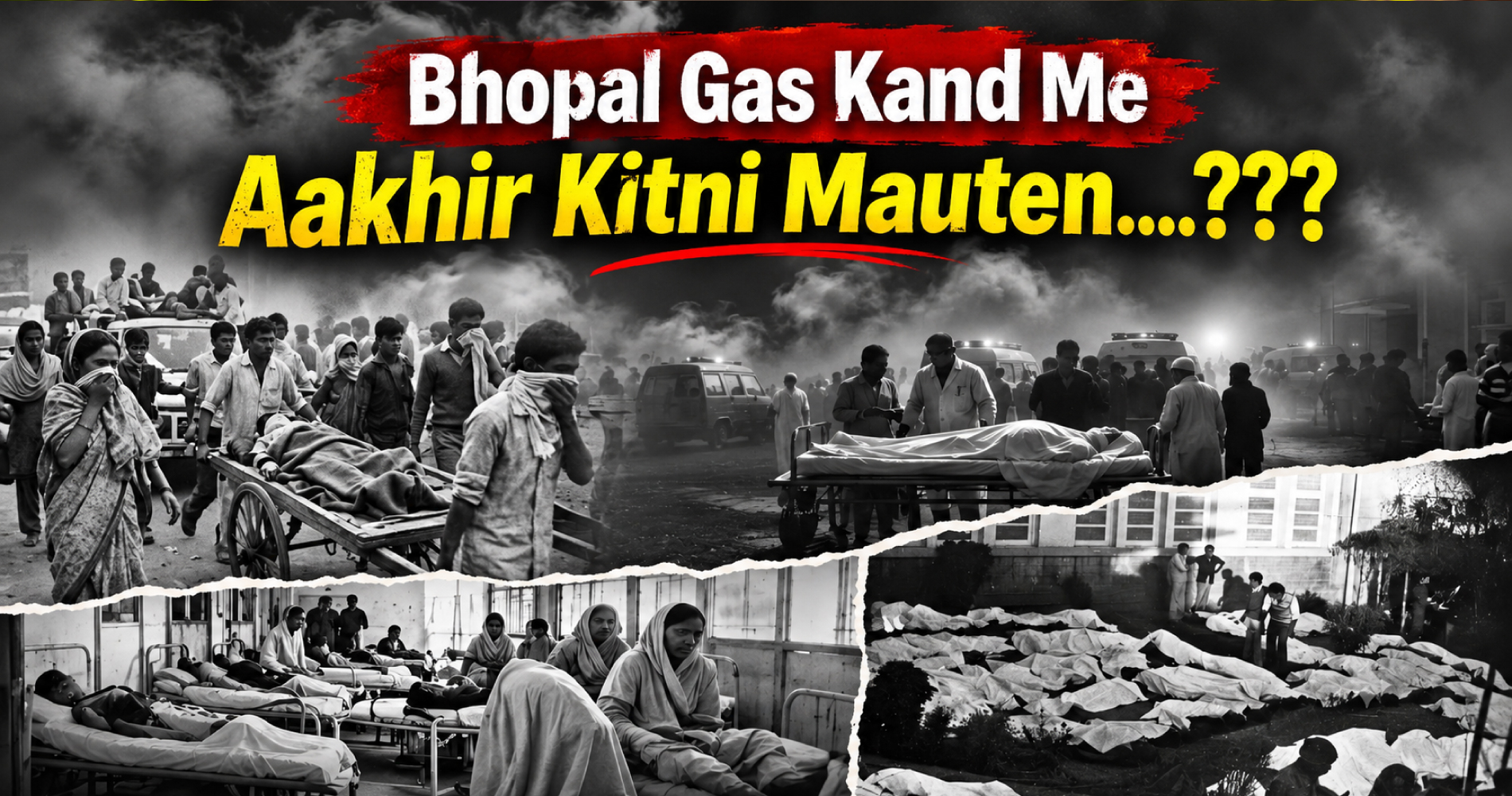
Patients kept arriving at Bhopal hospitals that night. Some people died immediately, some during treatment, and some in the following days. In the previous installment, we understood the crisis faced by the doctors. Now the same story raises a difficult question. After all, how many lives were lost in this disaster?
If the question is only about the deaths up to the morning of December 3, the answer will be different. If the next three days are included, the count will increase. To include deaths caused by illness years later, another kind of investigation is needed.
Still, many articles present these different numbers without context. The reader feels that one source has reported thousands more or fewer deaths. In some estimates, there are real differences. But in many places, the numbers are also answering different questions. The honest answer to how many people died in the Bhopal gas tragedy starts with this difference.
First, decide whose count we are reading
To understand a number properly, we have to ask three questions behind it. Which period of deaths is included? Which records were used? And what is the basis for linking a death to the gas tragedy?
“People who died after the accident” and “people who died because of the accident” are not the same category. Similarly, deaths recorded in a hospital are not a count of all the deaths in the city.
Early deaths
This category may include deaths in the first night, the first few days, or the early weeks. But the term “immediate deaths” does not refer to exactly the same time period in every source. So if a report only says “immediate,” you should not change it on your own to “the first 24 hours.” What seems like a small time difference can lead to a major misunderstanding later.
Compensation death cases
These are the cases that were accepted or recorded under the death category in the compensation process. Their purpose is administrative. They are important government records, but they are not necessarily a medical estimate of every exposure-related death in the entire population.
Estimates of later deaths
These use long-term monitoring of survivors, mortality in affected and comparison populations, and other records. Some estimates include the early deaths, while others describe only the additional losses in later years. This is the point that must be checked before combining the two.
In which source are there about 2,000 deaths in the first three days?
The ICMR clinical report gives an estimate of about 2,000 deaths in the first 72 hours. This number relates to the initial period. It should not be understood as the number of deaths over the entire lifetime after the accident or over the following decades.
This also does not mean that the count became final as soon as the 72 hours were over. The report presents an initial estimate. Other investigations give higher numbers for the same period or for a similar early time frame.
Then where did 2,259 come from?
2,259 appears in many historical summaries as the official immediate death toll. The Tribune’s reporting from October 2016 also presents it with the same description. But that news report does not provide a completely clear hour-by-hour cutoff or the full counting method for this number. So it would not be appropriate to turn it into a definitive statement like “that many people died that night.”
The responsible phrasing would be that it is a widely cited number as the initial official death toll. It is important to mention the source along with it, especially when comparing it with a long-term estimate.
Why do 3,787 and about 3,800 look the same?
3,787 is also often called the official death toll. In the training material of the National Institute of Disaster Management, it is described as the number of gas-related deaths confirmed by the Madhya Pradesh government.
This is the historical reference for that government confirmation. The final cutoff date is not clear from the available summary. So it would be wrong to write it as an updated total up to 2026.
Research of about 3,800
Edward Broughton’s 2005 review, The Bhopal Disaster and Its Aftermath, mentions at least 3,800 immediate deaths. The two numbers are close, but for that reason alone it is not right to assume they are exactly the same dataset. One source gives details of government confirmation, while the other states immediate mortality in a research review.
The better approach here is to keep the source’s own category along with the number. About 3,800 should not be turned into scientific proof of the exact 3,787 without verification. The difference in these early estimates is real. The difference in time period does not fully answer every disagreement. Limits in counting and in the available records are also important.
The figure of 3,000 was not the final death count
In Bhopal’s legal history, a reference to 3,000 deaths is found. But it is important to understand the context. The Supreme Court’s decision of 14 March 2023 compares the old settlement calculations with the figures later presented by the central government. In it, the assumed number of 3,000 death cases is shown for the 1989 compensation calculation.
The word assumed is important here. The number used in the financial calculation of the settlement and a fully prepared final mortality register are not the same thing. If a number appears later in a court document, that does not mean the court declared that number to be the final medical answer for all deaths in every period. It is just as important to read the purpose of the document as it is to read the number within it.
5,295 deaths or 5,295 compensation cases?
There is a clear official reference for the figure of 5,295. In the reply to a Lok Sabha question on 11 August 2011, the government gave the categories of cases that received compensation after adjudication. In that, 5,295 cases were recorded in the death category.
This record is identified by its time context — the compensation position recorded in the 2011 parliamentary answer. It is not just a count for the night of 2–3 December 1984.
What do the accepted cases show?
They show that the administrative process placed that many cases in the death category. This is important evidence. But by itself, it does not prove that there were no exposure-related deaths outside that category.
On the other hand, any claim larger than the accepted number does not become correct on its own. An estimate also needs a source and a method. Recognizing the limits of the government record and accepting every large figure without checking are different things.
Updated context for 5,479
In the updated comparison of the 2023 Supreme Court decision, the number of death cases up to 31 October 2022 is 5,479. In the same section, the older figure of 5,295 cases also appears. Therefore, writing 5,295 as the “latest official figure” without a date is incomplete.
A clearer sentence would be that the old government compensation records showed 5,295, while the updated position presented in court for October 2022 showed 5,479 death cases. Even so, neither should be written as the number of “people who died that night.” These are compensation-related categories and dates.
Whose estimate is it of 7,000 to 10,000 initial deaths?
Amnesty International researchers put the estimate of early mortality higher than the official accounts. In the organization’s article from December 2014, an estimate of 7,000 to 10,000 deaths in the first three days is stated clearly.
This should not be just a vague claim like “activists say something else.” The source’s name, its time period, and the fact that it is an estimate should all be written together.
Does this match ICMR’s initial figure?
No. For the first 72 hours, ICMR’s estimate of about 2,000 and Amnesty’s estimate of 7,000–10,000 for the first three days are different estimates. The difference cannot be dismissed here just by saying the timeframes are different. Presenting both with the same identification is the honest approach. Choosing one number and making the other disappear reduces the reader’s information.
Amnesty’s 2004 investigation also included accounts from people involved in the transport, burial, and cremation of bodies. These were part of its examination of the initial death toll. Such accounts are important, but it is not appropriate to directly add separate accounts together to create a new exact total.
Difference between 15,248 and the later 15,000 deaths
These two numbers seem close, but one is not the rounded version of the other. Amnesty’s 2004 report, citing the 2003 annual report of the Madhya Pradesh Gas Relief and Rehabilitation Department, mentions a total of 15,248 deaths up to October 2003. It clearly says that the early deaths are included. Here, the information comes from the departmental record cited by Amnesty.
15,000 deaths in later years
In the same report, Amnesty presents a separate estimate that at least 15,000 additional people died due to the gas leak between 1985 and 2003. For this, it used mortality rates from the ICMR cohorts and extrapolated them into later years.
Extrapolation simply means making a projection beyond the available period using the data and assumptions at hand. It is not the same as evidence equivalent to a list containing the names of all the dead.
Why would adding the two be wrong?
The reference to 15,248 is to the total deaths. The second estimate is for later deaths from 1985–2003. Their ranges overlap. So it would be wrong to add 15,000 to 15,248 and make a new total of 30,248. The same mistake would happen if early deaths were added again to a cumulative estimate.
Reading the words “total,” “additional,” and “up to which period” with the number is not a minor technical detail. That is what decides whether we are understanding the count or duplicating it.
On what basis are the figures of more than 22,000 and more than 25,000?
The Amnesty International article of 2 December 2024 gives an estimate of more than 22,000 deaths as a direct result of exposure of the leak. This is a cumulative assessment published on the occasion of the 40th anniversary. It should not be understood as the number from the first three days.
The source calls it an estimate. The article does not present individual death verification for every person or the full calculation. Therefore, changing it into a sentence like “22,000 names have been verified” would go beyond the evidence.
Estimate above 25,000
The facts compilation of the Bhopal Medical Appeal also includes an estimate of more than 25,000 combined deaths related to the organization and Sambhavna. On the same page, different sources give different numbers.
However, there is no clear, consistent cutoff date attached to that particular figure. So it cannot automatically be called the exact total up to November 2026. Here too, the correct way to report it is with attribution. You should write the number along with which organization’s estimate it is, whether it combines early and later deaths or not, and how clear the timeframe is.
A number being larger, whether 22,000 or 25,000, does not by itself make it more reliable. Reliability will be determined by the method and the evidence.
Do hospital or post-mortem records give the full count?
The ICMR pathology report states that 731 bodies were received during December 1984. This is the number in the medico-legal record, not the total deaths in the entire city. When reading it, the original question should be asked—what institution is this record limited to? Who did it receive? Did the body of every deceased person come there?
A record is not the whole population
Deaths that occurred during treatment in a hospital are a separate dataset. Bodies that reached a mortuary are separate. The municipal registration and compensation process also have their own purposes.
If all the lists are added together, one person may be counted in several places. If only one list is treated as final, there is a risk that people outside it will be missed. That is why matching and verification are needed to prepare the total for the entire disaster.
The question of people who left the city
Amnesty’s investigation had raised concerns about people who had moved out of the city and about incomplete death recording. According to it, there was not enough evidence to systematically track all affected people who died later.
This is the basis for investigating the undercount. But seeing gaps in the record does not mean we can fill in its size with any arbitrary number. Respecting missing information means clearly stating its limits and looking for better evidence.
It is also not right to link every death that happened later to the gas tragedy
For a person who was exposed in 1984, it may be difficult to determine the cause of death twenty or thirty years later. Age, other illnesses, and other exposures also play a role.
So we have to avoid two different mistakes. It is wrong to assume that every later death was only the result of the gas. It is also wrong to dismiss a gas-related contribution just because the death happened many years later.
What does the long-term study show?
The study published in 2023, Survival Analysis for Cohort of Bhopal Gas Disaster Victims During 1985–2015, examined the outcomes of 92,320 people in the exposed and unexposed groups. Researchers found higher mortality in the exposed group during the early follow-up phases; over time, the survival of the groups became closer.
This is research aimed at understanding the long-term mortality effects. But its entire sample population should not be read as “people who died from the gas.” It also included survivors and a comparison group.
The purpose of the study is to understand risk and survival. Its sample size is not the death toll of the entire city.
How do researchers estimate excess deaths?
When an individual causal record is not available for every death, researchers use excess mortality. This compares the number of deaths that occurred with the number that would have been expected under normal conditions.
WHO explains excess mortality as the difference between observed and expected deaths. This is a general statistical concept; WHO’s definition by itself does not provide any new total for Bhopal.
Take a hypothetical example. In a population, 100 deaths were expected under normal conditions, but 140 occurred. The initial excess would be 40. This example explains the method; it is not Bhopal data.
Why is caution needed in comparison?
Accurate information about age, migration, population size, and other health conditions is necessary. If the comparison group is very different, the interpretation of the differences will be affected.
That is why assumptions and uncertainty are also important along with the estimate. A statistical total helps in understanding the actual loss, but it cannot be called a verified death certificate for every individual.
Similarly, in compensation, an accepted death case should not be understood as the result of an epidemiological model. Both pieces of evidence are useful, but they serve different purposes.
So how should you answer the question, “How many people died in Bhopal?”
If you need to write one number, first decide which question you are answering. For the first 72 hours, give ICMR’s estimate of about 2,000 and also note Amnesty’s more initial estimate as a difference of opinion.
If the context is compensation, identify the older 5,295 and the 5,479 death cases from October 2022 with their dates. In a discussion of the long-term total loss, write Amnesty’s 2024 estimate of more than 22,000 or another organization’s estimate with clear attribution.
Do not combine them into a new total. For the Bhopal gas disaster, there is no single death figure that all major sources accept with the same timeframe and method. This uncertainty does not cast doubt on the scale of the event. It shows that the accounting between the record and the human loss was never complete.
There are people behind every number. Respecting their story does not come from choosing a higher or lower figure, but from writing the right number with the right meaning and the right time period.
Conclusion
When answering how many people died in the Bhopal gas tragedy, it is important to keep the context with each number. The deaths on the first night and in the early days, the death cases recorded in compensation, and the estimates of losses over decades are separate counts. Some of these differences come from the time period, while others reflect real disagreements between sources.
So it would be incomplete to present any one figure as the final count of the entire tragedy. Government records have their own importance, and long-term research has its own. Where the evidence is limited, the uncertainty should be stated clearly. Every number is connected to a family’s lost member. Correct identification and an accurate record of each death are a basic necessity for doing justice to the story of Bhopal.
Disclaimer
This article compares government compensation records, judicial documents, ICMR research, and published estimates from other institutions. These are not figures from the same methods or the same time period. Where a reference to an original record was found in a report instead of the record itself, that difference has been made clear. The article does not present any new death estimate.

Emanual Massey is a healthcare, lifestyle, and beauty content writer with over 7 years of professional experience. He specializes in writing SEO-optimized, research-based articles on health, wellness, nutrition, skincare, beauty, and Ayurveda. His mission is to simplify complex topics into practical, reader-friendly content that empowers people to make healthier lifestyle choices. Passionate about continuous learning and evidence-based writing, Emanual creates informative and engaging blogs that combine accuracy, readability, and search engine optimization.