
Abstract
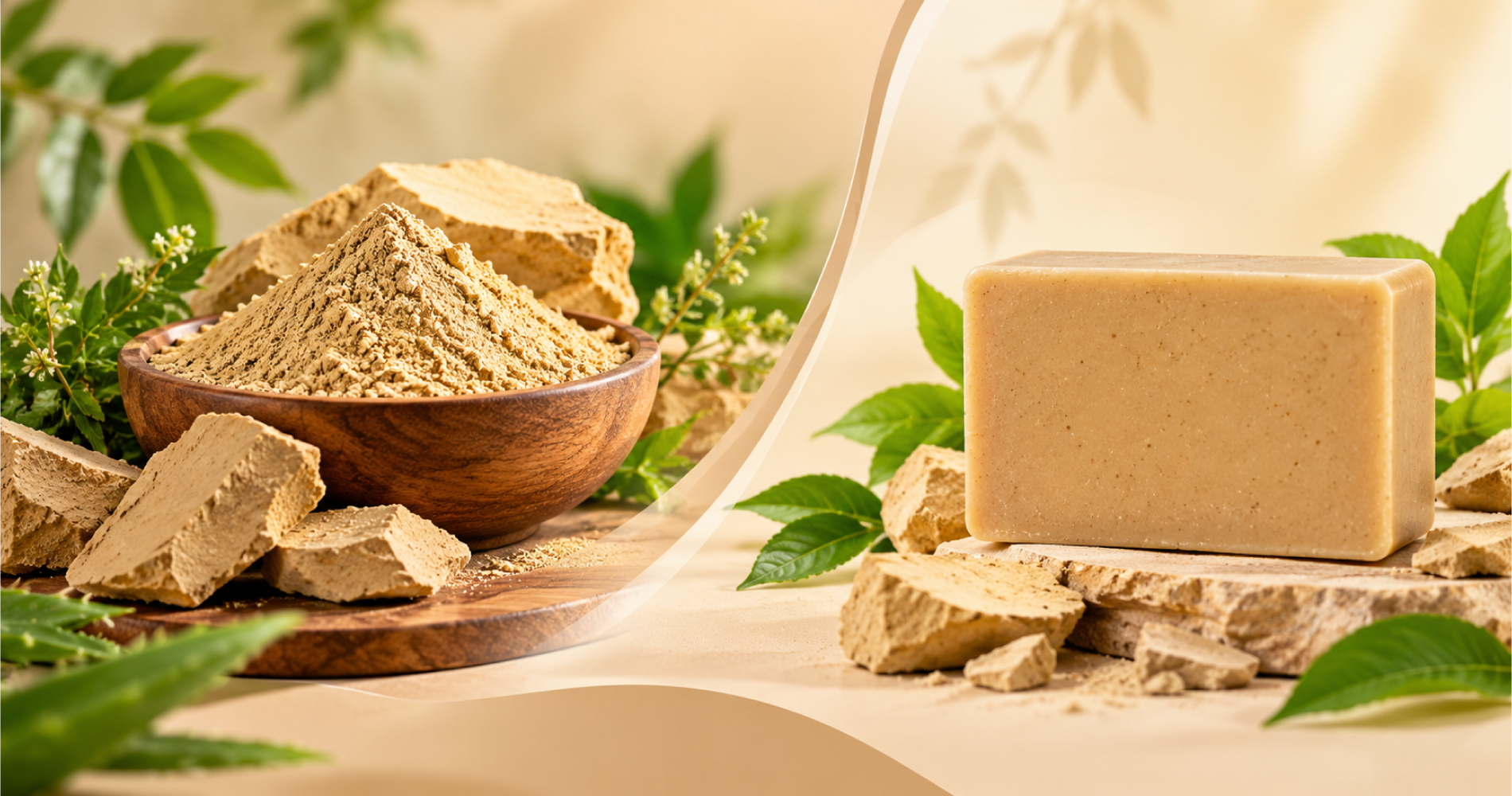
Remember the Multani Mitti face packs our grandmothers made for us? This age-old skincare ingredient is now finding its way into something we use every day which is a soap. For generations, Multani Mitti, also known as Fuller’s Earth, has been a familiar part of traditional South Asian skincare. Mixed with water, rose water or other ingredients, it was commonly used as a face pack to help absorb excess oil and leave the skin feeling fresh. Today, this traditional favourite is being reintroduced in modern skincare products that offer a more convenient way to incorporate familiar ingredients into everyday routines.
But does Multani Mitti work the same way in a soap as it does in a traditional face pack?
What benefits can you realistically expect, and what should you know before choosing one? Let’s explore how this time-honoured ingredient has evolved and what its modern-day form means for your skincare routine.
Introduction: What is Multani Mitti?
Before exploring how Multani Mitti has made its way into modern soaps, it is important to understand what this familiar ingredient is and why it has remained a part of traditional skincare for generations. Commonly known as Fuller’s Earth, Multani Mitti is a naturally occurring clay valued for its absorbent properties. It has been used in various applications, including cleaning and cosmetics, and is particularly well known in South Asian beauty practices.
The traditional use of Multani Mitti in skincare
For generations, Multani Mitti has been used in homemade face packs and hair-care preparations. Traditionally, the clay is mixed with water, rose water or other commonly used ingredients to create a smooth paste. This mixture is applied to the skin, left on for a limited period and then rinsed off. Its popularity comes partly from its ability to absorb excess oil from the skin’s surface. After washing off a face pack, the skin may feel less greasy and appear temporarily less shiny. This has made Multani Mitti a familiar choice, particularly among people with oily skin.
Why is Multani Mitti still popular today?
Despite the introduction of countless modern skincare products, traditional ingredients such as Multani Mitti continue to attract attention. One reason is their familiarity, while another is the growing interest in incorporating traditional beauty practices into contemporary routines. Today, Multani Mitti appears in different product formats, including face masks, cleansers and soaps. These products offer alternative ways to use an ingredient that was traditionally prepared at home. However, the format matters too because a homemade face pack and a rinse-off soap differ in their formulations, application methods, and contact time with the skin.
What does science say about its skin benefits?
Although Multani Mitti has a long history in traditional skincare, its traditional use should not be confused with scientifically established results. Its properties to absorb oil quickly helps in explaining its use in products intended to reduce surface greasiness, but evidence supporting broader claims about its effects on human skin remains limited. For example, the presence of Multani Mitti in a skincare product does not automatically mean that it can treat acne, remove pigmentation or permanently change skin tone. Such outcomes depend on several factors and require evidence specific to the product or treatment.
Understanding both its traditional role and its limitations provides a useful starting point for exploring how Multani Mitti is being incorporated into modern cleansing products.
From face packs to soap: How skincare habits are changing
From mixing a face pack at home to reaching for a ready-to-use soap, skincare routines are becoming more convenient. Traditional ingredients like Multani Mitti are now available in different formats, allowing people to incorporate familiar skincare favourites into their routines in new ways. But while the ingredient may be the same, the experience and purpose of each product can be quite different.
The traditional face pack: A skincare ritual
A homemade Multani Mitti face pack usually involves mixing the clay with water or rose water to create a smooth paste. Then it is applied to the face and rinsed off after a short period. This preparation makes it more of an occasional skincare ritual that requires a little time and effort which is mostly preferred during weekends or before any festival or occasion.
The modern soap: Convenience in everyday cleansing
A ready-to-use Multani Mitti soap offers a simpler alternative that requires no need to measure, mix, or prepare anything. The product can be easily incorporated into our daily cleansing routine by following its directions. This convenience reflects how traditional ingredients are adapting to modern lifestyles.
Same ingredient, different purpose
Even though both products may contain Multani Mitti, but they do not need to necessarily work in the same way. A face pack stays on the skin for longer, while a rinse-off soap is used briefly for cleansing. Their formulations, ingredient concentrations, and contact times can all influence the results. A Multani Mitti-based soap should not automatically be expected to deliver the same effects as a traditional face pack. The shift from face packs to soap is less about changing the ingredient itself and more about adapting a familiar skincare favourite to a different format and purpose.
What’s inside a modern-day Multani Mitti face pack soap?

The name of a skincare product usually highlights its most recognisable ingredient, but the complete formulation deserves equal attention. A soap is not simply a traditional face-pack powder pressed into a bar. It contains a base that allows it to cleanse the skin, along with any additional ingredients included for particular formulation or cosmetic purposes.
“Lebrostone’s Multani Mitti Face Pack Soap” is one example of this modern format. Its product listing identifies Multani Mitti alongside other ingredients, including coconut, rice water and oats. The precise ingredient forms and full formulation should be verified against the product packaging before drawing conclusions about their individual effects.
Multani Mitti: The traditional hero ingredient
Multani Mitti is valued primarily for its ability to absorb oil. In skincare, this property makes it relevant to products intended to cleanse the skin and reduce the feeling of excess surface greasiness. For people who experience an oily T-zone or a shiny appearance during hot and humid weather, a suitably formulated cleanser may help the skin feel fresher after washing.
Nevertheless, oil absorption has its limits. Removing excess surface oil is not the same as controlling the skin’s natural oil production over the long term. Nor does the presence of Multani Mitti establish that a product can treat acne, permanently reduce pore size or remove a sun tan. Its role in a soap also depends on how it interacts with the other ingredients. The finished formulation, rather than the ingredient name alone, determines the product’s overall cleansing characteristics.
Coconut-derived ingredients: understanding their role
Coconut-derived ingredients appear in many personal-care formulations, but their functions vary considerably. For example, coconut-derived cleansing agents can help remove oil and dirt, while certain coconut oils or emollient ingredients may serve different purposes. These ingredients should not be treated as interchangeable.
It is therefore important to identify the precise ingredient listed on the packaging before describing its role in a particular soap. The phrase “coconut” alone does not reveal whether the product contains coconut oil, a coconut-derived surfactant or another ingredient associated with the coconut plant. The overall formulation also matters. The presence of a coconut-derived ingredient does not guarantee that a cleanser will be moisturising or suitable for every skin type.
Rice water: A familiar ingredient in beauty routines
Rice water has a place in traditional beauty routines and is used in some contemporary cosmetic formulations. Its appeal is often associated with the broader interest in familiar, plant-derived ingredients. However, the term can refer to ingredients prepared or processed in different ways. The exact form used in a commercial product may differ from the rice water prepared at home.
Claims about brightening, reducing pigmentation or reversing visible skin ageing should be evaluated carefully. Evidence supporting a particular ingredient in one preparation cannot automatically be applied to every product that contains it. In a soap, rice-derived ingredients must be considered alongside the cleansing base and the way the product is used. Their presence alone does not establish a specific skin-lightening effect.
Oats: A potentially soothing ingredient
Certain oat-derived ingredients are used in skincare formulations for their skin-conditioning and soothing properties. Some forms of colloidal oatmeal, for example, have been studied for their role in supporting dry or irritated skin. However, the benefits associated with a particular oat ingredient should not automatically be attributed to every product containing oats.
The form of the ingredient, its concentration, the rest of the formulation and the amount of time the product remains on the skin can all influence its practical effect. A rinse-off soap is not equivalent to a moisturiser or a leave-on preparation containing the same ingredient. For anyone concerned about dryness or sensitivity, the complete ingredient declaration remains more informative than a product’s list of highlighted ingredients.
Why the complete formulation matters
Multani Mitti, coconut-derived ingredients, rice water and oats may each have different roles, but their presence does not guarantee that a product will suit every user. The cleansing base, fragrance, other additives and intended method of use also matter. This is why evaluating a skincare product requires looking beyond its most recognisable ingredients.
What can multani mitti soap actually do for your skin?

Multani Mitti’s traditional reputation can make it tempting to associate the ingredient with a wide range of skincare benefits. A more useful approach is to separate realistic cleansing effects from claims that require stronger evidence.
Cleansing away surface dirt and oil
A facial cleansing product can help remove sweat, dirt, excess surface oil and other everyday residues. This is the primary function to consider when evaluating a soap intended for facial use. A product containing Multani Mitti may be appealing to people who prefer a cleanser associated with oil absorption. However, its actual cleansing performance depends on the finished formula rather than the presence of clay alone.
Helping reduce an oily appearance
Excess surface oil can make the face appear shiny, especially during warm or humid weather. Cleansing can temporarily reduce this greasy feeling and leave the skin looking less shiny. However, the effect should not be confused with permanently reducing sebum production. The skin continues to produce oil as part of its normal functioning, and frequent washing is not necessarily better. A cleanser that leaves the skin feeling tight or uncomfortable may be too harsh for an individual’s needs.
Leaving the skin feeling fresh
The immediate feeling of cleanliness after washing is a reasonable expectation from a suitable cleanser. The skin may feel fresher and less greasy, particularly when surface oil and residue have been removed. This is different from claims about long-term improvements in skin texture, acne or pigmentation. Those outcomes depend on several factors and may require products specifically formulated for the relevant concern.
What about tun tan and uneven skin tone?
Tan removal deserves particular care because it is a common claim associated with traditional skincare ingredients. A sun tan develops when ultraviolet radiation triggers increased melanin production in the skin. Washing can remove surface dirt and oil, but it does not simply wash away the skin’s pigment response to ultraviolet exposure. There is insufficient evidence to conclude that Multani Mitti soap can reliably remove a sun tan or permanently lighten skin tone. A product’s name or marketing description is not proof of such an effect.
Broad-spectrum sunscreen, protective clothing and reducing excessive ultraviolet exposure are important steps in preventing further tanning. Persistent pigmentation may require assessment by a dermatologist. Overall, Multani Mitti soap is best evaluated as a cleansing product. Its usefulness depends on how well it cleanses without causing excessive dryness or irritation, rather than on assumptions based on the ingredient’s traditional reputation.
How to use Multani Mitti Face Pack Soap

The correct way to use a cleansing product depends on its instructions and formulation. The words “face pack” in a product name do not automatically mean that the soap should be left on the face like a traditional clay mask.
If the product is intended for rinse-off facial cleansing, the following general practices can help:
- Read the label first: Follow the manufacturer’s directions for facial use, including any instructions about application and frequency.
- Wet the face with lukewarm water: Avoid very hot water, which may contribute to dryness or irritation.
- Apply gently: If directed, work the soap into a light lather and use your fingertips to cleanse without vigorous rubbing.
- Rinse thoroughly: Remove the product completely, taking care around the eyes.
- Moisturise if needed: A suitable moisturiser can help maintain skin comfort after cleansing.
- Use sun protection: Broad-spectrum sunscreen is an important part of daytime skincare, particularly for people concerned about tanning or uneven pigmentation.
If you are trying the product for the first time, introduce it cautiously rather than immediately increasing how often you use it. Stop using it if you experience persistent burning, itching, redness or unusual dryness. People with very dry, sensitive or irritated skin may need a gentler cleanser. Those with a diagnosed skin condition should seek appropriate professional guidance if a product worsens their symptoms.
The objective of cleansing is to remove unwanted residue while maintaining the skin’s comfort. A product that leaves the face persistently tight or flaky may not be the right choice, regardless of its ingredients.
Is Multani Mitti soap suitable for every skin type?
There is no single cleanser that works equally well for everyone. Skin type, environmental conditions, existing skin concerns and the formulation all influence how a product feels and performs.
Oily skin
People with oily skin may appreciate a cleanser that removes excess surface oil and reduces a greasy feeling. Multani Mitti’s absorbent properties help explain its traditional association with this skin type. However, oily skin still needs a cleanser that can be used without causing excessive dryness. A squeaky-clean feeling is not necessarily evidence of a better cleansing result.
Combination skin
Combination skin may be oily around the forehead, nose and chin but comparatively dry around the cheeks. People with this skin type should pay attention to how different areas respond after cleansing. If the cheeks become tight or flaky while the T-zone remains oily, a gentler or more balanced cleanser may be more suitable.
Dry skin
Dry skin can be more prone to discomfort after cleansing, especially when a product removes too much of the skin’s surface lipids. A Multani Mitti soap may not be the most comfortable option for everyone with dry skin. If it produces persistent tightness, roughness or flaking, consider switching to a gentle cleanser designed for dry skin and following with a moisturiser.
Sensitive skin
Sensitive skin may react to fragrance, cleansing agents or other ingredients in a formula. The fact that a product contains traditional or plant-derived ingredients does not guarantee that it will be non-irritating. Review the complete ingredient list and test a new product cautiously. Discontinue use if irritation develops.
Acne-prone skin
Cleansing can form part of an acne-care routine, but a Multani Mitti soap should not be treated as a proven acne treatment. Persistent acne may require ingredients or treatments supported by clinical evidence. Excessive cleansing and aggressive scrubbing can also aggravate irritation.
The most useful approach is to select a cleanser based on how your skin responds, rather than assuming that a traditional ingredient makes the product suitable for every skin concern.
What to check before choosing a Multani Mitti soap
A product’s traditional ingredients may attract attention, but choosing a face soap requires a little more consideration. A few simple checks can help you make a better-informed decision.
Read the complete ingredient list
Look beyond the ingredients highlighted on the front of the packaging. The full declaration can help you identify cleansing agents, fragrance, and other components that may matter for your skin. If you have known sensitivities, check for ingredients that have previously caused a reaction.
Check whether it is intended for facial use
Not every soap or bathing bar is formulated with the same purpose in mind. Confirm that the product is intended for the face and follow the recommended method of use. A product marketed around a face-pack ingredient should not automatically be used as a leave-on mask.
Consider your skin’s needs
Think about whether your main concern is surface oil, dryness, sensitivity or another issue. A cleanser should support your routine without making your skin feel uncomfortable. If your skin is already irritated, peeling or inflamed, introducing a new cleansing product may not be the best immediate step.
Be cautious about dramatic claims
Claims such as permanent tan removal, guaranteed fairness, pore elimination or complete acne clearance should be treated cautiously. A product containing Multani Mitti may provide a cleansing experience, but that does not prove that it can deliver every result associated with the ingredient in traditional beauty practices.
Review packaging and manufacturer details
Check the manufacturer’s information, batch details, expiry or use-before date and other applicable label information. Make sure the product is properly packaged and that its directions are clear.
Compare price and quantity
Price alone does not determine whether a product is suitable. Compare the quantity, ingredients, intended use and compatibility with your skin. A less expensive soap that causes dryness may not be a better choice than a gentler product that fits your routine. The objective is to find a cleanser that meets your needs and can be used comfortably as directed.
Multani Mitti in a modern skincare format: A product example
The transition from homemade face packs to ready-to-use products can be seen in skincare offerings that incorporate traditional ingredients into everyday cleansing formats. One example is the “Lebrostone Multani Mitti Face Pack Soap”, listed in a 100 g size. Its product page presents it as a soap associated with Multani Mitti and deep cleansing. The product can be considered within the broader discussion of how traditional ingredients are being adapted for contemporary skincare routines. Instead of preparing a clay mixture at home, consumers can explore a ready-made format intended to fit into an existing cleansing routine.
Before choosing it or any comparable product, read the current packaging and ingredient declaration carefully. Confirm the full formulation, instructions for facial use, and any relevant precautions rather than relying only on the product name. It is also important to distinguish the product’s advertised positioning from independently established results. A name that refers to deep cleansing or tan removal does not, by itself, demonstrate a particular clinical outcome.
Ultimately, the product is one example of a broader shift: familiar ingredients are increasingly being presented in formats designed for convenience. Whether a particular soap is a good fit depends on its complete formulation, the manufacturer’s directions and the user’s skin response.
Conclusion: An old ingredient, a different skincare routine
Multani Mitti has a long history in traditional South Asian skincare, particularly in homemade face packs valued for their oil-absorbing properties. Its appearance in modern soap reflects how familiar ingredients are being adapted to contemporary routines. However, a traditional face pack and a rinse-off soap are not interchangeable. Their formulations, application methods, and contact times differ, and the benefits of any finished product depend on more than its headline ingredient.
Understanding these differences makes it easier to choose skincare products with realistic expectations. Whether you prefer a traditional face pack or a ready-to-use soap, the most important considerations remain ingredient transparency, skin compatibility, and appropriate use.
Disclaimer
The information provided in this article is intended for general educational and informational purposes only. It discusses the traditional use of Multani Mitti in skincare, its incorporation into modern cleansing products, and considerations for choosing and using such products. The information should not be considered a substitute for professional dermatological advice, diagnosis, or treatment.
Although Multani Mitti has a long history of traditional use, scientific evidence supporting all its claimed skincare benefits remains limited. The effects of any Multani Mitti-based product may vary depending on its complete formulation, method of use, and individual skin type. The presence of an ingredient does not guarantee specific results, including acne treatment, tan removal, pigmentation reduction, or permanent changes in skin tone. Readers are advised to review the complete ingredient list, follow the manufacturer’s instructions, and consider their individual skin sensitivities before using a new skincare product. Discontinue use if irritation or discomfort occurs and consult a qualified dermatologist if symptoms persist or if you have an existing skin condition.
Any product mentioned in this article, is included for informational purposes. References to a product or its advertised benefits should not be interpreted as a guarantee of effectiveness or suitability for every individual. Always refer to the product’s current packaging and official instructions for accurate ingredient information and directions for use.
FAQs
1. What is the difference between a Multani Mitti face pack and Multani Mitti soap?
A traditional face pack is usually prepared by mixing Multani Mitti with a liquid and applying the paste for a limited period before rinsing. A Multani Mitti soap is a formulated cleansing product intended to be used according to its directions. Although both may contain the same clay, their ingredients, contact times and purposes differ.
2. Is Multani Mitti face pack soap suitable for oily skin?
It may suit some people with oily skin because Multani Mitti is known for absorbing surface oil. However, the finished formula determines how the soap performs. If it leaves your skin excessively tight, dry or irritated, consider a gentler cleanser.
3. Can Multani Mitti soap remove a sun tan?
There is insufficient evidence to conclude that Multani Mitti soap reliably removes a sun tan. Cleansing removes surface dirt and oil, whereas tanning involves the skin’s response to ultraviolet radiation. Sunscreen and other sun-protective measures are important for preventing further tanning.
4. Can Multani Mitti soap be used every day?
The appropriate frequency depends on the product’s instructions and your skin’s tolerance. Some people may tolerate a particular cleanser regularly, while others may experience dryness or irritation. Follow the label and reduce or discontinue use if discomfort develops.
5. What should you check before buying Multani Mitti face pack soap?
Review the complete ingredient list, intended use, manufacturer details, expiry or use-before date and usage directions. Consider your skin type and any known sensitivities. Be cautious about unsupported claims of permanent tan removal, fairness or acne treatment, and choose a product that cleanses comfortably without irritating your skin.

Content Writer with 3+ years of experience turning ideas into words people want to read, share, and remember. I create research-backed social media and lifestyle content that blends storytelling, creativity, and audience insights to make every piece feel fresh, relatable, and engaging.