
Abstract
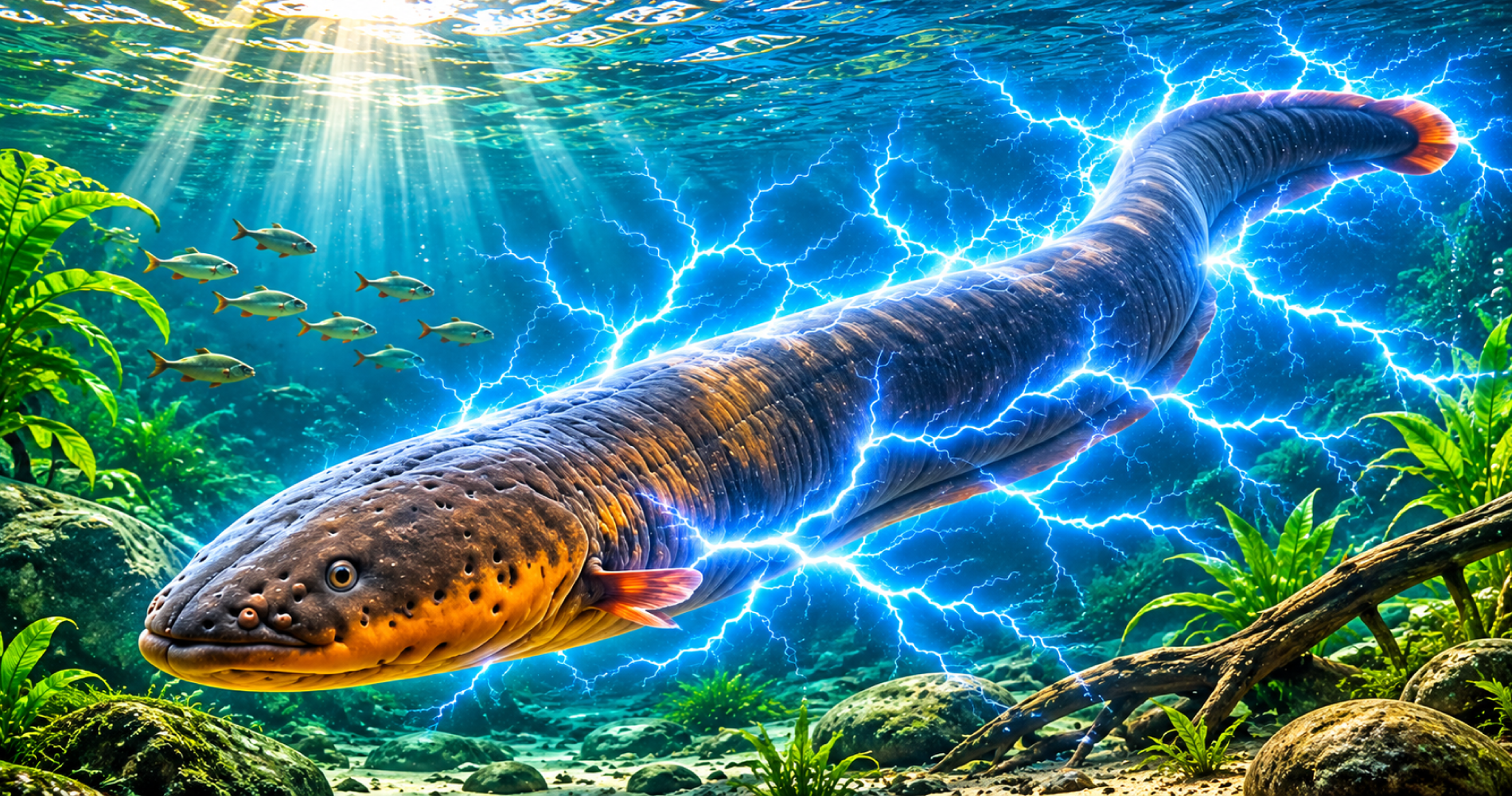
An electric eel capable of delivering an 860 Volt shock is not a fish from a fictional story. In 2019, Research recorded an electric discharge this high from Electrophorus voltai. But how does this fish produce electricity? Its body contains special Cells called Electrocytes, whose combined activity produces strong Electrical Pulses. In this article, we’ll explore how to identify electric fish, their habitat in the Amazon River Basin, their biological structure, hunting technique, and reproduction. We’ll also learn why 860 Volt does not mean a continuous Power Supply like household electricity.
Introduction: A fish in the water, electricity in its body
860 Volt. As soon as you hear this number, your mind turns to wires, electric poles, or a machine. Now imagine that same story of electricity unfolding in the murky waters of the Amazon. Fallen leaves surround it, roots lie beneath the water, and a fish swimming a short distance away is barely visible. In such an environment, a creature uses Electrical Signals from its body to find its way and catch prey.
This creature is the electric eel. It has no copper wiring and no ready-made Battery. Yet its special bodily structure allows it to release high-Voltage Pulses. Electricity is a means of attack for it, but that is not where the story ends. It also uses this ability to gather information about the world around it.
The question is not only how a fish generates so much electricity. The bigger question is how a living body made electricity such an important part of its life. To understand the answer, we first need to correct the mistake in that name, which we often take for granted as true.
1. What exactly is an electric eel—a fish, a snake, or a true eel?
With its long body and snake-like shape, it is easy to mistake it for a snake. Seeing eel in its name, it is also natural to assume it is a typical eel. But the electric eel is a fish and belongs to the group of Knifefishes. It is not a member of the group of True Eels.
Its long Anal Fin helps it swim. The wave-like movement of this fin, which runs along the underside of its body, allows it to maintain its position in the water. Reports indicate that large Electric Eels can reach about 2.5 meters in length. But not every species and every individual is the same size.
This distinction is essential to the entire story that follows. Applying information about typical eels directly to the electric eel leads to incorrect conclusions about its reproduction, habitat, and behavior. Looking alike does not mean being the same kind of animal. In nature, similar body shapes are found across many different groups.
2. Where in the Amazon River does this electric fish live?
When the Amazon River is mentioned, people often picture a very wide river. But the River Basin also includes tributaries, small streams, seasonal pools, lakes, and flooded forests. To understand the habitats of Electric Eels, we need to look at this larger aquatic system.
Descriptions place these fish in calm or slow-moving waters, muddy pools, oxbow lakes, and flooded forests. The ranges of the different Electrophorus species are not the same. So it is not correct to assume that every location found by searching for electric eel amazon river is home to all species.
Research in 2019 found that E. electricus is primarily distributed across the Guiana Shield, E. voltai across the Brazilian Shield, and E. varii across the lowland Amazon Basin. Referring to the Amazon in the title is a broad geographical reference; it would be wrong to think that the 860 Volt species is confined to the Amazon’s main channel.
Why does it breathe air even though it lives in water?
There is another special feature of its habitat—in many places, the water contains little dissolved oxygen. The Electric Eel comes to the surface to breathe air. The inner lining of its mouth has folds containing blood vessels, which help it take in oxygen from the air. So it is incomplete to think of it as an ordinary fish that breathes only in water.
This information is also connected to the question of generating electricity. Despite having such a specialized electrical system, its other biological needs do not disappear. It needs to breathe, needs food, and must keep its body’s energy system running. Not every movement of a creature emerging above the water is an attack; sometimes it is simply meeting a normal physical need. To understand the true meaning of a behavior, it is important to look at its context.
3. Who set the 860-Volt record?
A study published in Nature Communications in 2019 changed how Electric Eels were classified. Researchers studied genetic, physical, and geographic evidence from 107 specimens. The result was that a group long considered to be one species was found to consist of three species. Two of them were new to science.
Among them, Electrophorus voltai was recorded discharging 860 Volts. It was named in honor of Alessandro Volta, who is associated with the history of the battery. This discovery is a reminder that even a large, well-known animal may not be fully understood. The species diversity hidden within it can remain unnoticed for a long time.
Record means evidence obtained from instruments in a particular study. It should not be understood as the result of examining every fish in all the forests. Future Measurements will improve our knowledge.
These are the Measurements from that study, not the final biological limit for every species. A small sample does not establish a permanent maximum for all individuals of a species. This distinction is important when discussing electric fish voltage.
4. How electric eels produce electricity: the body’s actual mechanism
Now let’s get to the main question. Those searching the Internet for how electric eels produce electricity will find an answer that begins with one word—Electrocytes. These are specialized electricity-producing Cells derived from muscle. Their job is not to contract forcefully like ordinary Muscle Cells, but to provide Electrical Output.
The distribution of charged particles, or Ions, is not the same on both sides of their Membrane. This difference in Ions such as Sodium and Potassium is important for creating Electrical Potential. When a signal arrives from the Nervous System, the activity of the Channels present in the Membrane changes, producing an Electrical Pulse.
Electricity is not being created out of thin air here. Previously established and maintained Electrochemical Gradients come into play. In simple terms, the energy available in the uneven arrangement of Ions on either side of the Cell is converted into Electrical Activity. So rather than calling it a mysterious power, it is better to understand it as the body’s specialized Biological Engineering.
5. How do small Cells together produce such a high Voltage?
The Output of a single Electrocyte is very small. But thousands of such Cells work in an organized structure inside the body. The Voltages of components connected in Series add up, while a Parallel arrangement helps increase the capacity for Current. NIST has clarified this distinction in explaining the Electrocyte arrangement.
The example of multiple Cells in a Battery is useful here. A small Cell and the entire Pack made up of multiple Cells do not have the same capacity. In the Electric Eel’s body, too, what matters is the collective arrangement of the entire organ rather than any single Cell. At the same time, it is essential that Signals arrive at the right time.
If thousands of Cells activate independently at different times without coordination, their Output will not combine into a strong effect. The Nervous System is an important part of this Coordination. So the secret to generating electricity lies not only in the number of Cells; their orientation, structure, and synchronized activation are just as important.
6. Electricity is generated without a Battery, but where does the Energy come from?
The “without a Battery” part of the title is correct in the context of a human-made device. The fish does not have a Battery bought from a store inside it. But its body has a biological system for storing and using energy. So it would be wrong to interpret this as “electricity without any Energy Source.”
Active pumps work to maintain ion gradients in cells. Systems such as the sodium-potassium pump use the energy of ATP. Studies of the electric organs of electric eels have revealed the important role of proteins associated with sodium channels and sodium-potassium pumps.
This means, quite directly, that food and metabolism are the background to this ability. An organism uses the chemical energy obtained from food to power its body. Electric discharge is also part of that same energy system. A high voltage is not proof of getting energy for free. The fish does not generate electricity by breaking a scientific law; it operates a particular biological system within those laws
7. What do the three electric organs do?
Electric eels have three paired electric organs called the Main Organ, Hunter’s Organ, and Sachs’ Organ. Their functions are generally understood in terms of strong and weak electric discharges. A portion of the Main Organ and Hunter’s Organ contributes to strong discharges, while Sachs’ Organ and other parts of the Hunter’s Organ are associated with weak signals.
This arrangement allows the same body to use different outputs in different situations. It is not necessary to release the highest voltage every time to find a route. The needs of hunting and defense are different, as are the needs for gathering information about the surroundings.
However, this explanation of the organs is for general understanding. A figure given in older information about an aquarium should not be applied to every individual of all three species. The names and measurements used in scientific literature must also be considered in light of their dates. Before 2019, many studies used the name E. electricus broadly.
8. How does electricity help it navigate in murky water?
When there are leaves, soil, and roots in the water, it is difficult to find prey by relying on sight. The Electric Eel creates an Electric Field around itself. Nearby objects affect that Field, and electroreceptors in its body detect these changes. This is called Active Electrolocation.
Think of it as a kind of Electrical Sensing. The fish sends out a signal and reads the changes caused by objects around it. This is not like sonar sending out sound. Here, the medium is an Electrical Field, so it would be wrong to say the two processes are exactly alike.
Interestingly, the role of High Voltage is not limited to causing injury. A 2015 Research study showed Electric Eels using strong discharges to track fast-moving prey and conductors. The same ability serves both as a means of attack and as a way to gather information about their surroundings.
9. Affecting its Muscles without Touching the Prey
Understanding the Electric Eel merely as “a creature that eats fish by shocking them” greatly oversimplifies its Hunting Strategy. Kenneth Catania’s 2014 Science Research showed that High-Voltage Discharges activate the prey’s Motor Neurons. Its Muscles then Contract uncontrollably.
The effect is that a fleeing fish temporarily loses its normal movement. This gives the Electric Eel a chance to catch it. The prey’s Brain is not understanding an instruction and acting accordingly; its body is responding to external Electrical Stimulation.
The story is even more interesting when the prey is hidden. Electric Eels release two or three rapid pulses, causing the prey to twitch suddenly. That small movement signals its location. A swift attack follows. This behavior was revealed through experiments; it should not be considered proof of intelligence that presses a button deliberately in the human sense.
10. The Advantage of Bending Its Body Around the Prey
Sometimes it is not easy to catch large or struggling prey. In such cases, the Electric Eel bends its body and brings its tail to the other side of the prey. The prey is now positioned between its Electrical Poles.
Measurements showed evidence that the Electric Field Strength inside the prey was at least doubled. Repeated Pulses increase fatigue in its Muscles, making it easier to handle.
It would not be accurate to say, “the fish’s Voltage doubled.” The key point is that the intensity of the Field increases at the prey’s location. Changing the body’s position concentrates the effect of the same Electrical System. This example shows that an organism’s capabilities lie not only in its organ, but also in the behavior with which it uses it.
11. Do Electric Eels hunt together too?
For a long time, they were thought to be Predators that hunted mainly alone. But a study published in Ecology and Evolution in 2021 reported group hunting behavior in Electrophorus voltai. Groups of more than a hundred individuals were observed at one site in the Amazon.
Researchers recorded them encircling small fish, gathering them in one place, and attacking in groups. This changes the picture of the Electric Eel. Both solitary and group-hunting strategies emerge depending on the circumstances.
But it is important to avoid an appealing mathematical mistake here. If ten eels attack together, it would not be correct to add their 860-860 Volt and write 8,600 Volt. Electric Fields produced by different bodies in water do not automatically add together like Batteries connected in Series in a laboratory. The presence of a group Electrical Attack does not establish any such straightforward Voltage Calculation for the group.
12. Why does it rise above the water and deliver a shock?
The Electric Eel does not emit pulses from a distance only while underwater. When it senses danger, it also partially rises out of the water and makes contact with an object or organism submerged in the water. This Defensive Behaviour has been experimentally investigated.
As the upper part of its body rises above the water, the paths of the Current change. Direct contact helps increase the Electrical Effect on the target posing a threat. Catania’s studies analyzed the Circuit and Power Transfer that occur during this process.
This does not mean that Electric Eels are always looking to attack humans. The context for this behavior is defense. But touching one to test its Voltage or provoking it to make a video is not safe. There is a big difference between learning about an organism’s extraordinary ability and making yourself part of an experiment in front of it.
13. Why is comparing 860 Volts to household electricity incomplete?
Voltage indicates the Electrical Potential Difference between two points. Current tells us how quickly Charge is flowing. To understand Power and Energy, we also need to look beyond these at the duration of a Pulse and the Output over time. So a single Voltage figure does not give the full picture.
The Electric Eel emits short Electrical Pulses. It is not a system that provides continuous Output like a home’s Main Supply. The path the Current takes, the conductivity of the water, the distance, and the nature of the contact also affect the actual impact.
That is why neither “It is 860 Volts, so every encounter is deadly” nor “The pulse is short, so there is no danger” is the right conclusion. A shock causes pain, an uncontrolled reaction, and a risk of drowning. Institutions such as the National Aquarium use trained staff, monitoring, and protective measures when handling them.
14. Why doesn’t the Electric Eel’s own current harm it?
This is a perfectly natural question. The electricity is being generated inside its body, and the fish is in that same water. So why doesn’t it become incapacitated like its prey? The answer is not fully explained simply by saying “its skin is like rubber.”
The body’s structure, the electrical properties of its tissues, the paths taken by the current, the pulse’s short duration, and the potential difference that develops across different parts of the body are all relevant. Mandai’s explanation describes the role of short pulses and the path the current takes through the water.
Even so, not all aspects of self-protection are fully understood. Educational Reviews acknowledges this limitation. So absolute claims such as “it never feels its own shock” or “it is safe from every electrical current” should be avoided. The fish evolved with its own electrical system; that does not mean it is immune to unlimited electricity.
15. How do eels reproduce: the Electric Eel’s different story
When searching for how eels reproduce, two stories are often conflated. True eels such as the American Eel migrate to the sea to breed. According to the U.S. Fish and Wildlife Service, American Eels travel to the Sargasso Sea to spawn. This life cycle does not apply to the Electric Eel.
Male electric eels are described as making foam nests from saliva. The female lays eggs in them, and the male protects the developing young. Breeding is often said to be associated with the dry season. Smithsonian also makes clear that more research is needed on their reproductive cycle and spawning behaviour.
Different sources give different figures for the number of eggs. It would not be appropriate to present any one number as a definite rule for all three species. Much of the older information appeared under the broader name E. electricus, used before 2019. It is important to distinguish between what has been observed about reproduction and what remains to be investigated.
Young eels are not as capable as adults either. Weak electric organs play a role in early development, while the system associated with strong discharges develops later. So it is wrong to call every newly hatched electric eel a miniature 860-volt battery.
16. Can electricity for the home be generated from this fish?
Seeing the high voltage might inspire the idea of keeping many eels to run a small power plant. But they do not produce strong discharges continuously. They need food and suitable living conditions. Such a system would not provide free energy and would also create serious animal-welfare problems.
Real research imitates the fish’s principle rather than extracting electricity from it. A study published in Nature in 2017 demonstrated a soft artificial power source made from ion gradients and stacked hydrogels. It achieved an open-circuit voltage of about 110 volts.
This was not a household Battery or a ready-made Medical Implant. The study pointed toward a direction for flexible and potentially biocompatible power sources. Open-Circuit Voltage does not mean that the same continuous Output is available when connected to a load. Available Power and the limits of practical use are assessed separately.
Perhaps the most useful lesson from the Electric Eel is this: there is no need to take an organism from nature and turn it into a machine. Understanding its structure and how it works can point the way to better technology.
17. Five Myths and Facts About Electric Fish
| Myth | Fact |
| Every electric eel produces 860 volts. | The 860-volt record comes from a measurement of E. voltai. |
| An electric eel is a snake or a true eel. | It is a fish belonging to the knifefish group. |
| Electric eels do not need energy to generate electricity. | Maintaining ion gradients requires metabolic energy. |
| The voltages of ten electric eels can simply be added together. | Their electric fields in water do not behave like batteries connected in series. |
| All eels migrate to the sea to reproduce. | Electric eels belong to a different group from true eels that breed at sea. |
Understanding these distinctions does not make the story less thrilling. In fact, the scientific details make it even more interesting. An organism that turns energy from food into controlled Electrical Pulses, uses them to sense its surroundings, and catches prey with them is astonishing enough on its own. There is no need for false claims to make it seem miraculous.
Conclusion: Not Wires, but the Coordination of Thousands of Cells
The secret of the electricity hidden in the Electric Eel’s body lies in the coordination of Electrocytes, Ion Gradients, and the Nervous System. The 860 Volt record shows its capability, while the controlled use of its Pulses is what truly sets it apart. This fish does not use electricity only to catch prey; it also uses it to sense the world around it. This remarkable creature found in Amazon waters shows that when you study Biology closely, you find a whole story of Physics within it.
Disclaimer:
This article is for general scientific information. Do not try to touch, catch, or provoke Electric Eels. Electrical Output varies depending on the species, age, and measurement conditions.

Emanual Massey is a healthcare, lifestyle, and beauty content writer with over 7 years of professional experience. He specializes in writing SEO-optimized, research-based articles on health, wellness, nutrition, skincare, beauty, and Ayurveda. His mission is to simplify complex topics into practical, reader-friendly content that empowers people to make healthier lifestyle choices. Passionate about continuous learning and evidence-based writing, Emanual creates informative and engaging blogs that combine accuracy, readability, and search engine optimization.



One thought on “Learn the surprising story of the Electric Eel that lives in the Amazon jungle”