
Abstract: Where is the true strength of trees hidden?
In South America’s Amazon Rainforest, some trees are so tall that even multi-story buildings look small beside them. According to a study published in the scientific journal Science in 2013, the broader Amazonia region was estimated to contain around 390 billion trees. Researchers also suggested that there may be around 16,000 tree species here. This estimate was based on data collected from 1,170 forest study plots.
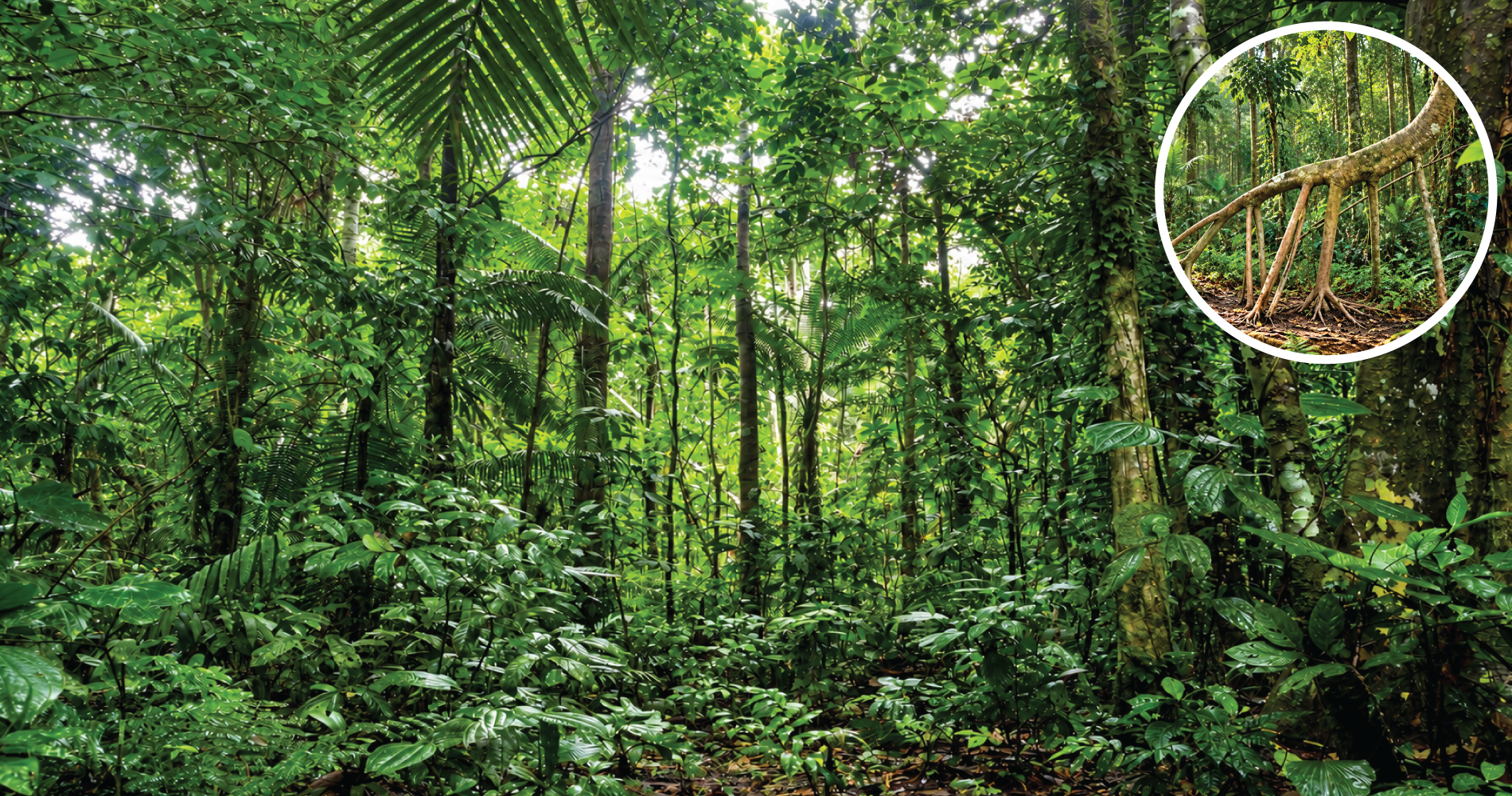
Many trees in these forests can grow 40 to 60 meters tall. Their branches spread far and wide, and their dense canopy of leaves prevents sunlight from reaching the ground. But how do such enormous trees remain upright for so long despite heavy rainfall, weak soil, and strong winds?
The answer lies not only in their strong wood, but also in the special structure of their roots, which spread both above and below the ground. Some trees develop broad, wall-like Buttress Roots, while plants such as the Walking Palm have Stilt Roots that emerge above the ground.
Scientific studies published in 1984, 1997, and 2007 showed that such roots can play an important role in trees’ mechanical stability, resistance to external forces, and vertical growth.
- But do all trees in the Amazon have such roots?
- Do all trees have deep roots? And can the Walking Tree really move from one place to another?
To answer these questions, we must first understand the Amazon’s forests and the conditions found there.
1. Amazon Rainforest: where survival is a competition among millions of trees
The Amazon Rainforest is one of the world’s largest tropical rainforest regions. It extends across several South American countries, with Brazil, Peru, Colombia, and Bolivia being the most prominent. In addition, Amazonian ecosystems are also found in parts of Ecuador, Venezuela, Guyana, Suriname, and French Guiana.
Across such a vast area, weather, soil, and vegetation conditions are not uniform. Some places receive extremely heavy rainfall throughout the year. Some regions also have a distinct dry season. Forests along rivers may experience regular flooding, while forests on higher ground may remain free from waterlogging for long periods.
Because of these conditions, rainforest trees have developed different adaptations. Some trees grow tall quickly, while others grow slowly and develop denser wood. The roots of some species spread near the soil’s surface, while others can reach several meters deep. This diversity is evident not only in the size of the trees, but also in the structure of their roots and trunks.
How many types of tree species are there in the Amazon?
In a study published in Scientific Reports in 2016, researchers analyzed records associated with 530,025 botanical specimens collected between 1707 and 2015. The study identified 11,676 recorded tree species in Amazonia.
The researchers reported that the actual number could be higher, and that the previously estimated figure of approximately 16,000 species was plausible. This number matters because, in a forest with such great diversity, a single type of root system may not be enough for trees to survive.
2. What poses the greatest challenge to the Amazon’s giant trees?
Simply being tall is a challenge for a large tree. As a tree grows taller, its trunk and roots may have to withstand greater weight and external forces. The branches and leaves spreading across the upper part of the tree are exposed to the wind. When strong winds blow, these branches sway, and their movement affects the trunk below.
In addition, rainfall and water in the soil can affect the stability of the roots. Another challenge is sunlight. In a dense forest, very little light may reach smaller plants. Some species therefore try to grow taller to reach areas with better light.
But greater height also means that the force exerted on a tree by the wind may increase. That is why trees must maintain a balance between height and strength.
3. Tree Roots: The natural structure that keeps trees upright
Tree roots are often considered merely organs that obtain water and nutrients. But their function is much broader than that. Roots anchor a tree in the soil. This process is called root anchorage.
When wind pushes a tree in one direction, it creates a bending force in the trunk. This force reaches the roots.
The combined resistance of the roots and soil helps prevent the tree from being uprooted. A pole’s foundation can serve as an example to understand this process. If a pole is tall and its foundation is weak, it can fall when subjected to external pressure.
But there is an important difference between a tree and a pole. A tree’s roots are alive. They grow, branch out, and can develop according to the water and nutrients available in the soil. The shape and spread of the roots, together with their relationship to the soil, affect the tree’s stability.
Do all roots support the tree equally?
No. Some roots are more active in absorbing water and nutrients. Other roots thicken and play an important role in providing mechanical support to the tree. However, in reality, a single root can perform several functions.
It is also not necessarily true that the longest root always provides the strongest support. The direction and thickness of the roots, the distribution of their branches, and soil conditions are also important.
4. What Are Buttress Roots, and Why Do They Develop in Large Trees?
Some of the larger trees in the Amazon have broad, triangular, wall-like structures at the base. These structures are called buttress roots. They are not like ordinary cylindrical roots. Broad wooden plates extend outward from the trunk.
In many species, they can reach several meters above the ground. These structures are especially common in large tropical trees. The kapok tree, whose scientific name is Ceiba pentandra, is one of the well-known trees with buttress roots.
Their shape can look like the supporting columns of a building. But this is more than just a visual similarity. Scientific studies have shown that buttress roots can contribute to a tree’s mechanical stability.
Key Functions of Buttress Roots
One important function of these roots is to handle forces transmitted from the trunk to the ground. When wind presses against a tree, tension and compression can develop at the base of the trunk.
The structure of buttress roots can help resist these forces.
Lateral roots connected to them and other roots that grow downward help maintain the tree’s anchorage in the soil. However, it is not correct to assume that a tree with buttress roots can never fall. Even trees with buttress roots can fall in very strong storms, in weak soil, when roots are damaged, or under other conditions.
5. The 1984 Scientific Study: Do Buttress Roots Protect Against Wind?
In 1984, Wayne Richter published a study in the journal Ecology. The study was titled A Structural Approach to the Function of Buttresses of Quararibea asterolepis. The research examined the buttress roots and other structural features of the tropical tree Quararibea asterolepis.
The researchers wanted to understand what kind of support these special roots actually provide. The study found that buttress development may be greater on the side of the tree facing the prevailing wind direction.
These structures appeared to play a role in strengthening the base of the trunk and resisting wind-induced pulling forces. According to the research, the size of the buttresses may also increase as the tree grows.
In particular, an increase in buttress height may help support the trunk against wind-induced stress. This study helped explain the structural importance of buttress roots rather than viewing them merely as an unusual botanical form.
6. 1997 Study: Are Trees with Buttresses Really Stronger?
In 1997, M. J. Crook, A. R. Ennos, and J. R. Banks conducted a comparative study of the roots of tropical trees. It compared the Root Anchorage Strength of trees with and without Buttresses.
The researchers studied the structure of the trees’ root systems and measured their resistance through mechanical tests.
The study recorded an average Anchorage Strength of approximately 10.6 kNm for trees with Buttresses. By contrast, the average capacity of the trees without Buttresses included in the study was approximately 4.9 kNm.
Anchorage Strength measured in the 1997 study
0 kNm3 kNm6 kNm9 kNm12 kNmTrees with Buttresses Trees without Buttresses These are measurements from a specific study, not an average for all trees in the Amazon. Source: Crook, Ennos & Banks, 1997. AGRIS
This meant that, in that particular study, trees with Buttresses had approximately twice the average resistance capacity. But an important scientific caveat is necessary here. This study was based on limited samples of different species. Therefore, it would not be correct to attribute this difference solely to the effect of Buttress Roots or to apply it to all Amazon Trees. Nevertheless, the results support the idea that buttress roots may be an important part of trees’ anchorage system.
7. Why aren’t Amazon trees’ roots so deep?
It is often assumed that the bigger a tree is, the deeper its roots go. But in the Amazon, the reality depends on different conditions. Many trees have large numbers of fine roots in the upper soil layers.
This may be because leaves, fruits, branches, and other organic matter continually fall onto the forest floor. As these materials decompose, they make nutrients available. In some soils, a large share of the nutrients is available in the upper layers. There, the growth of fine roots may be beneficial for obtaining nutrients.
The extensive spread of these roots also helps them obtain water and nutrients from the surrounding soil. But this does not mean that all Amazon trees have only shallow roots. Some Amazon Trees have roots that go deeper than eight meters
A study by Daniel Nepstad and his colleagues, published in Nature in 1994, shed light on the importance of deep roots in the Amazon. The researchers found that some evergreen forests in northeastern Pará can obtain water from depths of more than eight meters during the dry season. The study showed that deep roots may be important not only for keeping trees alive, but also for sustaining the forest’s water cycle.
This makes an important distinction clear. Shallow roots can be important for obtaining nutrients, while deep roots may provide water during long dry periods under certain conditions.
Both systems can exist in the same tree.
What is the relationship between the Amazon Rainforest and the Walking Tree?
There is a special natural relationship between the dense rainforests of the Amazon and the Walking Tree (Socratea exorrhiza). The Walking Tree, also called the Walking Palm, is found in the tropical rainforests of South and Central America, including the Amazon Rainforest. In these forests, the dense tree cover limits the amount of sunlight that reaches the ground. At the same time, heavy rainfall, varying soil conditions, and competition for light affect plant growth.
The most unique feature of the Walking Tree is its Stilt Roots, which emerge from the above-ground part of the trunk, spread downward, and support the tree. According to scientific studies, these roots may help the tree gain height and maintain stability with a relatively thin trunk.
Although the popular claim that this tree walks on its roots in pursuit of sunlight has not been supported by reliable scientific evidence. In fact, the Walking Tree is an interesting example of the specialized structures that plants have evolved to survive and adapt to the environment in dense forests like the Amazon.
8. Stilt Roots: How does the Walking Palm stand on roots above the ground?
An unusual palm is found in some tropical forests of the Amazon and Central America. Its name is Socratea exorrhiza. It is also known as the Walking Palm or Walking Tree. Its most distinctive feature is the long roots that emerge from the lower part of its trunk.
These roots emerge from the trunk some distance above the ground and angle down to reach the soil. They are called Stilt Roots. Their structure looks like a tripod or a stand with several legs.
These roots can form a supporting framework beneath the trunk. Thorny structures may also appear on some Stilt Roots.
But the actual function of these roots has been the subject of scientific debate for a long time. Some hypotheses linked them to waterlogged or sloping ground, while other scientists tried to explain their connection to height and stability.
9. 2007 Study: What Is the Real Function of the Walking Palm’s Roots?
In 2007, Gregory R. Goldsmith and Rakan A. Zahawi published a study on the Stilt Roots of Socratea exorrhiza. The research included a total of 80 trees at two Neotropical sites. The researchers compared trees growing on flat ground with those growing in areas with slopes steeper than 20 degrees.
They took measurements related to the number of roots, their height, the size of the Root Cone, and trunk growth.The results showed no clear differences, based on several measurements, in the Stilt Root structure of trees found on slopes and flat ground.
However, a positive relationship was observed between the number of roots, the size of the Root Cone, and vertical growth. The researchers suggested that Stilt Roots may help the tree gain height and maintain mechanical stability without developing a relatively thick trunk.
This could be beneficial in a dense forest, as gaining height may allow the plant to receive more sunlight. However, the study did not establish that the Walking Palm actually moves forward from its position.
10. Does the Walking Tree really walk through the forest?
The Walking Palm’s most famous claim is that it can slowly move from one place to another with the help of its roots. Some popular accounts say that when the tree gets more light in another direction, it grows new roots in that direction.
The tree supposedly then moves forward as its old roots die off. But scientific evidence does not accept this story as an established fact. The Walking Palm’s roots do grow, and their structure can change.
In addition, phenomena such as the trunk leaning and new roots growing can also be observed. But root growth cannot be considered equivalent to the entire tree walking across the ground. A 2010 field study conducted at the La Selva Biological Station in Costa Rica also examined hypotheses related to the Walking Palm’s movement, the direction of light, and the role of Stilt Roots.
The researchers found indications of structural advantages related to the ratio of its height to trunk thickness, but no reliable evidence that it regularly moves.
11. How do trees compete for sunlight in the Amazon?
In the dense Amazon rainforest, sunlight does not reach every plant equally. The branches of the large trees above form a canopy. This canopy can reduce the amount of light reaching the plants below. For smaller plants, obtaining enough light can become a challenge.
However, not all plants require the same amount of light. Some species can survive even in shady conditions. Other species can grow faster when they receive more light. When a large tree falls, it can create an empty space in the canopy.
This is called a light gap. Such a space allows more light to reach the forest floor. Some plants can take advantage of this and rapidly gain height. Research on the stilt roots of the Walking Palm suggests the possibility that its root system helps in the strategy of gaining height. However, this is not considered a proven advantage in every situation.
12. Can strong winds topple Amazon’s giant trees?
Yes. Large trees in the Amazon can also fall due to strong winds and storms. In fact, to understand the stability of trees, it is important to know the conditions under which they fail. A study published in Nature Communications in 2020 analyzed the causes of tree mortality in different regions of the Amazon.
According to the study, among the trees whose cause of death could be recorded, about 51.2 percent had broken trunks or had been uprooted with their roots. Many of these events may have been associated with strong winds and other mechanical processes.
Nature Communications
This does not mean that half of the living trees in the Amazon are about to fall. This figure referred to the causes of death among the dead trees recorded in the study. This makes it clear that no matter how developed a tree’s roots and trunk are, they too have limits when faced with extreme external forces.
Does a tree break or get uprooted?
Different conditions may be responsible for each outcome. If the trunk cannot withstand the force, it may break. But if the combined resistance of the roots and soil is insufficient, the entire tree may be uprooted along with its roots. Often, soil moisture, the condition of the roots, and the tree’s structure together determine the outcome.
13. How does Amazonian soil affect the stability of trees?
The strength of a tree’s roots and the condition of the soil are interconnected. The size and structure of the particles in the soil, its water content, and the presence of organic matter can affect how roots behave. In some types of soil, roots may spread easily.
But excessive waterlogging can change the mechanical properties of the soil. In such conditions, the risk of some trees being uprooted may increase. Conversely, excessively dry soil can also cause problems for a plant. Therefore, it is not appropriate to consider more water or deeper roots better in every situation. A tree’s stability depends on the relationship between the local soil and its Root System.
14. Is rain always beneficial for trees?
Trees need water, but excessive amounts of water can also be harmful in some circumstances. When soil remains waterlogged for a long time, the amount of oxygen available in it may decrease.
Roots need oxygen for normal respiratory processes.
A lack of oxygen can affect root function in some species. However, some tropical trees have developed special adaptations that allow them to tolerate waterlogging. For this reason, species in riverside forests may differ from those in upland forests. It would therefore be wrong to think of the Amazon as a forest with a uniform environment.
15. Can Climate Change Increase the Risk of Trees Falling?
Climate change is an important challenge for the Amazon Rainforest. Rising temperatures, prolonged droughts, extreme rainfall, and changing storm patterns can affect trees. In a study published in Nature Climate Change in 2019, scientists analyzed nearly five decades of monitoring records for more than 1,000 large trees in the Central Amazon.
The study found that the risk of tree mortality may increase after years with drought, heat, storms, and extreme rainfall. Some effects may persist even after a climate event. Nature Climate Change
This does not mean that all Amazon trees face the same level of risk.
Different species respond differently to temperature, water shortages, and soil conditions. But recurring severe climate events can change the structure of the forest. In such circumstances, it becomes more important to understand traits such as root types, trunk strength, and tree size.
16. When a giant tree falls, what changes in the forest?
The falling of a large tree in a dense rainforest is not merely the end of that tree. Its fall can damage the plants around it. But at the same time, it also creates an empty space in the canopy.
This allows sunlight to reach the ground.
Some smaller plants begin to receive more light, and their growth may accelerate. The fallen trunk gradually decomposes. Fungi, bacteria, and other organisms are involved in this process.
The decomposed material contributes to the cycling of nutrients.
Therefore, a natural treefall is part of the forest’s ecological processes. However, a tree falling naturally and large-scale deforestation are two different events. Deforestation can have major effects on wildlife habitats, the water cycle, soil, and carbon storage.
17. What Can Science Learn from the Giant Trees of the Amazon?
The study of tree roots is not limited to botany. The principles associated with them also spark interest in Biomechanics, Soil Science, and Structural Engineering. Buttress Roots show how the width and shape of a structure, and the distribution of forces, can affect its stability.
The Stilt Roots of the Walking Palm are an example of how some plants can balance height and stability with different types of supporting structures. However, developing engineering solutions inspired by such natural structures would require separate testing and scientific validation.
The behavior of tree roots and soil is not exactly the same as that of a building’s foundation. Nevertheless, studying nature can offer useful ideas for structural design.
18. Scientific Facts About Amazon Rainforest Trees
| Topic | Scientific Information |
|---|---|
| Estimated Number of Trees | Approximately 390 billion, according to a 2013 Amazonia-wide estimate |
| Estimated Tree Species | Approximately 16,000 species, based on scientific estimates |
| Buttress Roots | Contribute to mechanical stability in some large trees |
| Stilt Roots | Provide structural support in species such as the Walking Palm |
| Walking Palm | Socratea exorrhiza |
| Deep Roots | Evidence suggests that some Amazonian forests can access water from depths greater than eight metres |
| Impact of Storms | Strong winds and storms are major factors contributing to tree breakage and uprooting |
| Climate Change | Can influence the risk of tree mortality under various environmental conditions |
19. Common Myths and Scientific Facts About Amazon Rainforest Trees
| Common Myths | Scientific Facts |
|---|---|
| All giant trees have very deep roots. | Root depth varies depending on tree species and environmental conditions. |
| Buttress Roots are only decorative structures. | Scientific research confirms their role in providing mechanical support. |
| Walking Palms continuously move through the forest. | There is no reliable scientific evidence that Walking Palms regularly move from one location to another. |
| More rainfall always makes trees stronger. | Excessive waterlogging can negatively affect certain tree species. |
| A thick trunk completely prevents a tree from falling. | Tree stability depends on roots, soil conditions, trunk structure, and other factors. |
| All Amazon rainforest trees have the same root structure. | Different tree species develop different root architectures. |

Emanual Massey is a healthcare, lifestyle, and beauty content writer with over 7 years of professional experience. He specializes in writing SEO-optimized, research-based articles on health, wellness, nutrition, skincare, beauty, and Ayurveda. His mission is to simplify complex topics into practical, reader-friendly content that empowers people to make healthier lifestyle choices. Passionate about continuous learning and evidence-based writing, Emanual creates informative and engaging blogs that combine accuracy, readability, and search engine optimization.