
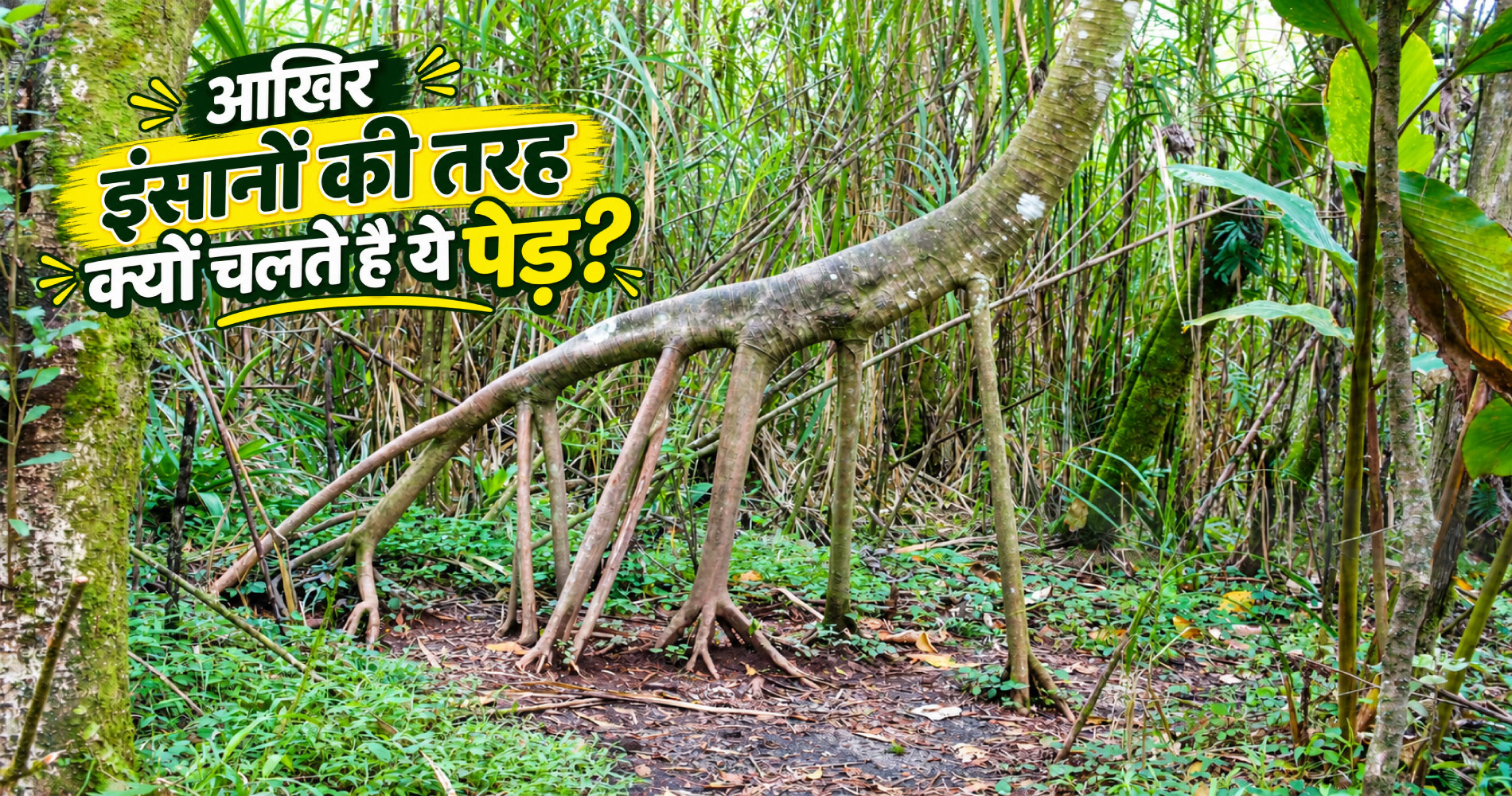
Do trees walk like humans? Discover the secret behind this

Walking tree

Abstract

In the dense rainforests of the world, many species of trees and plants are found whose structure is completely different from ordinary trees. One of these is Socratea exorrhiza, which is called the Walking Palm Tree. Its biggest feature is its long roots that emerge above the ground, which look like legs.
For this reason, the belief became popular that the tree can gradually move from one place to another by growing new roots. But do scientific studies support this claim? This article explains in detail the structure of Socratea exorrhiza, its natural habitat, the functions of its roots, the beliefs associated with it, and the scientific studies related to it.

1. What is Socratea exorrhiza?

Imagine that you are passing through a dense forest. All around you are tall trees, soil filled with moisture, and soft sunlight filtering through the leaves. Meanwhile, your eyes fall on a tree whose trunk, instead of touching the ground directly, stands supported by several long, slanting roots. At first glance, it seems that this tree has many legs. This tree is Socratea exorrhiza.
It is a tropical species of the palm family, whose scientific name is Socratea exorrhiza. It is commonly called the Walking Palm. It is mainly found in the humid tropical forests of Central and South America. The roots of ordinary trees are usually spread inside the soil. In contrast, some roots of this species emerge from the part of the trunk above the ground and extend downwards at an angle, entering the soil.
They are called stilt roots, that is, pillar-like roots that provide support. Their structure is so different that to the onlooker it seems as if the tree could move forward from its place at any moment.
However, its popular name and its actual scientific behavior are two different things. The tree’s roots do grow and change, but that does not prove that the entire tree walks.

2. Why is Socratea exorrhiza called the Walking Palm Tree?

The biggest reason behind the name Walking Palm Tree is the special structure of its roots. In most other trees, the lower part of the trunk appears directly attached to the ground. In Socratea exorrhiza, many roots emerge from the base of the trunk in different directions.
These roots remain in the air for some distance and then reach the ground. Their shape can resemble the legs of a standing person or long sticks resting on the ground. This is where the story of its walking began.
According to a popular belief, when the tree does not get enough sunlight around it, it develops new roots in the direction where there is more light. Gradually the old roots die off and the position of the tree changes.
This process is presented as the tree’s walking. In some popular stories and videos available on the internet, it is also stated that the Walking Palm Tree can move several meters forward every year.
But it is not correct to treat these claims as proof of actual movement.
Scientific studies show that the roots of this tree do undergo changes, but this does not lead to the conclusion that the whole tree roams around in the forest. Therefore, Walking Palm is a popular name, not a description of a proven ability to walk.

3. Where is Socratea exorrhiza found?

Socratea exorrhiza is mainly found in the tropical regions of Central and South America. According to the Plants of the World Online database of the Royal Botanic Gardens, Kew, its natural distribution extends from southeastern Nicaragua to the tropical parts of South America.

The countries within its natural range include:

  • Nicaragua
  • Costa Rica
  • Panama
  • Colombia
  • Ecuador
  • Peru
  • Bolivia
  • Brazil
  • Venezuela
  • Guyana
  • Suriname
  • French Guiana
In these regions, rainfall, temperature, soil moisture, and dense vegetation create a suitable environment for this species. The name of the Amazon rainforest is particularly often associated with this tree. However, it would be wrong to consider it limited only to the Amazon, because its natural range is much broader than that.
It develops in forests where vegetation exists at many levels. Small plants, shrubs, medium-height trees, and very tall trees can all grow in the same area. In such environments, there is competition for light. Plants close to the ground may receive limited sunlight due to the upper branches and leaves. To understand the structure of Socratea Exorrhiza, it is necessary to keep this natural environment in mind.

4. What is the structure of this tree like?

The external structure of Socratea Exorrhiza distinguishes it from many other palm trees. Its trunk is generally tall and relatively slender. Large, feather-like compound leaves emerge towards the top, while at the very bottom a cluster of roots is visible. Under favorable conditions, it can reach a height of about 20 meters or even more. Its size may vary according to different locations and the age of the trees.

Some of its key features are as follows

  • Tall trunk: The trunk grows upward and appears like a main pillar.
  • Special roots: The roots emerging from the base of the trunk spread around and anchor into the soil.
  • Leaves: Its leaves are large and compound. The leaves are divided into small units, forming a distinctive palm-like shape.
  • Upper part: The group of leaves remains concentrated in the upper part of the stem.
  • Reproductive structure: Like other flowering palm species, this too develops flowers and fruits.
Identifying this species only by its roots is not sufficient, because similar supporting roots can also be found in other palms. For correct scientific identification, the leaves, flowers, fruits, and other botanical characteristics are also observed.

5. Why are the roots of Socratea Exorrhiza so different?

The most interesting feature of this tree is its roots. In English they are called Stilt Roots. In Hindi they can be called pillar-like or supporting roots. Ordinary roots often emerge from below the stem and grow inside the soil, but some roots of Socratea Exorrhiza emerge from the part of the stem above the ground.
These roots grow downward at an oblique angle and, upon reaching the soil, support the body of the tree. This can create a cone-like structure beneath the tree. On the surface of many roots, a thorny or raised texture can also be seen.
Here an important question is why the tree needs such roots. Botanists have studied different possibilities for this. These include mechanical support, stem growth, and structural changes according to the surrounding conditions.
The most important scientific explanation related to these roots is that they may help stabilize the long and relatively slender trunk. This is why connecting the roots only with the idea of the tree “walking” gives incomplete information.

6. Does Socratea Exorrhiza really walk?

This is the most frequently asked question related to this tree. The scientific answer is that no reliable evidence is available that Socratea Exorrhiza moves from one place to another. However, some hypotheses were previously proposed to explain the possibility of its movement.
According to one idea, if a small tree is affected by a fallen trunk or some other obstacle, it may improve its position by developing new roots. With old roots weakening and new roots developing, it may appear that the tree’s location has changed. But a tree changing its inclination and its entire trunk shifting across the ground from one place to another are different processes.
Besides this, the growth of the tree can also change according to the surrounding light. Growth influenced by the direction of light is a common biological process in plants. This cannot be considered equivalent to the tree actually walking.
During its lifetime, the tree can develop new leaves and roots. Some old structures may also disappear over time. Even so, based solely on these changes, it would not be scientifically sound to say that the tree moves forward several meters every year. Therefore, the name “Walking Palm Tree” is certainly interesting, but it should not be taken as evidence of an actual ability to walk.

7. What do scientific studies say about Socratea Exorrhiza?

Scientists have conducted many studies on the roots of Socratea Exorrhiza. In these, they have specifically tried to understand what function its stilt-like roots serve.

Study from 2005:

In a study published in the scientific journal Biotropica, researchers examined the root structure of Socratea Exorrhiza and another palm species. The study included 36 Socratea and 31 Iriartea palms from two regions of Costa Rica.
The researchers found that the structure of the roots appears to be related more to the size of the tree than just to the slope of the ground. This indicated that the development of the roots may be related to the height and stability of the tree.

Study from 2007:

In research published in Revista de Biología Tropical, 80 trees of Socratea Exorrhiza were studied. Scientists compared the roots of trees growing on flat and sloping ground. This study also found a relationship between the structure of the roots and the vertical growth of the tree. According to the researchers, such roots may help the tree achieve height and remain stable without increasing the diameter of the trunk too much.

2010 regional study:

A study published in Dartmouth Studies in Tropical Ecology tested hypotheses related to the tree’s walking, light, and structural support. The researchers found that the texture of the roots may be related to the tree’s height and trunk thickness.
Field observations did not support the interpretation of actual walking. These studies make it clear that the tree’s special roots have scientific significance, but its alleged movement cannot be considered an established fact.

8. Does this tree change its place in search of sunlight?

In dense rainforests, sunlight does not reach all plants in equal amounts. The leaves of tall trees can block a large portion of the sunlight that reaches the ground. Because of this, plants growing below have to develop in limited light. Some plants can change the growth of their leaves or stems according to the available light.
This general information became the basis of a popular story related to the Walking Palm Tree. According to this story, the tree creates new roots in the direction where more sunlight is present. Over time, it abandons its old position and reaches a new place. But from a scientific perspective, there is a problem with this.
Greater growth in one direction of the tree is not proof that its entire body has shifted in that direction. Root growth, trunk bending, and changes in the plant’s overall position can be separate phenomena.
In a 2007 study, scientists suggested that special roots may help the tree take advantage of open spaces where light is available. This means that by gaining height, the tree can make better use of light. This does not prove that it moves on the ground to search for sunlight.

9. How far does Socratea exorrhiza walk in a year?

Many popular stories associated with the Walking Palm Tree mention its speed. Some claim that it can move a few centimeters per day, while others say that it can advance several meters in a year.
In some internet articles, it is even said to move up to 20 meters per year.
But such numbers should not be accepted as scientific facts. To measure the speed of the tree, it would be necessary to measure the position of its trunk relative to a fixed reference point over a long period. The distance covered cannot be determined merely from new roots appearing or old roots disappearing.
Similarly, photographs taken at different times are also not sufficient evidence, unless information about their position, angle, and scale is available. The scientific findings available so far do not support actual walking.
Therefore, it is not possible to state any verified annual walking speed of Socratea exorrhiza. The most accurate answer to this question is that there is no evidence that this tree moves a specific distance each year.

10. How do this tree’s roots prevent it from falling?

For any tall tree, staying stable is very important. The higher and heavier its upper part is, the more significant the effect of wind and other external forces can be. The roots of trees not only absorb water and minerals from the soil, but also serve to support them.
In Socratea exorrhiza, pillar-like roots emerge from the trunk in different directions. This creates a spread-out support at the base of the tree. To understand this, one can imagine an upright pole that is braced from several directions.
However, the actual structure of a tree is far more complex than this. Scientific studies indicate that its roots may help stabilize the trunk in proportion to its height. This can give the tree the opportunity to grow vertically with relatively less investment in developing a thick trunk.
But saying that these roots prevent the tree from falling in every situation would not be correct. Strong storms, soil erosion, disease, or other natural causes can affect any tree. Therefore, these roots should be seen not as a complete guarantee of safety, but as an important structural adaptation.

11. Can the Walking Palm Tree grow on swampy land as well?

In tropical rainforests, ground conditions are not uniform. In some places the soil remains constantly moist, while in other places water drainage may be relatively better. In many palm species, above-ground roots have been associated with wetter soil, the supply of air to the roots, and structural support.
But in the case of Socratea Exorrhiza, it would not be appropriate to consider any one cause as the final answer. Various scientific hypotheses have been proposed to explain the structure of its roots. Earlier it was also believed that such roots provide special advantages in waterlogged soil.
However, later studies showed that the shape of Socratea Exorrhiza’s roots cannot be explained solely by the slope or moisture of the ground. Studies from 2005 and 2007 found significant relationships between the size of the tree and the structure of its roots. This does not mean that soil conditions are irrelevant.
Rather, it means that many environmental and structural factors may be involved in the evolution of this species. That is why the scientific study of its roots is still a useful subject for understanding plant adaptations.

12. How different is Socratea Exorrhiza from other trees?

Socratea Exorrhiza can be easily identified by the structure of its base. In normal trees, the trunk appears directly attached to the ground, while in the Walking Palm Tree several major roots are clearly visible above the ground. Yet it is important to remember that supporting roots are not found only in this single species. Some other palms and tropical plants also develop similar kinds of structures.

Comparison Between a Normal Tree and Walking Palm Tree

FeatureNormal TreeSocratea Exorrhiza (Walking Palm Tree)
RootsMostly grow undergroundProminent roots also grow above the ground
Trunk BaseUsually directly connected to the groundSupported by stilt-like roots
SizeVaries depending on the speciesTall and relatively slender palm
Natural HabitatFound in different climatic regionsFound in humid tropical regions
Ability to WalkGenerally unable to move from one place to anotherActual walking has not been scientifically proven
Distinctive FeatureIdentified by leaves, trunk, and other characteristicsKnown for its prominent stilt roots
This comparison is for general understanding. The texture of roots and trunks of all trees is not the same. The real characteristic of Socratea Exorrhiza is not that it walks, but that its body develops with the help of special roots.

13. Do the roots of Socratea Exorrhiza change over time?

Yes, like any living plant, the roots of this tree also undergo growth and changes. Roots are not permanent, lifeless pillars. They are part of the plant’s living structure. New roots can develop, and old roots may become weak or inactive over time.
In young trees, changes in the number, length and position of roots can be seen during growth. This very characteristic sometimes makes stories of walking seem believable. Suppose new roots have developed on one side of a tree and some old roots on the other side have been destroyed.
Seeing this, one might guess that the tree is growing in the other direction. But for scientific study, assumption alone is not sufficient. It is also necessary to know how much and for what reason the trunk has actually shifted from its original place.
Changes in trunk height, inclination, and root length have to be measured separately from actual displacement. Research conducted on Socratea Exorrhiza helps in understanding these kinds of differences.

14. What is the relationship between this tree’s leaves and light?

Like all green plants, Socratea Exorrhiza also obtains energy through photosynthesis. In this process, plants use the energy of sunlight to produce organic substances like sugars from water and carbon dioxide.
For this, leaves play an important role. The large compound leaves of Socratea Exorrhiza are present in the upper part. In dense rainforests, the availability of light can constantly change. When the branch of a large tree breaks or a tree falls, an open space can be created in the upper canopy of the forest.
More light can reach down from such spaces. In scientific literature, these are called Light Gaps. The increased availability of light can affect the growth of surrounding plants. A long and slender stem with special roots can provide structural advantages in such an environment.
But even here, it is important to understand the difference between increasing the height of the tree and changing location. Developing taller to receive more light is a possible growth strategy.
Reaching light by walking on the ground is a separate claim, for which no evidence is available.

15. Why is Socratea Exorrhiza important for the forest environment?

In any rainforest, trees are not just structures made of wood and leaves. They are connected with many organisms around them and with environmental processes. Socratea Exorrhiza is also a part of its natural ecosystem. Its stem, leaves, fruits, and roots can form various kinds of relationships with the surrounding environment.
In the botanical records of the Royal Botanic Gardens, Kew, the food, environmental, and social uses of this species are mentioned. Its fruits can be a source of food for some wildlife. The decomposition of fallen leaves and other organic matter becomes part of the nutrient cycle in the forest.
Such plants also contribute to maintaining the vegetative diversity of the forest. There is diversity in the size, height, and root structure of the different species present in the forest. This very diversity creates different conditions for many kinds of organisms.
Therefore, the importance of a tree is not only due to its unique appearance. How it is connected to life processes in its natural habitat is equally important.

16. Do Socratea Exorrhiza have fruits and seeds?

Yes, Socratea Exorrhiza is a flowering plant in the palm family. It develops flowers for reproduction and then forms fruits and seeds. Seeds are an important part of the life cycle of plants.
Under suitable conditions, a seed can germinate and initiate the growth of a new plant. In tropical forests, the dispersal of seeds is influenced by many natural processes.
The seeds of some trees are dispersed by animals that eat the fruit, while in other plants, gravity, water, and other processes play a role. When understanding the natural life cycle of Socratea Exorrhiza, the development of its fruits and seeds should also be taken into account.
This is especially necessary because discussions about this tree on the internet almost always remain limited to its roots. Whereas for the scientific identification and conservation of any plant, its complete life cycle is important. How the tree develops, how it reproduces, and under what conditions its new plants can survive—these are all important questions in botany.

17. Are there local beliefs associated with this tree?

Communities living in the tropical forests of Central and South America have long recognized and used the vegetation around them. It is natural for a unique species to be associated with local names, experiences, and stories. With Socratea exorrhiza, the notion of a walking tree also became famous.
To understand this notion, it is enough to pay attention to the structure of the tree. The roots spread beneath its trunk look like the legs of a creature. When new and old roots at the base of the tree appear in different directions, the assumption of walking can become even stronger.
However, it is not correct to present every local story as the certified tradition of a particular community. To do this, reliable historical or anthropological sources related to that community and narrative are necessary. Therefore, it is better to understand the stories of the Walking Palm as a matter of cultural interest and natural curiosity.
They also show us that humans often try to understand nature’s unique shapes on the basis of familiar experiences. Similarly, scientific research provides an opportunity to examine these interesting notions.

18. How reliable are the videos of Socratea exorrhiza on the internet?

Today, the easiest medium to get information about any unusual natural phenomenon is the internet. But not every video on the internet is scientific evidence. In many videos and posts shared under the name “Walking Palm Tree,” it is claimed that the tree slowly moves forward in the forest.

19. Is Socratea exorrhiza found in India?

Socratea exorrhiza is not a palm that is naturally found in India. In the distribution records of the Royal Botanic Gardens, Kew, its natural occurrence is documented in countries of Central and South America. India is not included in that natural distribution list.
However, a plant not being naturally found in a country and it never being able to be grown there are different things. In many botanical gardens around the world, foreign species are planted in controlled environments. But this does not prove that Socratea exorrhiza is available in any particular garden in India.
For that, confirmation from the official plant-collection records of that garden would be necessary. In India too, many types of palms and tropical plants with special roots are found. Even so, seeing similar-looking roots in another palm and assuming it to be Socratea exorrhiza could be wrong. For correct identification of this species, matching the scientific name and botanical characteristics is essential.

20. Can Socratea Exorrhiza be planted at home?

Socratea Exorrhiza is not like a typical household potted plant. It is a tall palm that naturally grows in moist tropical regions. For it to grow healthily, it requires suitable temperature, sufficient moisture, space, and soil conditions.
Adequate space may also be important for the development of its special roots. In a small pot or limited indoor space, it would be practically difficult to maintain its natural size and structure.
Additionally, bringing a foreign plant into another country may require compliance with plant import, phytosanitary, and local regulations.
Environmental problems may also arise from extracting plants from forests for sale or purchase. Therefore, one should not decide to grow this species at home solely because of the attraction of its unique roots.
For those who want to see this tree, reliable botanical collections, educational material, and information about its natural habitat may be more useful. Before growing any foreign plant, it is appropriate to seek expert guidance and check its legal availability.

21. Is Socratea Exorrhiza in danger of extinction?

To understand the conservation status of any plant, it is necessary to look at its natural distribution, local populations, and habitat conditions. Socratea Exorrhiza is found in several Central and South American countries. In botanical records related to Colombia, this species has been listed in the Least Concern category.
However, the conservation status recorded in any one country should not automatically be considered the current situation for the entire world. It is also necessary to understand that the relatively wide distribution of a species does not mean that its habitat will always remain safe.
Deforestation in tropical forests, changes in land use, and other environmental pressures can affect many plants. The conservation of the natural habitat of Socratea exorrhiza is important not only for this species but also for other flora and wildlife. The popularity of this tree should be seen not merely as being limited to unique stories, but as an opportunity to understand the biodiversity of rainforests.

22. Conclusion: Is there really a walking tree in nature?

The story of Socratea Exorrhiza shows that the real characteristics of nature are sometimes more interesting than imagination. This tree is found in the moist forests of Central and South America. Its long, slanted roots that are visible above the ground make it different from many other trees.
Because of these roots, it is called the Walking Palm Tree. But according to scientific studies, there is no evidence that this species actually walks in the forest. Instead, research indicates that these special roots may be related to the height of the trunk, its growth, and mechanical stability.
Therefore, the right way to understand this tree is not just to ask whether it walks or not. A more important question is how the unique structure of its roots evolved, and in what way it helps in its natural life. Socratea Exorrhiza may not be a walking tree, but its structure is a remarkable example of the unique adaptations found in the plant world.

23. Disclaimer

This article has been prepared for general information and educational purposes. The information related to Socratea Exorrhiza is based on botanical databases and available scientific research. Conclusions regarding the tree’s growth, root functions, and conservation may change with new studies. Popular beliefs should not be regarded as equivalent to scientifically proven facts. For any decisions related to the identification, import, cultivation, or conservation of any plant, obtain information from relevant botanical experts and official institutions.

Leave a Reply

Your email address will not be published. Required fields are marked *