Abstract
On the night of the 1984 Bhopal gas tragedy, hospitals faced two crises at once. A sudden, large number of patients were arriving, and the doctors treating them had little information about the toxic exposure. Some could not open their eyes, some were coughing continuously, and a few patients were in severe respiratory distress. Available records give a picture of treatment amid crowded wards, limited resources, and uncertain medical information. Based on eyewitness accounts, ICMR reports, WHO descriptions, and medical literature, this article explains which decisions were most difficult that night and what subsequent research clarified.
A medical student’s first day, and the city’s most difficult night
Moira Sutcliffe arrived in Bhopal on 2 December 1984. The medical student from Bristol University had come to Hamidia Hospital for elective training in the paediatric department. She had spent only a few hours in the city on her first night when circumstances changed.
According to her account, published in the British Medical Journal in June 1985, the doorbell rang repeatedly at around half past one, and people troubled by severe coughing came inside. She herself also felt irritation in her eyes and throat. The full nature of the incident was not yet clear.
This is one eyewitness’s experience, not a minute-by-minute record of the entire city. Even so, it conveys the uncertainty of that night. The suffering was right there; the chemical behind it and the scale of the danger were still unclear.
In the previous article, we saw why a useful warning did not reach people in time. Now that same incomplete information had reached the hospital doors. Outside, people were searching for a safe place. Inside, medical teams had to decide whom to see first and whose breathing was most at risk.
Patients were in no condition to wait their turn
On ordinary days, a hospital treats patients with different illnesses. That night, people from a large area arrived at almost the same time with similar, but varying degrees of severe, problems.
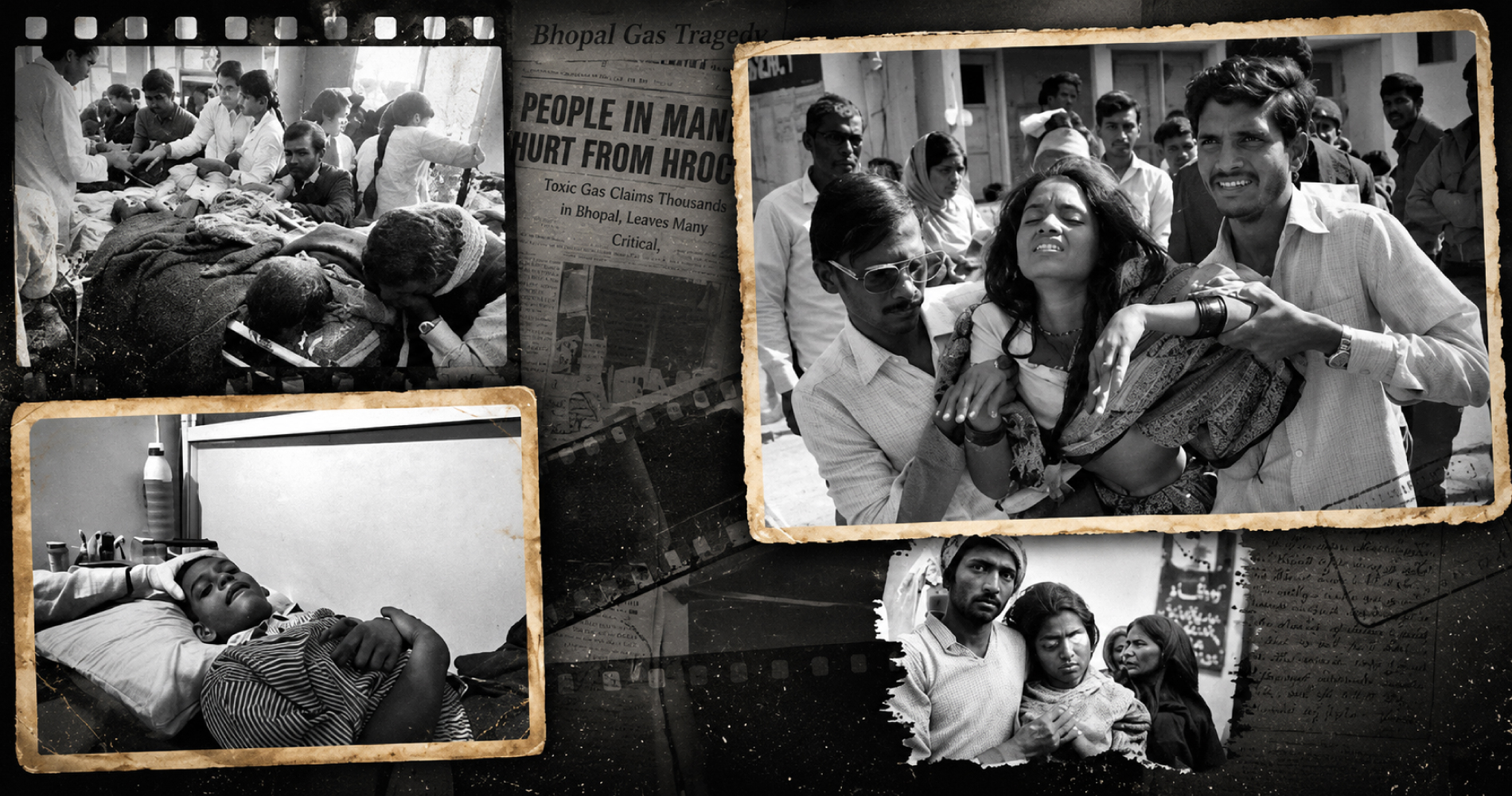
ICMR’s clinical report describes patients struggling to breathe, coughing, vomiting, and with swollen, watery eyes in hospital corridors. Some of them could barely see clearly.
Breathing distress alongside eye problems
Seeing eye irritation and assuming that only eye treatment was needed was not enough. The same person could also have a respiratory injury. While one patient could describe their problem by speaking, another nearby was struggling much harder to breathe.
So the problem was not just the large number of patients. It was identifying patients with different levels of severity quickly. Severe pain and an immediate threat to life are not always the same thing.
The hospital’s usual capacity was overwhelmed
A WHO chemical-incident document estimates that Hamidia Hospital treated around 15,000 people in the first 24 hours. The same account mentions providing treatment in the gardens outside the hospital building and additional doctors and medical students gathering there.
These are disaster-response estimates, not counts of individually and fully verified patient registrations. Even so, they show that the hospital had to handle people far beyond the scope of its regular work.
As the crowd grows, the meaning of space changes too. A corridor is both a passageway and a place to wait. Every new patient who arrives brings a need for assessment, time and some kind of resource.
What information did doctors lack?
When treating a toxic exposure, identifying the chemical is important. It helps explain possible injuries, effects that may emerge later and the monitoring required.
But in Bhopal, initial treatment began without all that information. According to the UK HSE assessment, hospitals did not have enough information about the gas involved and its effects. Emergency services were already under pressure from the number of patients.
Recognising distress and understanding its cause were different things
Doctors could recognise clinical signs such as breathing difficulties, eye injuries and worsening consciousness. But they had limited reliable experience of how illness would progress after a chemical exposure affecting such a large population all at once.
- Which patients would improve quickly?
- Who needed to remain under observation?
- Would lung injury worsen after some time? Such questions accompanied treatment throughout.
The ICMR pathology report also notes that the doctors initially lacked information about the nature of the gas and specific treatment. At the same time, it records their efforts to provide immediate help based on symptoms.
Knowing the name MIC wasn’t the whole picture
Methyl isocyanate, or MIC, was the main chemical. But the actual exposure also involved its reaction products. So the available information about pure MIC and a complete medical assessment of the mixture that reached people that night were not the same thing.
Those providing treatment at the time had to respond to the needs of the patients in front of them. It was not possible to delay treatment until the final analysis of every chemical contributor was available.
Which patient should be seen first?
When the number of patients exceeds a hospital’s capacity, the usual order is not enough. Triage is the name for this difficult need—setting treatment priorities based on patients’ condition and available resources.
Today’s WHO mass-casualty guidance identifies a sudden increase in patient numbers and inadequate resources as signs of such a situation. It prioritizes the medical intervention that offers the greatest benefit under the circumstances.
The first to arrive isn’t always the most critical
Someone may have walked in on their own, while a patient brought in later may need immediate breathing support. Likewise, someone able to complain loudly is not necessarily in greater danger than a quiet patient who is responding less.
This is a general medical principle. It does not support the claim that every hospital in Bhopal had the same formal triage protocol in place. The needs of that night should be understood within the limits of the available records.
Prioritization is not a one-time decision
A patient’s condition changes. They need to be reassessed after the initial assessment. In a major surge, this becomes difficult because staff are already attending to the next patient.
For this reason, the WHO hospital emergency checklist emphasizes having systems in place for triage, patient flow, alternative treatment areas, and reassessment. This is modern guidance; it helps us understand the challenge, but does not pass judgment on every bedside decision made in 1984.
The first goal of treatment was to support breathing and sustain life
There is no specific antidote for MIC exposure. But that does not mean there is no treatment. Supporting the airway, breathing, and circulation, assessing chemical injury, and providing respiratory care as needed are important.
The term supportive treatment should not be taken lightly here. In severe illness, supporting the body with oxygen and helping maintain essential functions can save lives.
Breathing problems involved more than just a cough
Chemical injury was affecting the breathing passages and lungs. In some patients, bronchospasm—that is, narrowing of the airways—was part of the problem. In severe cases, the lungs’ ability to exchange gases is affected.
With this kind of injury, simply reducing a cough is not complete treatment. The patient’s breathing, oxygenation, and changes in condition must be monitored. The scale of that need rising suddenly among thousands of people was one of the greatest medical challenges.
A medicine used in the past is not today’s advice
Records from that period mention different treatments, including bronchodilators, steroids, and eye medicines. But the historical use of a medicine does not prove that it was appropriate for every patient or that it should still be given in the same way today.
In particular, current ATSDR guidance describes the use of steroids for chemical pneumonitis and pulmonary edema as controversial. So past treatment should not be read as a modern prescription.
Staff and supplies were needed along with space
An empty bed does not by itself create treatment capacity. It also requires caregiving staff, medicines, oxygen arrangements, and time to see patients again. CSE reporting from 1984–85 mentions the initial chaos, the involvement of medical students, and some hospital personnel being affected by the gas themselves. This is reporting from the time; its observations should not be applied equally to every hospital in the city.
The people providing treatment were also in the same city
This was not an accident in a distant place where only injured people were being brought to a safe hospital. Medical teams were also part of the same affected urban environment. Staff safety and their ability to keep working became part of the response.
So bringing in additional teams was not simply about increasing the numbers. It provided support for personnel who were affected or exhausted and helped make it possible to continue treatment.
Supplies are also part of treatment
Health reports from that time describe the ongoing work of gathering medicines, bringing in oxygen from outside, and working across different treatment centres.
A large part of emergency medicine depends on this less visible work. A doctor may be with the patient, but if essential supplies do not arrive, clinical knowledge alone is not enough. On the other hand, delivering supplies alone cannot meet the need for trained staff.
What burden did the paediatrics department face?
In his BMJ account, Sutcliffe wrote that 1,337 children were admitted to the paediatrics department over the following two weeks, and 119 of them died. These are figures for the two weeks recorded in his account—not the whole city or just the first night.
Behind these numbers were families in different circumstances. While caring for a child, the condition of the accompanying adult also had to be monitored. Family members’ information and support are a practical part of treatment.
In his account, Sutcliffe also described the obstacles to providing help posed by an unfamiliar place, language difficulties, and limited local knowledge. His experience shows that even after outside assistance arrives, integrating it into an effective team cannot happen immediately.
That is why local staff play an important role in volunteer responses. They are familiar with the patients, the language, and how the hospital operates. On that foundation, people who come from outside can provide more useful assistance.
Why was monitoring still necessary even after some relief?
The end of exposure does not mean chemical injury ends at that moment. The effects of early swelling and tissue damage can continue to progress. That is why some patients’ condition may become serious later.
According to ATSDR, the onset of pulmonary edema after MIC exposure can be delayed by up to 72 hours in some cases. This does not mean this happens to everyone; it means that mild initial symptoms do not, by themselves, rule out serious exposure.
Crowds and the need for observation, face to face
When new patients are arriving on one hand and those already examined need monitoring on the other, the hospital’s burden cannot be measured by admissions alone.
Whom to keep, whose tests to repeat, and whom to instruct to return—these decisions depend on reliable information and available space. That night, chemical uncertainty made this work even harder.
Understanding the evolving illness remained
TIME reporting in December 1984 highlighted doctors’ concerns about secondary infections, especially pneumonia, among early survivors. This is an account from after the first night. In other words, the nature of the emergency changed over the following days. At first, there was immediate respiratory distress; later, questions about complications and recovery grew. The challenge of treatment did not end with the coming of morning.
What was the debate over sodium thiosulphate?
In discussions of Bhopal’s medical response, sodium thiosulphate, or NaTS, comes up. It was discussed in connection with cyanide-related toxicity and the role of the chemical mixture.
But treatment on the first night, later toxicological hypotheses, and the 1985 trials were events from different periods. To combine them and claim that a proven injection was available that could have prevented the entire tragedy would go beyond the evidence.
ICMR trials came later
The ICMR pathology report refers to a double-blind study conducted in late January 1985. The report concludes in favour of using NaTS, based on clinical improvement and changes in urinary thiocyanate. The same document discusses interpretations of later studies and notes that one trial was inconclusive.
This is a record of research, not a straightforward, universally accepted antidote story. There was disagreement over the chemical mechanism and the benefits of treatment.
What can be said clearly today?
Current medical guidance does not identify a specific antidote for MIC. When reading historical research on NaTS, it is important to keep both that fact and the complex mixture involved in the actual Bhopal exposure in mind.
This distinction does not make treatment any less necessary. Rather, it helps explain how important evidence, uncertainty, and the patient’s condition are to clinical decisions—even after a poison has been identified.
Why were patients’ records so important?
In a disaster, documentation presents a difficult challenge. Staff must focus on saving lives immediately, but information about what happened earlier is also needed for subsequent treatment.
Recording when patients arrived, where the exposure occurred, what symptoms they first had, and which medicines they received helps with follow-up. This need grows when patients receive treatment at multiple centres.
Why can’t the total number of patients be added up directly?
One report may count “patients seen,” another “admitted patients,” and a third “people who sought medical help.” These are not the same categories. The same person may also appear again at a different time or at a different centre.
That is why adding emergency estimates to arrive at an exact number of unique patients would be wrong. WHO’s historical account also describes the figure at the time as approximate.
From immediate treatment to systematic research
After its initial observations, ICMR’s clinical report describes systematic studies on respiratory function, radiology, pregnancy outcomes, children, and other health effects.
Responsibilities evolved. At first, the priority was to support the patients in front of them. Then came the task of understanding the pattern of illness, conducting follow-up, and preparing evidence to guide treatment. Both tasks were essential, but their pace and methods differed.
Doctors worked hard, and the system had limitations too
ICMR’s clinical account records how local doctors, Gandhi Medical College staff, paramedical personnel, and social workers quickly mobilised to provide medical relief. So it would be misleading to sum up that night by saying simply that “nobody understood anything.” At the same time, while recognising their efforts, it would not be right to overlook gaps in information, resources, and coordination.
A doctor can do their best based on the information available, while the response system they are working in remains inadequate. Both can be true at the same time. The purpose of examining the system is not to burden those working on the ground with all the information that emerged later. The question is what preparation, chemical information, and emergency support they should have received before such a situation arose.
What was the biggest challenge that night?
The sheer number of patients is not the whole explanation. Bhopal’s hospitals had to manage an enormous patient surge, incomplete toxicological information, limited resources, and changing clinical effects all at once.
The person in front of them needed treatment immediately. Research would have to find the answers later about how the illness would progress. Doctors had to work between these two demands.
The hospital story of the Bhopal gas tragedy cannot be reduced to a single secret antidote or one wrong decision. It shows people providing treatment, people mobilizing assistance, and health services stretched far beyond their capacity.
Perhaps that was the hardest part of that night—there was less information than needed, and less time than needed. Yet patients could not wait for the next answer.
Disclaimer
This article is based on eyewitness accounts, ICMR technical reports, WHO documents, and published medical guidance. The number of patients and some details of the early events are estimates or based on limited observations. Historical treatments and later trials are not presented as modern treatment advice. In the event of actual chemical exposure or severe breathing and eye problems, seek emergency medical help immediately.

Emanual Massey is a healthcare, lifestyle, and beauty content writer with over 7 years of professional experience. He specializes in writing SEO-optimized, research-based articles on health, wellness, nutrition, skincare, beauty, and Ayurveda. His mission is to simplify complex topics into practical, reader-friendly content that empowers people to make healthier lifestyle choices. Passionate about continuous learning and evidence-based writing, Emanual creates informative and engaging blogs that combine accuracy, readability, and search engine optimization.