

Abstract
The 1984 Bhopal gas tragedy began on a night when thousands of families in the city were asleep in their homes. Between December 2 and 3, poisonous gas escaped from the Union Carbide pesticide factory and reached nearby settlements. People’s eyes began to burn, they started coughing, and it became difficult to breathe. What exactly happened in one of the factory’s tanks? Why couldn’t the safety measures contain the gas? In this article, we will examine the events of that night based on government technical reports, industrial safety investigations, and medical research. Where there are disagreements about the death toll or any part of the accident, they are clearly distinguished.
A Night When Breathing Became Dangerous
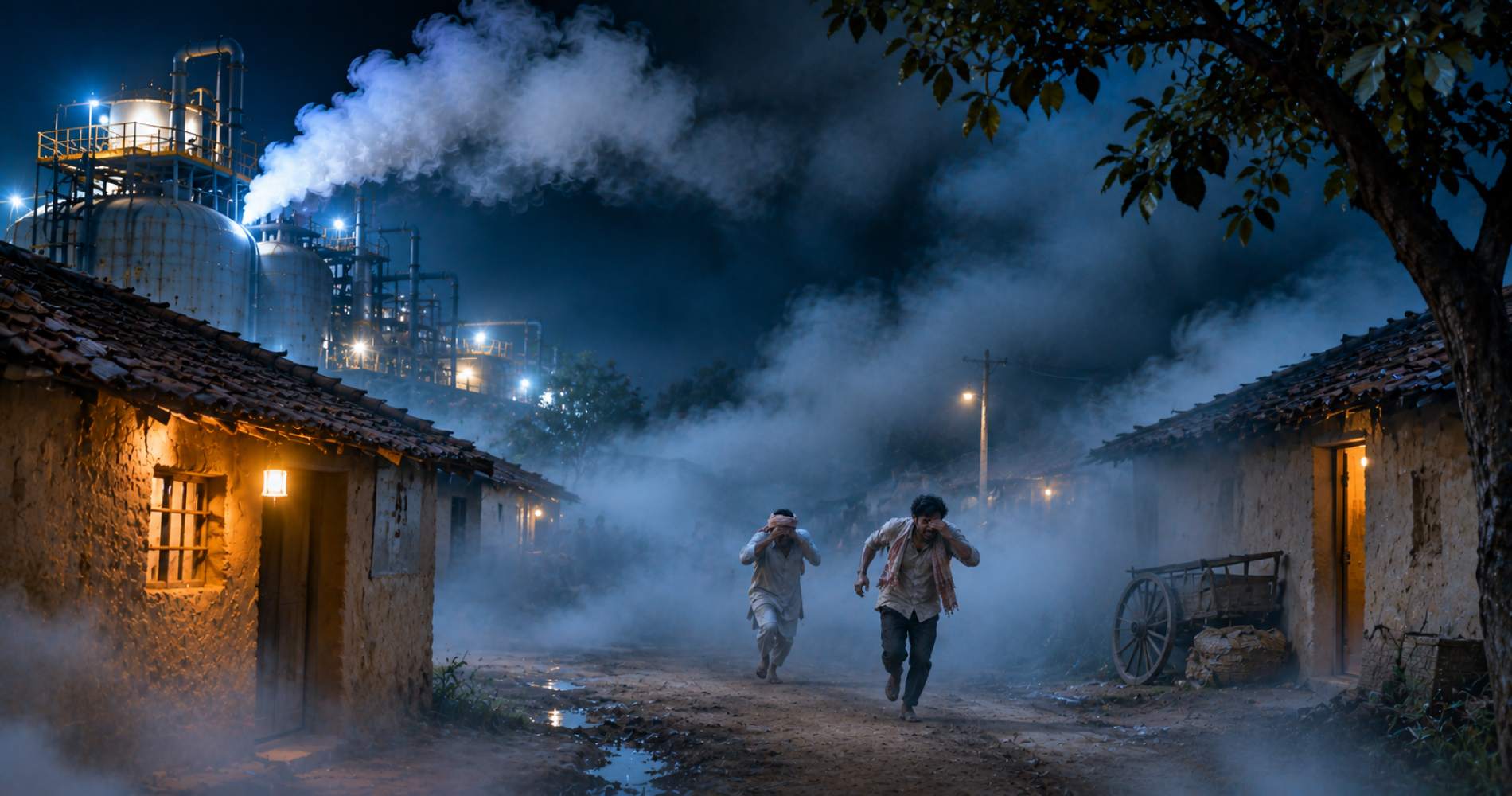
Imagine waking suddenly in the night and feeling as if someone had thrown chili powder into your eyes. The coughing is so severe that it is difficult to speak. You look for water, head toward the window, but even the air coming from outside offers no relief. That night in Bhopal, thousands of people woke to much the same distress. An ICMR report says people left their homes because of burning eyes, coughing, and suffocation. But poisonous air was waiting for them outside too.
No one knew which direction the danger was coming from. Was it safe to stay inside or to go out? Where should they take the children? How far away was the hospital? When all these questions confront an entire area at once, with no clear message to answer them, even attempts to escape turn into chaos.
When remembering that night today, one thing is often said—gas escaped from the factory and thousands of people died. But this single sentence conceals several important links. What happened between the gas being produced and escaping? What condition were the devices meant to stop it in? And why did the growing danger inside the factory not reach the people sleeping nearby in time? These questions reveal the true picture of that night.
What Is Bhopal Gas Tragedy?
What is Bhopal gas tragedy? The direct answer is: the large-scale release of toxic chemicals from the pesticide factory of Union Carbide India Limited, or UCIL, in Bhopal, the capital of Madhya Pradesh. The incident occurred on the night of December 2–3, 1984. So if you are searching for the Bhopal gas tragedy date, the correct reference is the night between the two dates; the main catastrophic events took place in the early hours of December 3.
The factory was operated by the Indian company UCIL, in which the American Union Carbide Corporation held a 50.9 percent stake. Pesticides used in agriculture were manufactured there. One important chemical involved in this production was methyl isocyanate, known by the short name MIC. The factory’s industrial operations and the everyday lives of the people living around it were closely intertwined.
The use of a hazardous chemical in a factory is not, by itself, an accident. The real questions concern its safe storage, monitoring, maintenance, and the protection of the surrounding population. This distinction is essential to understanding Bhopal. Focusing only on the chemical’s toxic nature does not tell the whole story; we also need to examine the condition of the systems meant to keep that danger under control.
Why Was Methyl Isocyanate Stored There?
MIC was not a finished pesticide. It was a chemical used midway through production, which was reacted with another substance to make a pesticide called carbaryl. It was kept in storage tanks at the factory. The main tank involved in the accident was E610, which contained about 40 tonnes of MIC, according to an ICMR report.
It is important to understand why the quantity matters. Keeping a small amount of a chemical on hand for a process and storing it in large quantities present different potential scales of accident. The larger the stockpile, the greater the responsibility for control and monitoring. Later engineering analyses also counted the large stockpile of MIC in Bhopal among the important factors that increased the risk.
Which Gas Was Released in Bhopal Gas Tragedy?
Which gas was released in Bhopal gas tragedy? The main answer is methyl isocyanate, or MIC. However, given the chemical reaction that occurred inside the tank, describing the toxic cloud that escaped as pure MIC alone does not give the whole picture. According to the ICMR, it also contained other substances produced by the reaction with MIC. That is why scientific accounts often use phrases such as “toxic gases” or “MIC and its reaction products.”
The word “gas” in the name creates a common misconception that MIC must always be stored in tanks as a gas. Under normal conditions, it is a highly volatile, colorless and flammable liquid. Its boiling point is about 39°C. This means that as the temperature rises, its conversion into vapor becomes very significant. But it would be wrong to explain the Bhopal incident solely by the heat of the weather or ordinary evaporation; a rapid chemical reaction took place inside the tank.
MIC is extremely harmful to the eyes and respiratory tract. Exposure to large amounts can cause severe lung injury. Its pungent odor is also not considered a reliable safety warning, because harmful exposure can begin before, or around the time, a person is able to recognize the smell. Therefore, a person’s failure to understand the danger in time was not simply a matter of carelessness.
That is why, when reading information about methyl isocyanate and Bhopal, it is not right to think of it as ordinary smoke. Visible smoke, an odor, and bodily harm—these three do not always occur in the same order. The need for sensors, alarms, and emergency communication in industrial safety arises precisely because of this difference.
What Happened Inside Tank E610?
The central event that night was water entering the tank. According to the UK’s Health and Safety Executive, or HSE, the water initiated a reaction with MIC that released heat. In scientific terms, this is called an exothermic reaction. However, uncertainty remains about the exact route by which water entered the tank. It would not be right to present this as a fully settled fact.
To understand this process, consider two things together. First, the reaction was generating heat. Second, the system designed to manage that rising heat was ineffective. The temperature kept climbing, and pressure inside the tank began to rise as well. In such conditions, the reaction can accelerate further because of the heat it generates. This uncontrolled process is called a runaway reaction.
This was not a simple matter like water boiling at home. A highly reactive chemical was present in a large quantity in an enclosed space. An unwanted substance entered it, and rapidly changing conditions increased the danger. ICMR’s technical assessment also links the accident to a runaway chemical reaction involving MIC and notes several safety shortcomings.
We should also be cautious about the popular phrase “the factory tank exploded.” HSE’s account describes the tank’s relief valve opening because of the increased pressure and toxic material escaping. In other words, a movie-like massive explosion was not necessary to devastate the city. The release of toxic vapors into the atmosphere alone proved catastrophic.
Was It Just Water Entering the Tank?
The entry of water explains how the reaction began, but it does not explain the entire disaster. The next question is: how did an initial failure turn into such a major accident? The purpose of a safety system is precisely to ensure that when one mistake occurs, the other safeguards prevent it from escalating.
Engineering investigations reveal many aspects, such as tank storage, equipment maintenance, employee training, changes to safety systems, and emergency planning. Therefore, the answer to what happened in the Bhopal gas tragedy cannot be reduced to “water got into the MIC.” There were several links in the chain of safety failures between the initial incident and its widespread consequences.
The Hours Before the City Woke Up
It is difficult to present the entire incident that night as an undisputed minute-by-minute record. Some times differ across accounts. Even so, technical reports make the main sequence of events clear: first, unusual conditions developed inside the tank, then the pressure rose rapidly, and finally the poisonous substance escaped. The danger to the city did not begin when people started coughing; it had begun earlier, inside the factory.
According to the HSE timeline, at around 11 p.m. on December 2, an operator noticed that the storage tank’s pressure was higher than normal, although it was still within its working pressure range. Around the same time, a report was also made of an MIC leak near the vent gas scrubber. Early warning signs were present, but the situation soon became far more serious.
At approximately 12:15 a.m. on December 3, an MIC release was reported in the process area. The tank’s pressure was rising rapidly. When they went outside to inspect, they heard noises coming from inside it and felt heat. These were not signs of normal operation. Events had reached a point where employees had very little time left to respond.
Understand its practical meaning. If a chemical is sensitive to temperature, cooling is no longer just a convenience. It becomes part of operational safety. When deciding to shut down such equipment, it is essential to check again under what conditions the rest of the system will remain safe.
The Scrubber and Flare Could Not Contain the Release
The vent gas scrubber’s job was to reduce the harm caused by escaping hazardous gas through chemical treatment. The flare system was intended to handle the gas by burning it in a controlled manner. According to the account of the Bhopal incident in France’s government industrial accident database, ARIA, the scrubber was not operational and the flare was also unavailable.
It is important to distinguish between having safety equipment installed in a plant and having it work when needed. The presence of a piece of equipment on an inspection checklist does not ensure safety. Its operational status, capacity, and actual maintenance condition matter.
Emergency Measures Also Had Limits
IChemE’s incident analysis mentions the ineffectiveness of the emergency water spray and the lack of a clear alert and evacuation plan for the surrounding community. In other words, the problem was not limited to containing the gas within the factory. Preparations to warn people outside about the danger and guide them to safety were also weak.
This is where the Bhopal gas leak of 1984 appears to have become a vast human disaster rather than simply an industrial accident. A hazardous substance escaped, the measures to contain it proved inadequate, and the people it reached did not have actionable information either.
What People Experienced Outside the Factory
ICMR’s clinical records show that amid the cold and atmospheric conditions that night, the toxic cloud spread across nearby areas. People suddenly began struggling with coughing, severe irritation in their eyes, and difficulty breathing. Exposure was not limited to those outside; families sleeping inside their homes were also affected.
Opening the door and running outside was a natural response. When it feels suffocating inside the home, the open air seems like the first refuge. But the problem here was not just the air inside the home. The surrounding environment had become contaminated. That is why the victims’ actions cannot easily be judged as right or wrong in hindsight, based on information that became available later.
It is also important to note that people’s exposure was not the same. Distance from the factory, the cloud’s path, the layout of the area, and how long a person remained in that environment all made a difference. Living in the same city does not mean inhaling the same amount of toxic gas. Later epidemiological studies also divided the affected population into groups with different levels of exposure severity.
The story of that night often includes a short phrase like “people started running.” But behind it lay a profound helplessness: people could sense the danger, but could not understand it. By the time they received accurate information, their bodies had already begun signaling it.
What Did the Gas Do to the Human Body?
Irritation in the eyes was not merely discomfort. Contact with the toxic substance was damaging the surface of the eyes and the airways. In cases of severe exposure, inflammation and fluid can build up inside the lungs, a condition called pulmonary edema. This makes it difficult for the body to get enough oxygen.
During normal breathing, air reaches the lungs and oxygen passes into the blood. When the lungs suffer chemical injury, this entire process is disrupted. The person tries to breathe, but despite the effort, the body’s needs are not met. So “suffocation” here was not merely a description of fear or panic; it was accompanied by serious physical injury.
ICMR’s pathological studies identified conditions such as acute lung injury, chemical pneumonia, and acute respiratory distress as causes behind the immediate deaths. In some cases, the lack of sufficient oxygen also had severe effects on other organs. This helps explain why exposure to the toxic cloud became fatal so quickly.
For hospitals, the challenge was not only the number of injured people, but also the lack of information. According to HSE, during the initial response, hospitals did not have adequate information about the gas involved and its effects. On one hand, patients kept arriving; on the other, there was a need to understand the chemical nature of the incident. This was not a situation like the routine treatment of a previously identified illness.
No specific antidote is available for MIC. Medical management primarily involves removing people from the exposure and supporting breathing and circulation. It is important to understand this, because claims that a single secret injection or simple home remedy could have stopped the entire tragedy misrepresent the real medical challenge.
How Many People Died in Bhopal Gas Tragedy?
How many people died in the Bhopal gas tragedy? To answer this, we must first ask: deaths over what period, and according to which record? Deaths in the first few days, deaths caused by gas-related illnesses later on, and death cases accepted for compensation are not the same figure.
The ICMR clinical report mentions more than 2,000 deaths in the first three days. On the other hand, a medical review published in 2005 puts the number of immediate deaths at at least about 3,800. These differences show that even the number of early deaths is not consistent across all sources. Writing any one figure as the final truth without context would therefore be misleading.
The Supreme Court’s 2023 judgment mentions 5,295 death cases in the context of the central government’s arguments in its curative petition. This figure relates to claims presented in court and the discussion of compensation. It would be wrong to describe it as the number of people who died that night alone.
Amnesty International has given much higher estimates of deaths, combining the immediate aftermath and subsequent years. Its 2009 information estimates 7,000–10,000 deaths in the immediate aftermath and approximately 15,000 additional deaths over the following twenty years.
These estimates relate to a different basis and period than government compensation records. Amnesty International The most responsible conclusion is that thousands of people died in the early period, and health-related harm continued afterward. But there is no single figure for total deaths on which all major sources agree.
Accepting this uncertainty does not diminish the tragedy; it means presenting the record honestly.
Did the Disaster End When the Gas Dispersed?
The injuries to the body do not end just because morning comes and the amount of gas in the air decreases. Surviving that night and being completely healthy afterward are two different things. This is why treating the Bhopal gas tragedy as an event lasting only a few hours leaves the survivors’ story incomplete.
A study published in the Public Health journal in 2020 analyzed respiratory morbidity data from 1986–2016. It found that chronic breathing problems persisted for decades among people affected by the gas. Both the severity of exposure and age at the time of the accident were associated with subsequent health outcomes.
Another study in 1996 compared exposed and unexposed people. Groups with greater exposure reported more respiratory, neurological, and mental health problems. Some findings also matched clinical test results. This matters because it was not enough to explain all later problems as merely fear, rumor, or normal aging.
The mental health aspect is also important. The sudden threat to life, deaths in the family, illness, and the disruption of everyday life become a long-term burden. A 2014 review drew attention to the serious gap between the mental health needs of Bhopal survivors and the care available to them. Limiting the response to the disaster to lung examinations makes it difficult to understand a person’s full experience.
What Does Research Say About Children Exposed Before Birth?
A study published in BMJ Open in 2023 examined the later health and educational outcomes of children who were in the womb at the time of the disaster. Researchers used population survey data, birth year and geographic information to make comparisons. Associations were found in some male cohorts with disability, cancer and lower educational attainment.
But this should not be taken as grounds for saying that genetic damage has been proven in the next generation of every affected family. The study had its own limitations: the actual chemical dose received by each individual was not measured directly, and exposure was assessed on the basis of groups and locations. The results point to the need for further monitoring and research; they do not support a uniform conclusion about every child.
Why Compensation Did Not Close the Story
In 1985, the Government of India passed a special law to handle victims’ claims. Later, under a settlement linked to the Supreme Court in 1989, an amount of 470 million US dollars was set. On 14 March 2023, the central government’s curative petitions seeking additional compensation were dismissed. This was an important decision in the long legal proceedings related to compensation.
But a legal settlement and a family’s life getting back on track are not the same thing. Working while ill, taking time for treatment, changes in family income and care needs—these experiences cannot be fully captured in a single payment. That is why, in discussions of Bhopal, the question of justice goes beyond the amount of compensation.
In 2010, seven former Indian officials associated with UCIL were convicted in a case of death by negligence. The verdict also prompted widespread dissatisfaction over the punishment and accountability. So to say that the entire tragedy was settled as soon as a court delivered its verdict does not accurately reflect the demands and experiences of the victims.
What That Night Still Teaches Us
The most serious lesson of the Bhopal gas disaster is that safety goes beyond arrangements written down on paper. Equipment must work, employees must recognize unusual signs, and people living nearby must know what to do when they receive an emergency message. For this reason, engineering reviews have emphasized the central importance of maintenance, training, risk identification, and community planning.
It is also important to remember another distinction: the MIC gas released in 1984 and the long-term chemical waste problem associated with the factory are not the same thing. MIC reacts and breaks down in the environment and water. Therefore, it would be scientifically wrong to explain every environmental concern decades later by saying that “the gas from that night is still present today, unchanged.”
Remembering Bhopal should not mean merely repeating a horrifying number. The question is also how much an ordinary family living near a hazardous industry knows about its safety. Who will warn them? Where will the hospital get chemical information? And who will take responsibility for the decision to shut down a safety system?
Conclusion: What Really Happened That Night?
The reaction that began when water entered tank E610 that night caused the temperature and pressure to rise. A toxic substance escaped and spread into nearby populated areas. Safety measures involving cooling, gas treatment and emergency response failed to prevent it from becoming a massive human disaster. This is the main scientific and technical picture of what happened.
But the 1984 Bhopal gas tragedy was more than just a chemical reaction in a tank. On the other end were sleeping families who felt its impact before they could understand the nature of the danger. For many people, surviving until morning did not mean returning to their old lives. To understand that night properly, we must consider chemistry, safety and human experience together.
Disclaimer:
This article presents information based on historical, technical and medical sources. Sources differ on the number of initial deaths, subsequent deaths and some circumstances of the accident; the article clearly identifies these differences. The health information is not advice for individual diagnosis or treatment.

Emanual Massey is a healthcare, lifestyle, and beauty content writer with over 7 years of professional experience. He specializes in writing SEO-optimized, research-based articles on health, wellness, nutrition, skincare, beauty, and Ayurveda. His mission is to simplify complex topics into practical, reader-friendly content that empowers people to make healthier lifestyle choices. Passionate about continuous learning and evidence-based writing, Emanual creates informative and engaging blogs that combine accuracy, readability, and search engine optimization.

3 thoughts on “Bhopal Gas Tragedy 1984: What Really Happened in the City That Night?”