Abstract
The main chemical in the poisonous cloud released during the 1984 Bhopal gas tragedy was methyl isocyanate, or MIC. But treating it as pure MIC alone would give an incomplete picture. Reactions inside Tank 610 produced other substances as well. The most evident effects of this exposure on the body appeared in the eyes and respiratory system. The surface of the eyes was injured, the airways became inflamed, and in severe cases, the lungs’ ability to transfer oxygen into the blood was affected. Based on medical guidelines, ICMR reports and peer-reviewed studies, this article explains how the damage occurred and which questions research can still answer only to a limited extent.
The eyes were burning, but the danger was not limited to the eyes
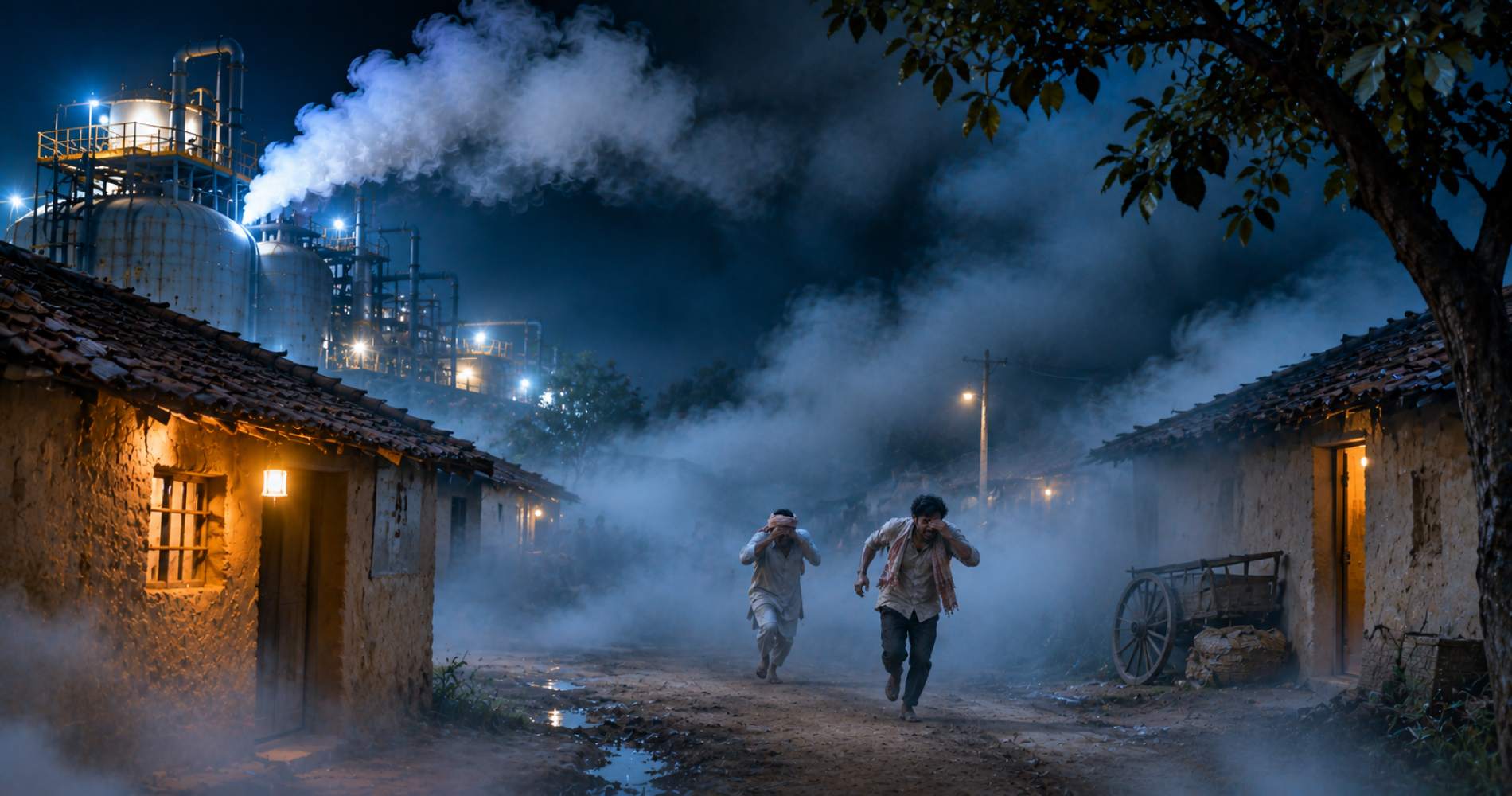
In the previous article, we examined the chemical reaction that took place inside Tank 610. After the temperature and pressure rose, the poisonous substance escaped from the factory. The question now is what happened when the air around residents came into contact with their eyes and breathing passages.
That night, people experienced severe eye irritation, persistent coughing and difficulty breathing. ICMR’s clinical and pathological reports link these symptoms to serious chemical exposure. It would therefore be wrong to dismiss them as mere panic or a reaction to an unpleasant smell. The body’s surfaces and lungs were sustaining actual injury. icmr.gov.in
An important distinction matters here. Watery eyes cause immediate discomfort, but the full extent of an injury developing inside the lungs is not understood as quickly. Even when someone appears to be breathing normally, their body may be struggling to get enough oxygen.
To understand Bhopal’s toxicology, we must follow this same path—first identify the chemical, then how it contacted the body, and after that, the effects of the injury.
Which gas leaked in Bhopal?
Which gas was released in Bhopal gas tragedy? The main answer is methyl isocyanate, or MIC. It was an intermediate chemical used in pesticide production. This means it is reacted with other substances to produce the final product.
MIC is a colorless, flammable liquid that readily forms vapour. At normal atmospheric pressure, its boiling point is about 39°C. So the presence of liquid in the tank and the spread of its vapours into the atmosphere are not contradictory. The term “gas leak” does not mean that the entire substance was stored as a gas in the first place.
MIC and methyl cyanide are not the same
Even when chemical names sound similar, the substances may be different. Methyl isocyanate should not be mistaken for another name for methyl cyanide or hydrogen cyanide. NIOSH identifies MIC by the formula CH₃NCO and CAS number 624-83-9. Methyl isocyanate
This distinction is not just about correcting a name. Different chemicals harm the body in different ways, and their medical management also differs. Misidentifying the chemical while trying to understand a tragedy can undermine the entire explanation that follows.
If the main chemical is known, why is the rest of the mixture important?
Because the substance released from the tank in Bhopal was not pure MIC kept in a laboratory bottle. Uncontrolled reactions had taken place inside it. According to ICMR, the toxic material released into the atmosphere also included other substances formed through reactions with MIC.
Therefore, it is important to distinguish between two different kinds of research. The first explains how toxic MIC itself is. The second describes what happened to people exposed to the mixture released in Bhopal. They help explain each other, but they are not exactly the same.
How was MIC different from the other reaction products?
The reaction in Tank 610 converted some of the MIC into other compounds. A complete individual record of which substances were present in the cloud that escaped, in what quantities, and how much each person inhaled is not available. That is why it is difficult to attribute a definite share of every illness to any one compound.
The ICMR pathology report discusses the possible presence of MIC, substances formed when it broke down in water and heat, and other reaction products. This shows the complexity of the mixture; it does not, by itself, establish the quantity of every possible compound.
Did hydrogen cyanide also play a role?
There is disagreement in the medical literature on this question. Some ICMR investigators argued in support of cyanide-related toxicity, based on blood cyanide levels and pathological findings. On the other hand, a 1987 respiratory review did not consider the suspicion of early acute cyanide poisoning to be supported by subsequent investigations.
Therefore, claims such as “all the deaths were caused by cyanide” or “other chemicals played no role”—both are more certain than the evidence warrants. The clearest medical evidence points to chemical injury to the eyes and respiratory tract, and severe lung damage.
Here, uncertainty does not mean doubt about the harm. The question is which chemicals contributed to it. A toxic mixture can clearly have severe effects, while it may be difficult to measure the separate contribution of each ingredient.
What does MIC do when it comes into contact with the body?
Toxicology is the study of the harm caused by substances. It does not look only at the name of a chemical. Its concentration, the duration of exposure, the route by which it enters the body, and a person’s health are also important. ATSDR’s toxicology information explains the effects of exposure on the basis of these factors.
Exposure to MIC through inhalation affects the respiratory system. Direct contact with its vapours can also injure the eyes. Very high exposure can also cause skin damage. NIOSH lists the eyes, skin, and respiratory system as its primary target organs.
The story of a reaction with moisture alone is not enough
An easy explanation is often heard that MIC came into contact with the body’s moisture and that alone caused all the damage. Its reactivity with water is important, but biological toxicity is more complex than that.
According to ATSDR, all of MIC’s toxic mechanisms are not fully clear. The role of chemical modification with globin and other proteins is possible. So it would not be scientifically correct to reduce it to a single simple reaction.
Why was the effect not the same on everyone?
The actual exposure of two people living in the same area can be different. One may have spent more time in contaminated air, another may have been reached by a lower concentration, and someone may already have had a respiratory illness. So “came into contact with the gas” by itself does not tell the full dose.
Why did such a severe burning sensation occur in the eyes?
The eyes remain in direct contact with the environment. The transparent surface in front of them is called the cornea. It is not only a protective layer; it also helps focus light properly. According to the National Eye Institute, a deep injury or scarring of the cornea can affect the ability to see.
In MIC exposure, effects such as eye pain, watering, sensitivity to light, swelling of the eyelids, and corneal injury are seen. Medical management guidelines also mention the possibility of long-term eye damage after severe exposure.
Tearing does not mean the danger has been washed away
Tears from the eyes are a response to irritation. But continuous exposure to toxic vapours does not make tearing enough protection. Chemical injury is not just a feeling of discomfort; it can also cause real damage to the surface of the eye.
This difference is also understood in common chemical eye injuries. Ophthalmology guidance gives importance to the clarity of the cornea, surface damage, and vision when assessing the severity of the injury. Simply asking whether the burning has lessened No, it does not replace a full examination.
Was everyone’s eye injury permanent?
No. The outcome was not the same for every exposed person. Some people’s superficial injuries healed, while some people continued to have problems for a long time. So it would be wrong to describe all survivors as permanently blind.
A study published in 1987 examined the eyes of 1,140 people from the affected community and used a non-exposed community for comparison. The researchers recorded problems such as chronic conjunctivitis, reduced tear production, and corneal opacities.
In a follow-up study in 1990, eye irritation, eyelid infection, and reduced visual acuity were found more often among exposed people. There were also observations related to cataracts, but the authors noted limits in how they interpreted them. This research shows that recovery from the initial injury and the complete disappearance of all later eye problems are not the same thing.
What was happening in the airways?
The air we breathe goes from the nose or mouth through the trachea and then to the branching airways of the lungs. Toxic vapours come into contact with the surfaces of this pathway. With MIC, cough, chest discomfort, breathing difficulty, and asthma-like respiratory effects have been documented. ICSC: 0004
Here, the cough was not just a sign that there was something in the air. Chemical irritation and tissue injury were affecting the breathing passages. In severe exposure, the problem extends beyond the larger airways to the smaller passages and the gas-exchange surface of the lungs.
Bronchospasm: the passage becomes narrower.
Bronchospasm means the muscles around the airways contract. This narrows the passage for air to move in and out. If swelling and secretions are also present, breathing becomes even more difficult.
That is why a whistling sound while breathing, chest tightness, and breathlessness should not be seen only as a result of panic. Clinical descriptions of MIC respiratory injury mention bronchial spasm and asthma-like effects.
Why can problems in the small airways be missed?
A little improvement in breathing is not proof that the entire respiratory system has recovered. The large and small airways can behave differently. Some injuries are not as obvious during normal conversation or at rest as they are when you are exerting yourself.
Follow-up research published in 1992 used clinical examinations and lung-function tests to observe changes over time in exposed people. The study highlighted the fluctuations of the disease and the importance of different respiratory measurements. In practical terms, this means that feeling better on just one day is not a measure of complete recovery.
Why does fluid in the lungs reduce oxygen?
There are small air sacs inside the lungs called alveoli. Oxygen and carbon dioxide are exchanged with the tiny blood vessels around them. The purpose of normal breathing is not only to take in air, but also to deliver oxygen to the blood.
According to the NHLBI, if the walls of the alveoli are seriously injured, fluid from the blood vessels can collect in the air sacs. This disrupts gas exchange. Such severe conditions are part of acute respiratory distress syndrome, or ARDS.
A simple meaning of pulmonary edema
Pulmonary edema is an abnormal accumulation of fluid in the lungs. To understand it, it is helpful to think that the delicate surface that delivers oxygen is no longer working in the normal way. A person may breathe with more effort, yet the blood still does not get enough oxygen.
In ARDS, surfactant is also affected along with the fluid. Surfactant is the substance that helps keep the small air sacs open. When its function is disrupted, it becomes harder for the lungs to fill with air.
This was not just a matter of low oxygen in the environment
The suffocation in Bhopal is sometimes explained as if the poisonous gas had simply removed the oxygen from the air. The main medical picture was different and more serious. The respiratory apparatus that takes in oxygen inside the body was being injured.
According to the ICMR, early autopsies identified acute lung injury, chemical pneumonia, and asphyxia associated with ARDS as important causes of the immediate deaths. Severe oxygen deficiency also led to outcomes such as brain damage.
Why did the injury worsen even after the danger had passed?
The time when contact with a chemical ends and the time when tissue injury stops are not always the same. Inflammation that begins during exposure can continue to progress. That is why a person who appears better from the outside can later develop severe respiratory symptoms.
According to ATSDR guidelines, after MIC exposure, the onset of pulmonary edema can be delayed by up to 72 hours in some cases. This does not mean that every person will develop injury after three days. It means that it is not a safe medical conclusion to rule out serious exposure just because the initial symptoms are mild.
That is why monitoring is important in disaster medicine. Doctors do not look only at the cough at that moment; they assess the condition through breathing rate, oxygenation, examination, and investigations as needed.
This biological delay also explains the experience of that night. The person who survived in the early hours did not necessarily escape serious injury as well. For some people, the following hours and days brought the next difficult stage of the illness.
Can one night of exposure leave effects for decades?
Yes. A chemical does not have to remain in the body forever for the injury it caused to also disappear. After an injury, healing may remain incomplete, and some tissue may undergo permanent changes.
A 2010 respiratory review describes various conditions among Bhopal survivors, from obstructive airway disease to interstitial lung fibrosis. Fibrosis means scar-like changes in tissue. Such changes affect the lungs’ normal flexibility and ability to function.
What does long-term research say?
A study published in Public Health in 2020 examined trends in chronic respiratory morbidity in the 1986–2016 data. In the exposed cohorts, problems persisted for decades. The severity of exposure and the age at the time of the accident were found to be related to these trends.
A significant part of the data in this study was based on people’s reported symptoms. Therefore, it should not be considered a substitute for each person’s complete clinical diagnosis. Even so, it is important evidence for understanding the long-term disease burden.
The 2013 Lung India study examined changes in spirometry in survivors with respiratory symptoms. Such studies are necessary because spirometry measures breathing capacity; it does not only describe symptoms. But the results for symptomatic patients do not represent the same condition in the entire exposed population.
If MIC was removed from the air, then why did the illness remain?
According to ATSDR, MIC breaks down through reactions in the environment. In water too, it changes into other compounds. But the story of injured eyes or lungs is different from a chemical remaining in the environment.
Think of it as a simple injury: even after the thing that caused the injury is removed, the wound and its effects can remain. So an illness decades later does not mean that the same person’s lungs are still filled with the MIC from 1984 exactly as it was.
Is there an antidote for MIC?
There is no specific antidote for MIC. But that does not mean treatment is useless. The purpose of medical care is to stop exposure, support oxygenation and breathing, and manage injury to the eyes and other affected tissues.
The difference between an antidote and treatment is important here. An antidote specifically counteracts the effects of a poison. Supportive treatment helps the body function and recover during a serious injury.
In a real chemical exposure, breathing difficulty, severe eye pain, or changes in vision are reasons for emergency assessment. For a chemical injury to the eye, medical guidance emphasizes immediate irrigation and urgent evaluation. Home remedies or trying to “neutralise” it with another chemical are not the right options.
Conclusion: MIC did not cause only irritation
The main chemical in the toxic cloud that leaked in Bhopal was methyl isocyanate, but the exposure was to a complex chemical mixture. Keeping this distinction does not reduce the importance of the injuries to the eyes and lungs; it makes the scientific explanation more accurate.
The burning in the eyes was due to surface injury. The coughing and breathlessness were due to irritated and injured airways. In severe cases, injury to the alveoli and fluid accumulation obstructed oxygen from reaching the blood. Later studies show that for some survivors, the damage continued far beyond the initial days.
The medical story of the Bhopal gas tragedy shows that toxic exposure is not always only the suffering felt at that moment. How the body responds afterward, how much it recovers, and what injuries remain — these are also part of the same incident.
Disclaimer:
This article is educational information based on medical guidelines, ICMR reports, and published research. The actual exposure in Bhopal was to a mixture of MIC and other reaction products; the separate chemical contribution of each health effect is not certain. This article does not give advice on individual diagnosis or treatment. In case of actual chemical exposure, breathing difficulty, or serious eye injury, seek medical help immediately.

Emanual Massey is a healthcare, lifestyle, and beauty content writer with over 7 years of professional experience. He specializes in writing SEO-optimized, research-based articles on health, wellness, nutrition, skincare, beauty, and Ayurveda. His mission is to simplify complex topics into practical, reader-friendly content that empowers people to make healthier lifestyle choices. Passionate about continuous learning and evidence-based writing, Emanual creates informative and engaging blogs that combine accuracy, readability, and search engine optimization.