
Abstract
We always thought that growing up would bring us freedom, but as we get older, we have other problems to worry about. As adults, we start worrying about things like our careers, money, and relationships. Whereas we open social media to escape from reality, they end up pressuring us more by putting someone’s achievements in front of us.
This article explores how social comparison, unrealistic expectations, and major life transitions influence our perception of success. It also examines fake influencer lifestyles with rented stuff, the pressure to achieve financial independence early, and the relationship between ambition and emotional wellness. Understanding these influences helps us understand what a realistic timeline should be like and how we can achieve it without abandoning what we enjoy.
Introduction
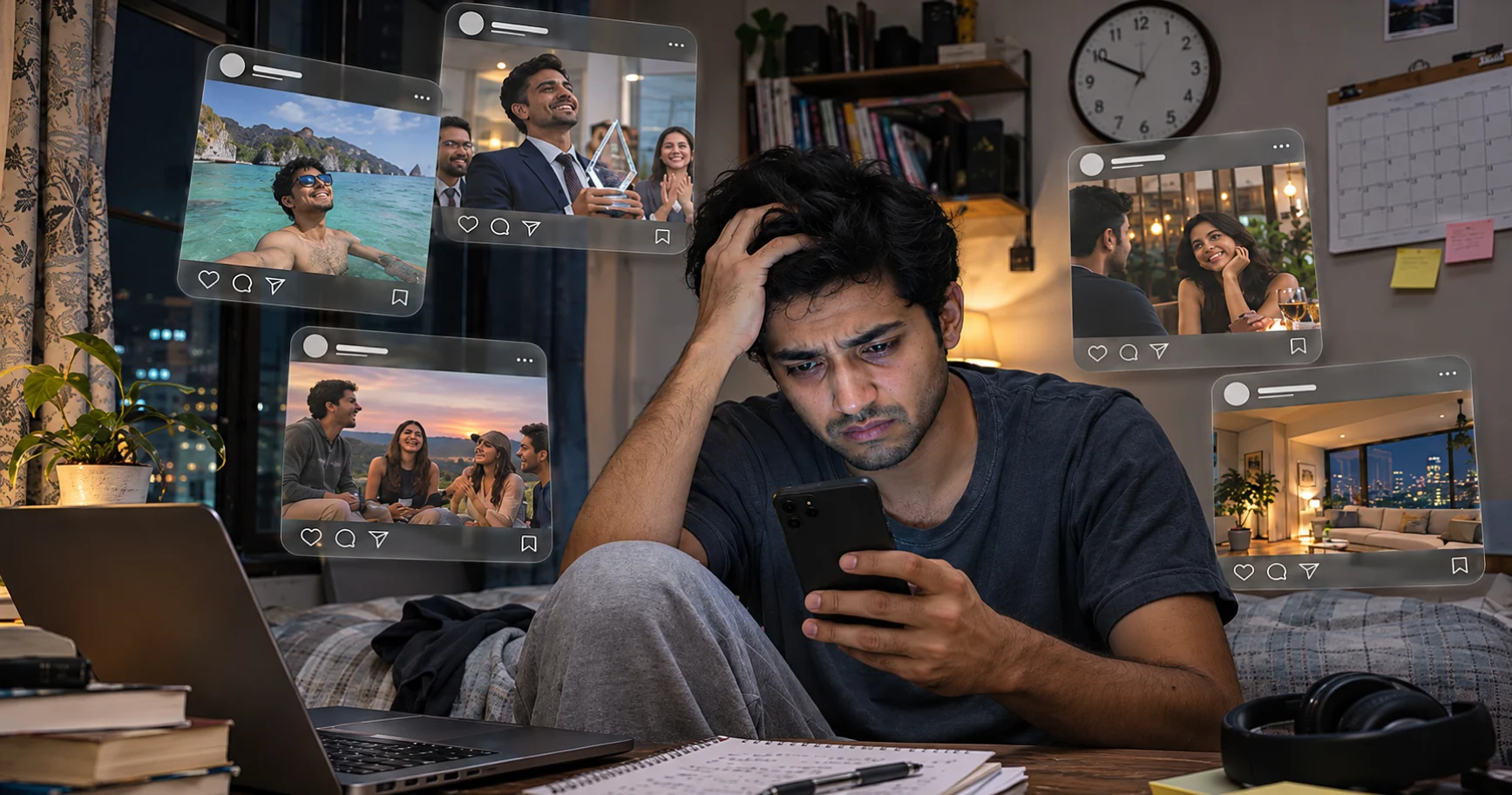
Imagine opening Instagram after a draining, hard day, and you see a classmate traveling across Europe, a younger guy making millions through trading, telling you how your 9-5 is a scam and you’ve failed. Meanwhile, you are questioning if ordering dinner from outside will ruin your budget.
Then, to avoid that, you open LinkedIn, and things just get worse as you see people getting their dream jobs or promotions. Even the guy from your college who was dumb looks like he has it all figured out.
And suddenly, the normal evening became a question about your own existence. Then you start doubting your choices and career, and even if you have wasted your best years of life,
The twisted part here is that nothing actually changed about your life’s trajectory in those few minutes you just lost. What actually changed is the standard of comparison you had. Then this standard keeps following you till your progress in life feels inadequate and causes insecurity.
Why do your twenties feel like a deadline?
There’s a specific type of uncertainty that can’t be explained and knocks you as you enter adulthood. For more than a decade, it was easy to measure your progress. You moved from one academic class to the next, and then you finally graduated. And then suddenly the old, known structure disappeared, and people want you to know it all.\
The quarter-life crisis
There was a theory called emerging adulthood, created in the year 2000 by psychologist Jeffrey Jensen Arnett, describing the twenties as a period of identity exploration in societies where young people have the opportunity to explore different adult roles.
Sometimes you may feel like changing careers; sometimes you may feel that you’re no longer interested in the degree you spent so many years pursuing. Uncertainty is natural during these Life Transitions, because there is no longer a predetermined path for making decisions.
In 2013, Oliver Robinson and his team studied 50 experiences associated with the quarter-life crisis. These included feeling trapped in a situation, breaking away from old commitments, exploring new options, and reorganizing one’s life.
However, not every young person goes through a quarter-life crisis. For someone who supports their family, changing jobs is not simply a decision to pursue their personal preferences.
Who decided what success should look like
A good job, your own car, financial independence, a partner, and a nice home. As we grow up, we inherit this unspoken checklist.
Many of these achievements depend on circumstances that are beyond our control. Still, a friend buying a home can start to feel like proof of our failure, even if buying a home was never our priority.
The Psychology of Comparing Yourself to Everyone
Comparing yourself is not a personality defect. It also helps people understand their abilities and social standing. The difficulty begins when the yardstick for comparison starts to drift away from reality.
Why Other People’s Success Feels Personal
In 1954, Leon Festinger introduced Social Comparison Theory. According to it, when people have no clear standard for assessing their own opinions and abilities, they evaluate them through others.
We used to compare ourselves with classmates, colleagues, and neighbors. Today, that list also includes entrepreneurs in Dubai, teenagers with millions of followers, and strangers who appear in our feeds because of the algorithm.
In 2014, research by Erin Vogel and her team found a link between heavier Facebook use and lower self-esteem, with comparisons to people who seemed more successful than oneself playing a role. In the experiment, participants’ views of themselves also immediately worsened after viewing such profiles.
However, we also learn from other people’s success. The problem is when every achievement starts reminding you of your own shortcomings. When this happens constantly, it affects Emotional Wellness.
The Version of Yourself You Think You Should Be
In 1987, E. Tory Higgins introduced Self-Discrepancy Theory. It describes the differences between the Actual Self, or how we see ourselves; the Ideal Self, or who we want to become; and the Ought Self, or who we think we should be. The gaps between them are associated with different kinds of emotional distress.
There are also family expectations. You may not even want the career your family expects you to pursue, but not meeting their expectations can still feel like failure. So Anxiety About the Future isn’t just worry about tomorrow. It also involves grieving the future that, in your view, should by now have become your present.

The Internet’s Fake Success Economy
Travel creators show videos of beautiful places, and business owners show off their success. There’s nothing wrong with that. The problem arises when people start making money from the appearance of real success instead of actual success.
The Rise of the Online Larper
LARP stands for Live-Action Role-Playing. On the Internet, the term is also used for people who present a false identity. For example, an image of being a millionaire created with the help of a luxury car, an expensive watch, and motivational speeches.
There’s nothing inherently wrong with renting a car, booking an apartment for a few days, or borrowing a watch for a shoot. But passing them off as your permanent possessions to prove you’re rich is another matter.
In 2020, a photography studio in Los Angeles drew attention for having a set that looked like the inside of a private jet. It went viral amid discussions of staged luxury on Instagram, although actual commercial shoots also took place there. Imagine staying up all night worrying about your career because someone had posted a photo sitting inside a set like that. You had no idea what their actual circumstances were.
When Insecurity Becomes a Business Model
Some online personalities first explain that having a job is ruining your life. Then those same people sell paid courses to teach you an easy way to get rich.
The U.S. Federal Trade Commission has warned against giving misleading impressions about earnings in multilevel marketing through lifestyle images featuring expensive cars and vacations. This doesn’t mean every influencer or course is bad. But someone’s luxurious lifestyle is no sure proof of their income or profits, either.
A screenshot of revenue doesn’t reveal expenses, debt, refunds, or the costs of running a business. Even a genuine success story can be quite different from the typical experience of other customers. Next time someone makes you feel like a loser for having a job, think about whether they might be making money from your insecurity.
The Invisible Head Start
Of two people the same age, one has parents who are paying their rent while they start a business. The other sends part of their salary home, repays an education loan, and cannot afford to be without a job for even a month.
The 2024 India Employment Report by the International Labour Organization and the Institute for Human Development highlights several challenges related to young people’s employment and education, and finding work that matches their qualifications. Career uncertainty is not just a matter of the mind. Economic circumstances also matter.
Many young people in India also make decisions shaped by family responsibilities. Relatives are often more interested in knowing how much you earn than whether you like your job. The pressure increases further when it comes to marriage and financial independence.
Here, a Mindset Shift means understanding each person’s different circumstances and challenges, alongside the importance of hard work.
Why Ambition Sometimes Turns Into Anxiety
Wanting more from life is not a bad thing. Ambition gives us direction. But if every achievement starts reminding us of the next unfulfilled desire, it becomes difficult to enjoy our own progress.
The Fear of Wasted Potential
The Internet is full of discussions about people who achieve extraordinary success at a young age. One is a young billionaire, another is a viral creator, and another has broken records before turning thirty. Compared to them, our small accomplishments start to seem insignificant.
If everyone told you that you were talented as a child, perhaps even an ordinary life today feels like a waste of your abilities. There is pressure to do something big, even though it is still unclear what doing something big means to you.
One reason for Feeling Stuck in Life is procrastination. Fearing that we might choose the wrong direction, we keep planning and researching, but never actually begin.
Why Uncertainty Feels Like Danger
In Psychology, Intolerance of Uncertainty means having difficulty coping with situations whose outcomes are unknown. Emily Gentes and Ayelet Ruscio’s 2011 meta-analysis found that it was associated with symptoms of several mental health problems, including generalized anxiety disorder.
Everyday uncertainty is not in itself a sign of any disorder. Still, this helps explain why not hearing back about a job application or not having a clear career direction bothers us so much.
Many times, we try to solve every possible problem right away, even when we don’t have all the information. When dealing with Anxiety About the Future, it’s important to understand which worry you can work on today and which one you don’t have an answer to yet.
Is Social Media Really Making Everything Worse?
It’s easy to blame Instagram for every insecurity, but social media is also a way to stay in touch with friends, find new opportunities, and connect with people like you.
In Rebecca Godard and Susan Holtzman’s 2024 meta-analysis, 141 studies involving approximately 145,000 participants were analyzed. In most cases, active or passive social media use had only a very small association with mental health and well-being. The circumstances of use mattered, and online social support was among its potential benefits.
In a 2018 study, 143 university students were divided into two groups. One group limited their use of three social media platforms to ten minutes each per day, while the other continued their usual use. After three weeks, the first group had fewer symptoms of loneliness and depression than the second. However, this was an experiment involving a specific student population.
If scrolling leaves you Feeling Lost in Life, pay attention to your feed. The inspiration you get from creators who teach skills and the impact of content that measures a person’s worth by their money are not the same.
The Mindset Shift That Actually Matters
Having a healthy mindset doesn’t mean pretending to be satisfied with your circumstances. Maybe you really do need a better job, new skills, or greater financial stability. Ignoring this won’t make the problem go away.
Separate Your Goals From Your Identity
Wanting to succeed and believing that you have to succeed to be worthy of respect are two different things. The first way of thinking leaves room for mistakes; the second turns every failure into a question of your own worth.
In a 2003 study, Carsten Wrosch and his team found a connection between the ability to abandon unattainable goals and adopt new ones and subjective well-being. Changing your goals to suit your circumstances isn’t backing away from Personal Growth.
Stop Using Self-Criticism as Fuel
In experiments conducted in 2012, Juliana Breines and Serena Chen found that after personal setbacks, participants who treated themselves with compassion showed several signs of increased motivation to improve.
In other words, you don’t have to put yourself down all the time to stay ambitious. Acknowledging a mistake and thinking of yourself as a mistake are two different things. If you’ve been putting off work, acknowledge it and plan your next steps. There’s no need to remember every opportunity you’ve missed from school until now.
Personal Growth Is Not Always Comfortable
A question that often comes up is: how does embracing challenges contribute to personal growth? Accepting challenges that match our abilities gives us the chance to improve our skills, try new approaches, and recognize our capabilities.
In Mark Seery and his team’s 2010 longitudinal study, people who had experienced some difficulties showed several better indicators of well-being and resilience than those who had experienced very many difficulties or none at all. This doesn’t mean that every hardship makes a person stronger. Serious or long-lasting difficulties also have harmful effects.
Going to a difficult interview, making videos despite feeling camera-shy, or learning a new skill gives you information that you can’t get just by overthinking. You might find that you enjoy something, or discover that it simply isn’t for you.
What to Do When You Feel Left Behind
If you’re searching for what to do when you feel lost in life, first understand your problem. Falling behind in life is a very broad and vague idea. Once you identify the real problem, you can start to see a way to work on it.
Give Yourself a Smaller Problem to Solve
Maybe you need more income, don’t like your job, or feel distant from your friends. Every problem has a different solution. Watching motivational reels for hours won’t necessarily solve any of these problems.
Peter Gollwitzer and Paschal Sheeran’s 2006 meta-analysis found evidence that clearly planning when and how to do something can help you achieve your goals. [15]
Instead of promising to change careers within a year, decide that on Tuesday after dinner, you’ll spend half an hour updating your portfolio. When you’re tired, choose a task you can actually finish.
Protect Your Emotional Wellness
Make time for friendships, sleep, and activities that don’t earn you money. You don’t have to turn every hobby into a source of income or calculate a productivity score for every weekend.
Talk to someone you trust about what’s really troubling you. If the feeling of Feeling Stuck in Life lasts a long time, affects your daily life, or your hopelessness grows, seek help from a qualified mental health professional.
Conclusion
The feeling of falling behind in life is often a mixture of real difficulties and unrealistic expectations. Your money worries may be entirely real, but some stranger standing beside a supercar does not determine how quickly you should change your life.
There is nothing wrong with wanting more from life. What matters is whether your ambition is leading you toward the life you want or chasing an image of success created by someone else.
Time is passing, and your decisions matter. But what good does it do to spend today grieving the end of an imaginary deadline? Identify what needs to change and start there.
Disclaimer
This article is written for educational and general awareness purposes. It is not intended to diagnose or treat any mental health condition. Uncertainty about the future is not, by itself, evidence of an anxiety disorder or depression. Research findings are based on specific populations and study conditions. Examples of staged influencer lifestyles illustrate the limitations of online content; they do not suggest that every creator is misleading. If anxiety, sadness, or hopelessness persists for a long time or affects your daily life, contact a qualified mental health professional.

A passionate health and lifestyle content writer dedicated to making complex medical and psychological topics easy to understand. With a focus on mental health, lifestyle, and overall well-being, I curate informative, research-based articles that help readers better understand their health and make informed decisions. The goal is to spread awareness, simplify health information, and encourage healthier living.