
Abstract
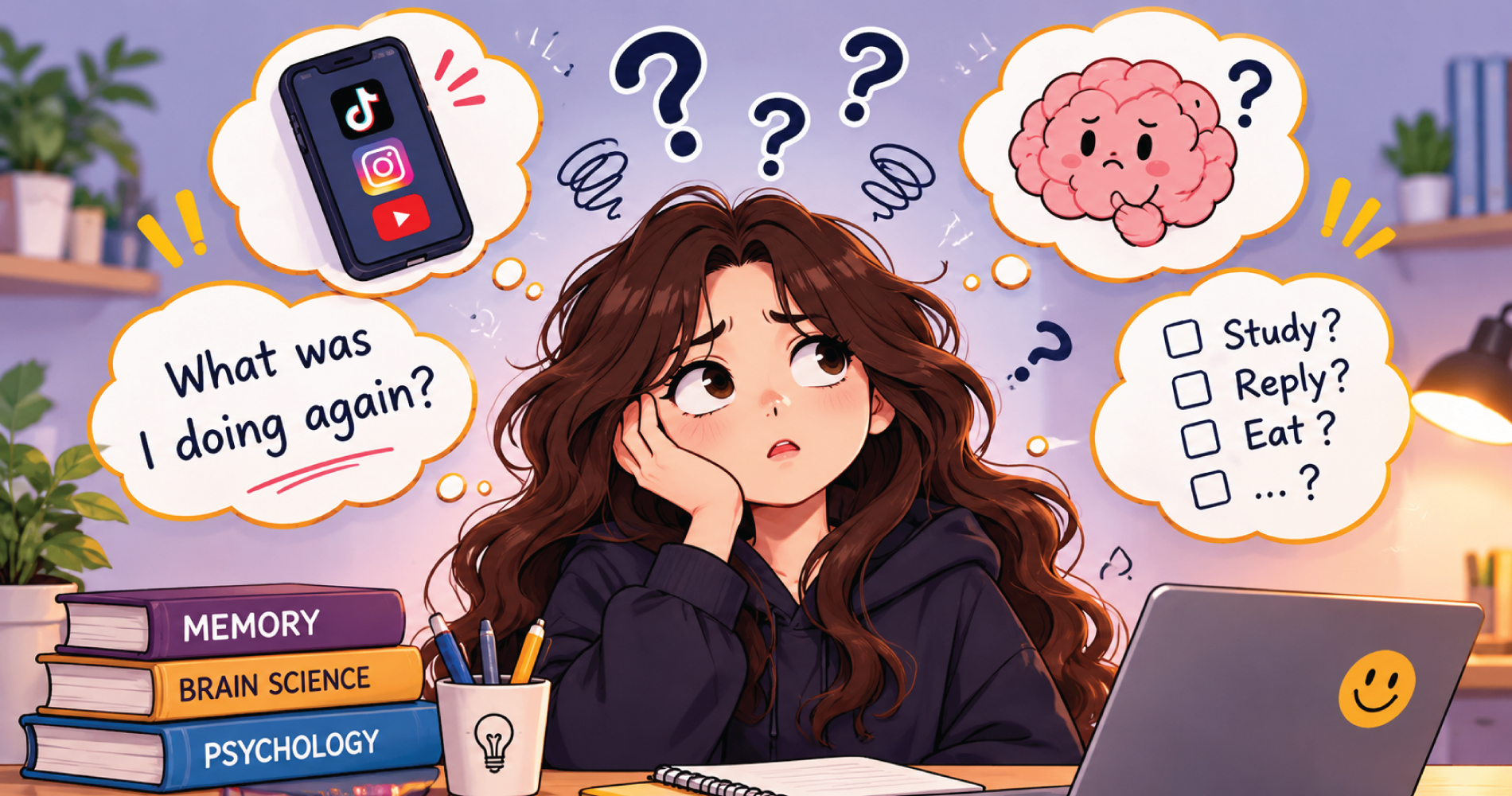
I walk into my room to grab something, but the moment I get there, I completely forget why I came in. I open my phone to reply to a message, get distracted by a notification, scroll through three different apps, and suddenly realize I never replied. Sometimes, I even forget what I was about to say halfway through a conversation.
And honestly, it makes me wonder: Why does remembering the simplest things feel so difficult sometimes?
For many people in Gen Z, forgetfulness has become an everyday experience. Between endless notifications, short-form videos, academic pressure, multitasking, irregular sleep schedules, and constant digital stimulation, our brains are processing an enormous amount of information every day.
But does that mean our memory is getting worse? Is social media actually affecting our ability to remember things? Or are we simply expecting our brains to do too much at once?
To understand why we sometimes feel like our memory has a mind of its own, I decided to explore the science behind how memory works, what affects it, and whether our everyday habits are making it harder to remember things.
Introduction: Why Do I Keep Forgetting Everything?
I pick up my phone to check one notification. Five minutes later, I am watching a random video, reading comments, checking someone’s profile, and wondering how I ended up there in the first place. The original reason I picked up my phone? Completely forgotten.
It happens more often than I would like to admit. I forget small instructions, struggle to remember what I studied the previous night, and sometimes walk into a room only to stand there wondering what I came for.
At first, I thought it was just a personal habit. Maybe I was distracted, lazy, or simply not paying enough attention. But when I started noticing how frequently people around me experienced the same thing, I became curious.
Why does an entire generation seem to be struggling with something as basic as remembering? We live in an age where information is available almost instantly. We can search for answers, save important posts, set reminders, and access almost anything through our phones. Yet, remembering simple details sometimes feels harder than ever.
I find this contradiction interesting. We have more access to information than any generation before us, but that does not necessarily mean we are better at remembering it.
The first thing I discovered is that memory is not simply about storing information. It involves several complex processes that depend on attention, concentration, sleep, emotions, and the way our brains organize experiences.
So, before blaming our phones or calling ourselves forgetful, I wanted to understand what actually happens inside the brain when we remember something.
How Does Memory Actually Work?
Before understanding why I forget things, I need to understand how my brain remembers them in the first place. Memory is not like a folder on a computer where information is saved permanently. Instead, it is an active biological process involving different brain regions that work together to receive, organize, store, and retrieve information.
Psychologists commonly divide memory into three major processes.
Encoding: How Information Enters the Brain
Encoding is the first stage of memory formation. It happens when the brain receives information and converts it into a form that can be stored.
For example, imagine I am attending a lecture and listening to my professor explain an important concept. My brain receives information through hearing, processes the words, and attempts to understand their meaning. However, simply hearing something does not guarantee that I will remember it.
If I am simultaneously checking messages, thinking about lunch, and looking at notifications, I may hear the lecture without properly processing the information. This is where attention becomes important. The brain is constantly exposed to more information than it can consciously process at once. Attention helps prioritize what deserves further processing.
If I am not paying attention when something happens, the information may never be encoded properly. This explains why I sometimes forget instructions immediately after hearing them.
Storage: Keeping Information for Later
Once information has been encoded, the brain can retain it for different periods. Psychologists generally discuss three broad types of memory:
- Sensory memory: Briefly holds information received through the senses, such as a sound, image, or touch.
- Short-term memory: Temporarily holds a limited amount of information that is currently being used.
- Long-term memory: Stores information for longer periods, potentially lasting for years.
For example, when someone tells me a phone number, I might repeat it mentally until I can write it down. That information is being held temporarily. However, if I repeatedly practice a new skill, understand a concept, or revisit information over time, it has a better chance of becoming part of long-term memory.
Retrieval: Bringing Information Back
Retrieval is the process of accessing stored information when we need it. This is the stage where things can become frustrating. I might remember studying a particular topic but struggle to recall the exact definition during an examination. Sometimes, I know that I know the answer, but the information simply refuses to come to mind.
This experience is often called the tip-of-the-tongue phenomenon. It does not necessarily mean that the information has disappeared. Sometimes, the brain struggles to access the correct memory at that particular moment.
What I find interesting is that forgetting does not always mean information was never stored. Sometimes, the problem lies in how it was encoded, maintained, or retrieved.
Is Our Attention Span Getting Shorter?
I have noticed that watching a 30-second video feels effortless, but sitting through a 30-minute lecture without checking my phone can feel surprisingly difficult. This raises an important question: Are we becoming less capable of concentrating, or are we simply getting used to environments that constantly demand our attention?
The Endless Scroll and Constant Stimulation
Social media platforms are designed to provide a continuous stream of content. One video leads to another, followed by a notification, a message, or a new recommendation. Every few seconds, something different competes for our attention.
This creates an environment where our brains are repeatedly shifting between different sources of information.
Although this does not automatically mean that social media permanently damages memory, frequent interruptions can make it harder to concentrate on a single task.
For example, imagine I am studying a chapter while checking my phone every few minutes. Each time I switch between studying and scrolling, I have to redirect my attention. I may spend an hour at my desk, but much of that time is divided between unrelated activities. As a result, I might remember less than I expected.
Does Multitasking Make Us More Forgetful?
I used to think multitasking was a useful skill. Listening to music, replying to messages, studying, and eating simultaneously seemed like a productive way to manage my time.
But research on attention suggests that the brain is not particularly efficient at handling multiple demanding tasks simultaneously. What we often call multitasking is actually task-switching. The brain moves its attention from one activity to another, sometimes leaving behind information from the previous task.
This switching can increase cognitive load and make mistakes more likely. For instance, if I am reading an important paragraph and suddenly respond to a message, I may return to the paragraph without remembering what I just read.
The problem is not necessarily that my memory has failed. My attention was interrupted before the information could be processed properly.
The Difference Between Watching and Remembering
One thing I find particularly interesting is how easily we confuse familiarity with actual memory. I might watch an educational video and feel like I understand everything. But when someone asks me to explain the topic without looking at my phone, I struggle.
This happens because recognizing information and retrieving it independently are different processes. Repeatedly seeing information can make it feel familiar, but familiarity does not always mean that meaningful learning has taken place.
This is why actively recalling information, explaining it in my own words, and testing myself can be more useful than simply watching the same content repeatedly.
Is Social Media Changing the Way We Remember?
Our phones have become external storage systems for everyday life. We save birthdays in calendars, directions in navigation apps, important information in screenshots, and reminders in notes. Instead of remembering everything ourselves, we depend on technology to keep track of it.
But does this affect our memory?
The Google Effect: Why We Remember Where to Find Information
Psychologists have studied a phenomenon known as the Google effect, also called digital amnesia. It describes the tendency to remember where information can be found rather than remembering the information itself.
For example, if I know that I can search for the capital of a country whenever I need it, I may not make the same effort to memorize it. My brain recognizes that the information is easily accessible elsewhere.
This does not mean using Google automatically weakens memory. External tools can reduce the mental effort required to remember routine details and allow us to focus on other tasks. However, constantly relying on external storage may change which information we choose to remember.
Why Do I Remember a Meme but Forget What I Studied?
Sometimes, I can remember a funny video I watched weeks ago but struggle to recall a definition I studied yesterday. It feels unfair, but there are psychological reasons why certain information is easier to remember. Memory is influenced by several factors:
- Emotional significance: Information connected to strong emotions may receive more attention and become more memorable.
- Repetition: Repeated exposure can strengthen memory, particularly when combined with meaningful processing.
- Personal relevance: Information connected to our interests and experiences may be easier to remember.
- Novelty: Unusual or surprising experiences can attract attention and become memorable.
A funny video might combine humor, surprise, music, and visual information. An ordinary textbook paragraph may not offer the same level of stimulation. However, this does not mean that entertainment is always remembered better than educational material. Learning strategies, attention, and the meaning attached to information also matter.
Screenshots: Are We Saving Information Instead of Remembering It?
I have a habit of taking screenshots of things I consider important. A recipe, a study note, a useful quotation, a skincare tip, or even a random reminder can end up in my gallery. But how often do I actually revisit those screenshots?
Sometimes, saving something gives me the feeling that I have successfully preserved the information. However, saving is not the same as learning. If I never revisit, organize, or actively process the information, I may not remember it later.
Screenshots can be useful external reminders, but they cannot replace understanding and meaningful practice.
How Sleep Affects Our Memory
If there is one everyday habit that I often underestimate, it is sleep. I have stayed awake late at night scrolling through my phone, watching videos, or finishing work, only to wake up feeling mentally exhausted the next morning. What I find surprising is that sleep does much more than help the body rest. It also plays an important role in memory formation.
What Happens to Memory While We Sleep?
During sleep, the brain remains active. Different sleep stages contribute to memory processing and consolidation, which is the process through which newly acquired information becomes more stable.
Research suggests that slow-wave sleep is particularly important for consolidating certain declarative memories, such as facts and events. REM sleep may also contribute to emotional and procedural memory processing.
For example, if I study a new concept during the day and get adequate sleep afterwards, my brain has an opportunity to process and strengthen aspects of that learning. This is one reason why studying throughout the night before an examination may not be as effective as it seems.
Why Does Sleep Deprivation Make Me Forget Things?
When I do not get enough sleep, I may notice that concentrating becomes harder. I might read the same paragraph repeatedly, struggle to follow conversations, or forget small instructions. Sleep deprivation can affect:
- Attention and concentration.
- Working memory.
- Learning and information processing.
- Decision-making.
- Emotional regulation.
It can also make it harder to encode new information properly. In other words, the problem may begin before information even reaches long-term memory.
The Late-Night Scrolling Problem
Using a phone late at night can interfere with healthy sleep habits in several ways. Engaging content may keep the brain mentally stimulated, while notifications and continuous scrolling can delay bedtime.
Light exposure from screens can also influence the body’s circadian rhythm, particularly when exposure occurs at night. However, screen use is not the only factor affecting sleep. Stress, caffeine, irregular schedules, and environmental conditions can also contribute.
I find it useful to think of sleep as part of the learning process rather than something that happens after learning is finished.
Can Stress and Anxiety Make Us Forgetful?
Have you ever entered an examination hall knowing that you studied everything, only to forget the simplest answer when the question paper is placed in front of you? I have always found this experience frustrating.
It feels as though the information was available a few minutes earlier, but suddenly my brain refuses to cooperate. Stress and anxiety can influence memory in several ways.
The Brain Under Pressure
When we experience stress, the body activates systems that prepare us to respond to a perceived challenge. This involves the release of stress-related chemicals, including adrenaline and cortisol.
In the short term, these responses can help us become alert and respond to immediate demands. However, intense or prolonged stress can interfere with certain cognitive functions, including attention and memory.
The effects depend on the intensity, duration, and context of the stress.
Why Do I Forget Answers During Exams?
Working memory is the system that temporarily holds and manipulates information while we perform a task. For example, when solving a mathematical problem, I may need to remember several steps while calculating the answer.
When anxiety becomes overwhelming, worrying thoughts can occupy some of the mental resources needed for the task. Instead of focusing entirely on the question, I might start thinking:
- What if I fail?
- What if I forget everything?
- What will happen if I cannot finish the paper?
- Why can’t I remember something I studied yesterday?
These thoughts can make it harder to concentrate and retrieve information. This is one reason why an answer may suddenly come back to mind after the examination, when the pressure has reduced.
Can Emotional Experiences Affect Memory?
Emotions can influence how memories are formed and retrieved. Events associated with strong emotions may become particularly memorable because emotional processing interacts with systems involved in memory.
However, emotional memories are not necessarily perfect recordings of what happened. Our memories can be influenced by attention, interpretation, later information, and repeated recollection. This means that remembering something vividly does not always guarantee that every detail is accurate.
Is Forgetfulness Normal, or Should I Be Concerned?
After exploring attention, sleep, stress, and digital habits, I started wondering whether everyday forgetfulness is something everyone experiences.
The answer is that occasional forgetfulness is a normal part of human cognition. The brain does not preserve every detail of every experience. It prioritizes information based on attention, relevance, repetition, and other factors.
Everyday Forgetfulness
Some common examples include:
- Forgetting where I placed my keys.
- Walking into a room and forgetting why I entered.
- Struggling to remember someone’s name.
- Forgetting a small task when distracted.
- Losing track of what I was about to say.
- Needing to reread information to understand it.
These experiences can happen when attention is divided, information is not encoded effectively, or several tasks compete for mental resources.
When Should I Pay More Attention?
Forgetfulness may deserve professional evaluation when it becomes persistent, progressively worsens, or begins interfering with everyday activities. Examples of concerning changes may include:
- Frequently forgetting important conversations or events.
- Repeatedly asking the same questions.
- Becoming confused in familiar surroundings.
- Struggling with tasks that were previously manageable.
- Experiencing noticeable changes in language, judgement, or daily functioning.
Memory difficulties can have many possible causes, including sleep problems, stress, certain medications, nutritional deficiencies, and medical conditions. Persistent or worsening symptoms should not automatically be blamed on social media or a busy lifestyle. A healthcare professional can help identify the underlying cause.
How Can I Improve My Memory Without Completely Changing My Lifestyle?
After understanding the science, I realized that improving memory does not necessarily require expensive supplements, complicated routines, or deleting every social media application. Small, consistent habits can support attention, learning, and memory.
Practice Active Recall
Instead of repeatedly reading the same paragraph, I can close the book and try to explain what I just learned. This technique is called active recall. It involves retrieving information from memory rather than simply recognizing it when it appears in front of us. For example, after studying a chapter, I can ask myself:
- What were the three main points?
- Can I explain this concept without looking?
- What examples can I remember?
The effort involved in retrieving information can strengthen learning.
Use Spaced Repetition
Trying to learn everything in one sitting can be exhausting. Spaced repetition involves revisiting information at increasing intervals rather than studying it repeatedly in one session. For example:
- Review a topic on the day you learn it.
- Revisit it the following day.
- Review it again after a few days.
- Test yourself after a week.
This gives the brain repeated opportunities to retrieve information over time.
Reduce Unnecessary Distractions
I do not necessarily need to stop using my phone completely. However, I can make small changes, such as keeping notifications off while studying, placing my phone away from my desk, and focusing on one demanding task at a time. Even short periods of uninterrupted concentration can make learning more effective.
Prioritise Consistent Sleep
Adequate sleep supports attention, learning, and memory consolidation. Most adults need around seven to nine hours of sleep each night, although individual needs can vary. Maintaining a regular sleep schedule, limiting late-night stimulation and creating a comfortable sleeping environment can help support better sleep.
Move Your Body
Physical activity is not just beneficial for physical fitness. Regular exercise is associated with better cognitive health and may support memory and other brain functions. Activities such as walking, cycling, dancing, or playing a sport can help make movement part of everyday life. I do not need an intense workout routine to begin. Even regular moderate activity can contribute to overall health.
Give Your Brain Time to Process Information
Constant stimulation can leave very little room for uninterrupted thinking. Taking short breaks, spending time away from screens, and allowing myself to focus on one activity can help reduce unnecessary mental interruptions. The goal is not to avoid technology but to use it more intentionally.
Myths vs Facts About Memory and Forgetfulness
There are several common assumptions about memory that sound convincing but do not always reflect what science tells us.
Myth 1: Having a Bad Memory Means I Am Not Intelligent.
Fact: Intelligence and memory are related to several cognitive abilities, but they are not the same thing. Forgetting information does not automatically indicate low intelligence.
Myth 2: Multitasking Makes Me More Productive.
Fact: Switching between demanding tasks can increase cognitive load and reduce efficiency. Focusing on one task at a time is often more effective.
Myth 3: Watching Something Repeatedly Means I Have Learned It.
Fact: Familiarity is not the same as understanding. Active recall and spaced repetition can support more effective learning.
Myth 4: Social Media Permanently Damages Memory.
Fact: Digital habits can influence attention, sleep, and information processing, but there is no simple evidence that ordinary social media use permanently damages everyone’s memory.
Myth 5: Forgetting Things Is Always a Sign of a Medical Problem.
Fact: Occasional forgetfulness is normal. However, persistent or worsening memory difficulties should be evaluated by a healthcare professional.
Myth 6: Sleeping Less Gives Me More Time to Study.
Fact: Sleep supports learning and memory consolidation. Regularly sacrificing sleep may make it harder to concentrate and retain information.
Myth 7: If I Remember Something Clearly, It Must Be Accurate.
Fact: Memories can change over time and may be influenced by emotions, expectations, and later information. A vivid memory is not necessarily a perfectly accurate one.
Conclusion: Maybe My Brain Is Not Forgetting Everything After All
After exploring how memory works, I realized that my forgetfulness may not be as mysterious as I once thought.
Sometimes, I forget because I was not paying attention. Sometimes, I am trying to process too much information at once. On other days, poor sleep, stress, or constant digital interruptions may be affecting my ability to concentrate. The interesting part is that memory is not a fixed ability. It is influenced by the way we learn, the information we pay attention to, and the habits we develop over time.
Being part of a generation surrounded by technology does not automatically mean that our brains are becoming less capable. But it does mean that we need to understand how our digital environments influence our attention and everyday routines. I cannot expect my brain to remember every notification, conversation, video, assignment, and random thought while giving it very little time to rest and process information.
So, the next time I walk into a room and forget why I came there, I might not immediately blame my memory. I might start by asking myself a simpler question: Was I actually paying attention in the first place? Because sometimes, the problem is not that my brain cannot remember. It is that I never gave it the chance to.
Disclaimer
This article is intended for general educational and informational purposes only. It does not replace professional medical advice, diagnosis, or treatment. Occasional forgetfulness can be a normal experience, but persistent, worsening, or disruptive memory problems should be discussed with a qualified healthcare professional.
FAQs
1. Why do I keep forgetting simple things?
Simple forgetfulness can occur because of divided attention, stress, poor sleep, mental fatigue, or information overload. Sometimes, information is not properly encoded because we are distracted when it is presented.
2. Does social media affect memory?
Frequent social media use may influence attention, sleep habits, and task-switching. These factors can affect how effectively information is processed and remembered. However, ordinary social media use does not automatically cause permanent memory damage.
3. Can lack of sleep cause memory problems?
Yes. Sleep supports memory consolidation, attention, and learning. Insufficient sleep can make it harder to concentrate, process new information, and retrieve stored memories.
4. How can I improve my memory naturally?
Practicing active recall, using spaced repetition, getting adequate sleep, exercising regularly, managing stress, and reducing distractions can support memory and learning.
5. When should I worry about forgetfulness?
Occasional forgetfulness is generally normal. However, if memory problems become frequent, progressively worsen, or interfere with everyday activities, consult a healthcare professional to understand the possible cause.

Content Writer with 3+ years of experience turning ideas into words people want to read, share, and remember. I create research-backed social media and lifestyle content that blends storytelling, creativity, and audience insights to make every piece feel fresh, relatable, and engaging.