Abstract
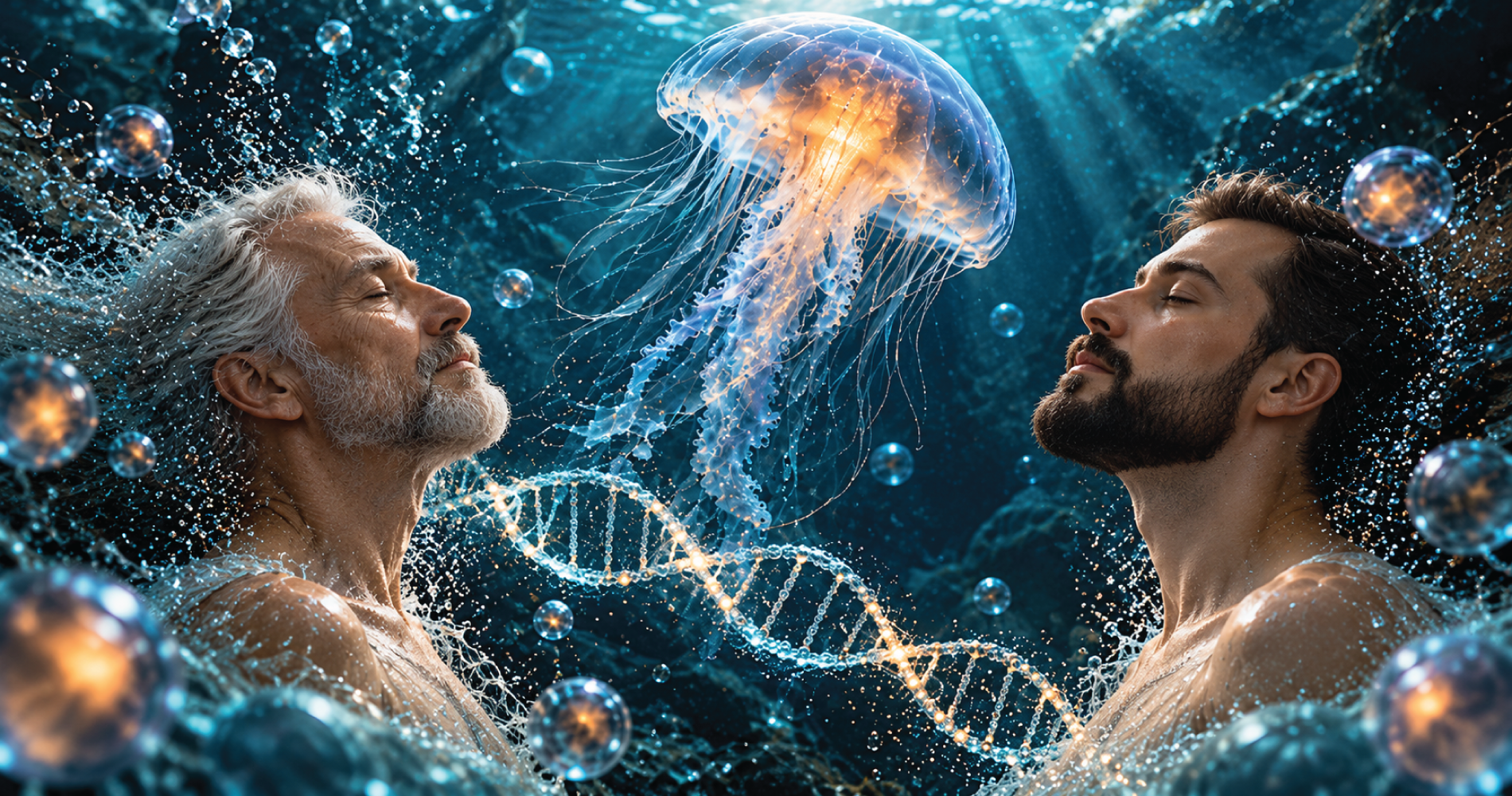
Have you ever thought about whether humans can ever stop the aging process. Or one day be able to make their bodies young again and again? This question sounds like a science fiction movie. But a small species found in the ocean gives us an opportunity to think about it in a new way. Known as the immortal jellyfish, ” Turritopsis dohrnii, ” . It can revert from its adult life stage to its primitive stage under certain circumstances. On the other hand, the human body also constantly repairs damaged cells, but its capacity is limited and gradually reduces after a certain age.
In this article, we will test a hypothesis, like a conspiracy theorist. What if the human body’s cellular regeneration capacity increased a hundredfold, could life be much longer than expected? You will also understand the scientific evidence of DNA changes, cancer, telomeres, stem cells, epigenetic reprogramming, and human trials. The point is that faster cell division and safe rejuvenation are not the same thing.
Introduction
Imagine that a ninety-year-old man wakes up in the morning and feels that his body has regained the vigor of his thirty years. Muscles are stronger, wounds heal faster than they were, the ability to fight diseases is better, and the heart, kidneys, and eyes are functioning better than before. The most interesting thing is that his memories, experiences, and personality remain the same.
We know that the body already does this to some extent. Skin injuries heal, new blood cells are formed over time, and the liver can regenerate lost tissue in some circumstances. Yet over time, repair slows, and many organs begin to weaken.
Nature’s Remarkable Exception
Turritopsis dohrnii is the only known animal yet capable of reversing its aging process to achieve biological “immortality”.
A life cycle that can run backwards
Turritopsis dohrnii is an extremely small marine jellyfish. Normally, its life begins with a fertilized egg, then a larva is formed, which attaches itself to a surface and reaches the polyp stage. The polyp later develops into a swimming adult medusa.
In most organisms, the life cycle runs in one direction. The child may become an adult, but the adult body usually does not return to the child-like state of development but a remarkable exception appears in this jellyfish. In response to injury, starvation, temperature stress, or other hard living conditions, the medusa may shrink to an intermediate stage and then
develop into a polyp. Later, new medusae may develop from the same polyp. Scientists call this life-cycle reversal, or, in simple words, that the clock has started backwards.
How does a jellyfish do it?
Transdifferentiation and Cellular Reprogramming- The secret of jellyfish isn’t just making new cells really very fast. During its life cycle reversal, some mature cells may change their previously specialized roles. This process is called Transdifferentiation. Along with this, there are also changes in the activation of genes, messages between cells, and the structure of its tissues.
Gene-expression studies of 2019 and 2021 revealed that its intermediate state activates or alters several biological pathways related to DNA repair, response to damage, protein regulation, and cellular identity. A study published in PNAS ( Proceedings of the National Academy of Sciences) in 2022 compared the genome of this jellyfish with that of the related Turritopsis rubra. The researchers found differences involving DNA replication, telomere maintenance, oxidative balance, and stem cell control.
Yet finding an association with a gene does not prove that it alone causes immortality. Till now, no such ‘immortality gene’ has been found that can be inserted into a human being and the entire lifespan can be reversed. There is a big difference between the simple body structure of jellyfish and the complex multi-organ structure of humans.
Why do Humans Age
The Twelve Hallmarks of Aging- Aging is not the failure of any one organ, but is the result of the mutual influence of many biological processes that go on in our body over time. An important review in the journal Cell, published by Cell Press in 2023, revealed twelve major signs of aging, which include.
- DNA instability.
- Telomere shortening.
- Epigenetic changes.
- Protein management problems.
- Decreased clearance of cellular waste.
- Energy-production dysfunction.
- Accumulation of old cells.
- Stem cell impairment.
- Chronic inflammation.
In simple terms, damage to the internal machinery of cells accumulates over time a organism lives. Some proteins are not formed into the correct shape Mitochondria cannot provide enough energy; The balance of the immune system may get disturbed over time after this, the damaged tissue starts giving harmful signals to other cells aswell.
The 100x Theory
Faster Division Is Not Better Repair- There is difference which is really important to understand here. Hundred times faster cell division and hundred times better controlled regeneration are not the same things. In the first case, unnecessary cells may start forming, the shape of the tissue may deteriorate and groups of cells with errors may increase over time.
The second situation would be much more useful. The body first recognizes the damage, then removes the damaged cell, replaces it with a new cell of the right type, and finally checks whether the new tissue is functioning normally or not.
Not all parts of the human body change cells at the same rate as others. The intestinal lining and blood undergo continuous renewal, whereas many nerve cells and heart muscle cells show limited regeneration. Therefore, it is not scientifically justified to expect a single universal remedy to rejuvenate the entire body and give you immortality.
The Regeneration Reserve
Why the Repair System Weakens- Stem cells are cells that can make copies of themselves and develop into certain specific cells as needed by the body. Bone marrow stem cells make blood; Separate cellular stores in the skin and intestine as they help in regular repair.
As we age, the number, functionality, or surrounding environment of many of these stores may change over time. This is understood in the broader context of Stem-Cell Exhaustion. Simply putting more stem cells in doesn’t solve the problem, because they must work with the right signals in the right tissue for full use.
The hidden cost of Regeneration
DNA mutation and its risk- When a cell divides the copies of its DNA. This process is extremely precise and needs to be accurate, but not completely error-free. Apart from this, ultraviolet rays of the sun, chemicals, metabolism, and normal biological processes can also damage the DNA structure of an individual.
Not every mutation is harmful. Most changes are passive or minor. Concern arises when certain changes affect genes that control cell growth in a person. In a 2022 Nature study, the lineages of blood-forming stem cells and related cells of ten individuals were examined. On average, about 17 acquired mutations were recorded per cell per year. In older age, blood formation appeared to be more dependent on certain cell lineages than in young people.
Keep in mind, this number relates to specialized blood-forming cells and can’t be applied to every cell in the body. Also, there is no simple hundredfold mathematics as to how much cancer will increase due to more division.
The Regeneration of Cancer Paradox
Healing and uncontrolled growth are different. There are many protective mechanisms present in the body. Apoptosis destroys dangerous cells. Cellular senescence can stop some cells from dividing. Immune cells attempt to recognize abnormal growth and trigger apoptosis.
Imagine that regeneration was greatly accelerated, but these defense mechanisms were not equally strengthened to match its speed. The proliferation of misplaced cells may then increase along with repair. This is the twisted paradox of regeneration.
A Double-Edged Mechanism
Telomeres and Telomerase- There are structures in cells called telomeres at the ends of chromosomes. In many normal cells, their length decreases over time with continuous division. Too short telomeres can signal the cell to stop dividing or die. The telomerase enzyme helps maintain telomeres in certain types of cells. Researchers wondered if its activity could be increased to avoid age-related frailty.
A 2012 based on mouses being a test subject study found that telomerase gene therapy increased the median lifespan of adult mice by 24 percent rather than in older mice and by 13 percent in older mice. No additional growth of cancer was seen in that experiment. But sadly, this cannot be considered a proven successful approach in humans. The telomere biology of mice and humans is significantly different. Additionally, many cancer cells use telomerase to continue dividing further.
Protection and Inflammation
Can Clearing Old Cells Help? Some cells stop dividing after a period of damage or stress, but remain in the body. These are called Senescent Cells. In many circumstances, this response protects us from cancer and also plays a major role during tissue repair. Problems can arise when such cells continue to accumulate and release inflammatory substances into surrounding tissues, which can cause problems in people. Experimental drugs that target these are called senolytics.
A small controlled trial in 2023 studied the dasatinib and quercetin combination in twelve people with serious lung illness. This assessed the feasibility of use, but did not prove a clear benefit in physical performance of the people. Mild or moderate adverse effects were also seen more frequently in the treatment group.
Cellular Reprogramming and Yamanaka Factors
Can a Cell Remember Its Younger State? In 2006, researchers did a study which showed that with the help of certain gene-regulatory factors, developed cells could be transformed into more primitive cells. These are commonly called Yamanaka Factors: OCT4, SOX2, KLF4, and c-MYC. This discovery revealed that cell identity is not completely immutable. But if a mature cell is completely stripped of its identity and left in an unprotected state, there may be a risk of unwanted tissue or tumor formation, which increases the chances of cancer.
For this sole reason, scientists are studying Partial Cellular Reprogramming. The idea is to give the cell some youthful signals for a period of time, but to stop the process before it loses its original identity. Here comes the role of epigenetics. Think of DNA as a book of instructions and manuals and epigenetic marks controlling the use of those instructions. These controls change over time. Some experiments suggest that further studies could improve some of these.
Researchers published a 2020 study in Nature showing youth-like molecular signaling, neuro-growth, and vision improvements in the eyes of mice using just three factors: OCT4, SOX2, and KLF4.
Promising results yet Serious Warnings
In the year 2024 a study, very old male mice were given controlled gene therapy of three reprogramming factors. Their remaining median lifespan after treatment was longer than that of the control group. The study indicated improvements, but the limited animal sample and specific circumstances of the experiment limit general interpretation of the results for further studies.
The other side of this story is concerning and worth worrying about. In 2023 Nature Aging research, long-term expression of four reprogramming factors throughout the body impaired liver and intestinal function in the mice. This led to premature death. When expression of the factors was limited in those organs, harmful effects were reduced. The lesson is simple: the dose, duration, organ, and cell type of treatment are important for the host’s survival. What is helpful for one tissue can be harmful for the other.
How close are we to Human trials?
In January of 2026, US regulators permitted Phase 1 of human trials of an experimental therapy known as ER-100. Its purpose is not to reverse the aging of the entire body, but to check the functionality of some damaged nerve cells of the eye.
The first participant received treatment in June of 2026. In this, efforts are being made to bring epigenetic changes in the tissues of the eyes through controlled expression of OCT4, SOX2, and KLF4.
On October 8 of, 2026, the company released preliminary information on only three participants with glaucoma. Treatment was reported to be tolerated for up to 56 days, and two people had early positive signals on vision tests, which was the green light, but this was a small, preliminary result announced by the company. It does not conclude anything about the effectiveness of the treatment, long-term safety, or human longevity.
Countering the side effects like jellyfish
A Hypothetical Six-Layer Safety System can be implemented- now consider the most interesting hypothesis. Suppose in the future a certain therapy is developed that takes inspiration from the evolutionary flexibility of jellyfish, but preserves the structure and identity of the human body to give us that immortality we dreamed of.
Layer 1 —
Damage Detection: Advanced testing to identify which cells are repairable and which are so damaged that they must be removed. However, no test today can read every cell in the entire body with complete accuracy, and the future of science is uncertain.
Layer 2 —
Selective Cell Removal: Make better use of the body’s natural cell death and immune surveillance. The challenge will be to ensure that healthy cells are not destroyed unnecessarily with the damaged/dead ones.
Layer 3 —
Safe Cell Replacement: Healthy stem cells create new tissue in the right amounts. New cells not only have to be formed, but they also have to establish proper connections to the blood supply and surrounding structures to operate smoothly..
Layer 4 —
Controlled Reprogramming: Youth-like signals are given to only selected organs for a specific period of time, so that the specific identity of the cell is maintained. Stopping or increasing the process at the wrong time can cause harm to humans.
Layer 5 —
Cancer Surveillance: Constantly checking for signs of dangerous mutations and abnormal growth in growing cells. Still, the idea of complete safety is not scientifically justified.
Layer 6 —
Whole-Body Coordination: The heart, brain, immune system, hormones, and other organs remain in balance with each other. Rejuvenating one body part should not put unexpected pressure on another, as we need all of the organs to operate smoothly.
This six-tier model is a thought experiment, not an available treatment. In the real world, gene delivery systems can generate immune responses, overgrowth may be associated with fibrosis or tumours, and repeated interventions may pose long-term risks for the host’s mortality.
The Brain problem
A young body alone will not be enough for a man. Our memories, habits, and personality are linked to the brain’s complex neural circuits and the connections between them, and that’s what makes us what we truly are. If a technology rapidly replaces all the old cells in the brain, what would be the effect on the information and connections between them? We do not have a definite answer to this question yet.
So in the case of the brain, the goal may not be uncontrolled cell replacement, but repair of pre-existing nerve cells, improvement of the health of supporting cells, and preservation of vital connections. The scientific question of immortality also becomes philosophical here: if the body survives but its memories and personal identity change, will it remain the same person, more like vampires?
Real way to expand Lifespan today?
The technology of the future is attractive and full of promises, but currently the most useful goal is to increase healthspan, that is, the years of life in which a person can remain relatively healthy and independent.
Regular physical activity, exercise to keep muscles strong and flexible, a nutritious, balanced diet, adequate sleep, avoidance of tobacco, vaccination, and timely medical check-ups are important bases. Proper treatment of risk factors such as blood pressure, diabetes and cholesterol is also associated with a healthy life.
The CALERIE study followed 220 adults for around two years, based on calorie restriction. DunedinPACE, a measure of DNA methylation, showed a difference of about two to three percent in the speed of aging. But there are other measures did not find the same effect. This did not provide any evidence of an increase in the actual age of humans.
Drugs such as rapamycin and metformin are also the subject of longevity research. Some drugs have shown benefits in animals, but they cannot be considered effective treatments. As a provenly increasing the lifespan of healthy humans. Their adverse effects are also possible for some.
Therefore, taking experimental drugs, gene therapy, or unproven stem-cell treatments without medical advice is not a scientific strategy to extend life and can risk an individual.
Biological Immortality Vs. Living forever
The difference that changes everything- Biological immortality may mean that the risk of death does not continually increase with the person’s age, or that the body handles its own damage so efficiently that old age is not an inevitable limit on life.
But this does not mean complete protection from accident, infection, injury, or external danger. Therefore, Biological Immortality and living forever in the literal sense are different things.
A theoretical formula explains this idea: if repair capacity remains equal to or greater than the rate of damage over a long period of time, age-associated decline can be reduced. But in real biology, it is extremely difficult to identify and correct all forms of damage since the human body is not as simple as a rat.
Conclusion
Immortal jellyfish challenge an important assumption, the processes associated with development and aging do not necessarily move in the same direction in every organism. But reversing its life cycle is not a ready solution to human immortality either, as there are other factors to consider as well.
If human cells began to divide a hundred times faster, the risk of cancer, tissue deformation, and genetic errors could increase in individuals. Conversely, if the body someday can recognize and replace damaged cells, preserve DNA quality, prevent cancer, and preserve brain information, new possibilities may arise for extending healthy life spans.
Science has signs associated with rejuvenation in certain organs and animals. The biological immortality of humans is still an unproven hypothesis. Perhaps the goal should be not to never die, but to remain healthy, independent, and mentally active for many more years to come.
Disclaimer
This article is curated as educational material based on scientific research and presented to us by widely known organizations. Do not consider animal experiments and early human trials as proven anti-aging treatments. Any drug, or stem-cell procedure should not be used without qualified guidance and necessary regulatory approval.

A passionate health and lifestyle content writer dedicated to making complex medical and psychological topics easy to understand. With a focus on mental health, lifestyle, and overall well-being, I curate informative, research-based articles that help readers better understand their health and make informed decisions. The goal is to spread awareness, simplify health information, and encourage healthier living.