Abstract
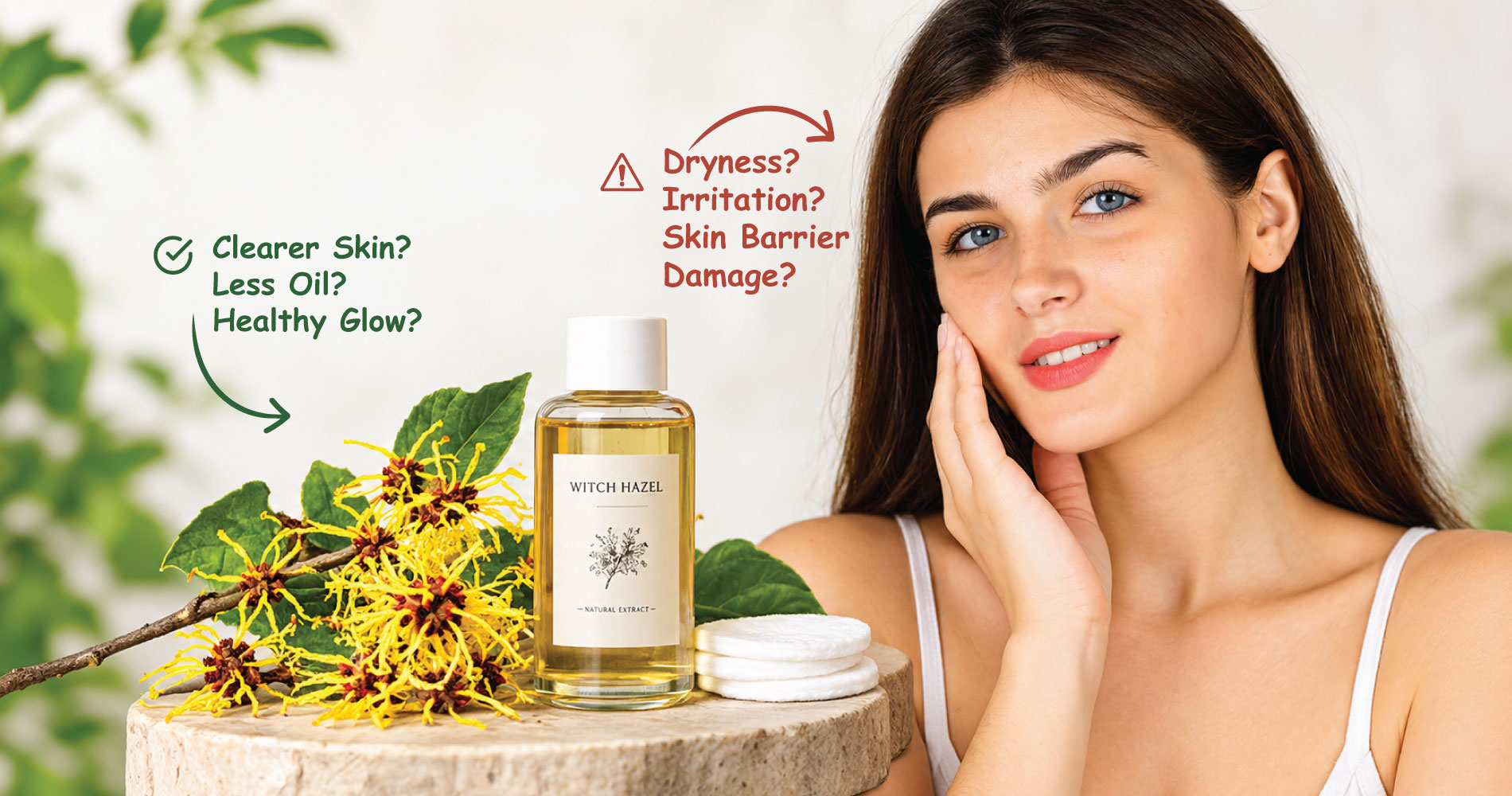
Your skincare routine includes a toner for oil control, a serum for radiant skin, and a moisturizer to maintain balance in the skin. But what if one of your favorite skincare ingredients is not as effective as the internet claims? Enter witch hazel which is a plant-based ingredient that has been used in traditional skincare for years and is commonly found in facial toners, astringents, and products made for oily or blemish-prone skin.
Among the benefits of witch hazel for the skin that are often discussed online are temporary oil control, antioxidant activity, and potentially skin-soothing effects. The plant compounds it contains, especially tannins and other polyphenols, have attracted the interest of scientists because of their biological properties. However, promising results in the laboratory do not by themselves guarantee proven skincare outcomes, and the effects of every witch hazel formulation are not the same.
Now comes the real twist: some products can make your skin feel refreshed and less oily, while others can cause dryness, stinging, or irritation. This experience depends on the product’s formulation, the amount of alcohol it contains, how often it is used, and your skin’s individual sensitivity. So, is witch hazel an essential part of skincare, or an overhyped ingredient with some drawbacks? Let us understand the science behind it, explore its potential benefits and limitations, and find out whether it deserves a place in your skincare routine.
Introduction: Understanding the witch hazel trend
In skincare trends, common ingredients often become overnight sensations. One week everyone is talking about a new serum; the next week, an old-fashioned toner suddenly emerges as a solution for oily skin, visible pores, and breakouts. Witch hazel falls into this second category. It has a long history of use on the skin and remains a familiar ingredient in products marketed for cleansing, oil control, and soothing the skin.
Its popularity is understandable. Witch hazel contains naturally occurring plant compounds that have been studied for their astringent, antioxidant, antimicrobial, and anti-inflammatory properties. These characteristics explain why it has attracted interest in dermatology and cosmetic science. However, a substance showing biological activity in research and a skincare product delivering a clear benefit in everyday use are two different things. Results depend on the form in which the substance is prepared, the concentration of the relevant compounds, what other ingredients are in the formula, and which skin-related concern is being addressed.
For example, a product may temporarily reduce the visible amount of oil on the surface, but that does not mean it is reducing oil production in your skin over the long term.
Similarly, research on the anti-inflammatory properties of a concentrated botanical extract does not mean that every toner containing that extract will soothe sensitive skin. Therefore, the real question is not simply whether witch hazel is good or bad. The question is what this ingredient can actually do, how limited the available evidence is regarding its benefits, and whether the product you are considering is suitable for your skin.
What Is Witch Hazel?
Witch hazel belongs to the Hamamelis genus. One common species, Hamamelis virginiana, grows in eastern North America and has a long history of traditional skincare use. Its leaves and bark contain natural compounds such as tannins, flavonoids, phenolic acids and other polyphenols that interest skincare researchers.
Where Is Witch Hazel Used?
Witch hazel commonly appears in:
- Facial toners and astringents for oily-feeling skin.
- Cleansers and aftershaves.
- Products designed for oily or blemish-prone skin.
- Topical preparations for minor skin discomfort.
- Formulations explored for their potential soothing and antioxidant properties.
Why Does Its Formulation Matter?
Not all witch hazel products are the same. Manufacturers may use distilled witch hazel or extracts from its leaves and bark. The preparation process affects the compounds present, while ingredients such as alcohol, fragrance and moisturizing agents can influence how the product feels and how well the skin tolerates it.
What Does Research Say?
A 2025 review published in Molecules examined witch hazel’s chemical composition, potential dermatological uses and available scientific evidence. Although researchers have identified promising properties, strong clinical evidence supporting many of its proposed skincare benefits remains limited.
The key takeaway: Witch hazel’s plant-based origin and potential benefits make it worth studying, but they do not guarantee that every product containing it will deliver the same results.
How does witch hazel actually work?
To understand its potential benefits, we need to look at the properties that make witch hazel different from other skincare ingredients.
1. Astringent properties
Witch hazel contains tannins. These are plant compounds that can react with proteins and contribute to producing an astringent effect. When applied to the skin, an astringent preparation can temporarily make the skin feel tighter and less oily. This is why witch hazel has traditionally been used in toners and aftershaves.
However, the feeling of tightness in the skin should not be understood as a permanent change in pore size or a reduction in the amount of oil produced by the skin.
2. Antioxidant Capacity
Witch hazel contains polyphenols, whose antioxidant activity has been studied. Antioxidants can help neutralize certain reactive molecules under experimental conditions. Therefore, they are relevant in research related to oxidative stress and skin health. However, demonstrating antioxidant activity in the laboratory does not by itself prove that a facial toner can prevent wrinkles, reverse sun damage, or lighten dark spots. Evidence from properly conducted studies on people is necessary to confirm such outcomes.
3. Potential Anti-Inflammatory Activity
Researchers have investigated whether witch hazel extracts can affect the biological pathways involved in inflammation in certain skin conditions.
In a 2022 study, a standardized extract derived from witch hazel bark was tested on human keratinocytes. These cells were exposed to inflammatory signals associated with atopic eczema. The researchers observed changes in several inflammation-related mediators. These findings offer a possible explanation for the ingredient’s potential skin-soothing properties, but the study was conducted in a laboratory model, not as a clinical trial of a regular facial toner on people with eczema.
These properties make witch hazel scientifically interesting, but they do not prove that every formulation will produce the same effects on human skin.
What are the potential witch hazel benefits for skin?
Witch hazel may have several properties that are useful in skincare, but the strength of the evidence supporting them varies considerably. Let us examine five potential benefits and what can realistically be expected from them.
1. May temporarily reduce the appearance of excess oil
If your face starts looking shiny just a few hours after cleansing, the astringent properties of witch hazel may be the reason for its popularity. Astringent products can make the skin feel temporarily less oily and give it a matte appearance. This may seem useful for people with oily skin who prefer a light, matte finish rather than a shiny one.
However, changing the feel of oil on the surface and reducing the amount of sebum produced by your skin’s sebaceous glands are different things. The effectiveness of witch hazel as a treatment for controlling excessive oil production over the long term has not been firmly established.
If you feel the need to repeatedly remove facial shine, it may be helpful to see whether your overall skincare routine is suitable for your skin. A gentle cleanser and a light moisturizer can help manage oiliness without making the skin excessively dry. The goal is not to eliminate all of the skin’s natural oils. Sebum contributes to the surface environment of the skin, and trying to remove it excessively can make your skincare routine uncomfortable.
2. Contains antioxidant compounds that interest researchers
One of the most interesting scientific aspects of witch hazel is its chemical composition.
Its leaves and bark contain tannins, flavonoids, and other polyphenols, which have been studied for their antioxidant activity. These compounds can react with reactive molecules under laboratory conditions. This is relevant to research related to environmental stress and the skin’s biological functions.
Oxidative stress is associated with many processes related to skin aging and environmental damage. Therefore, antioxidant compounds are an important area of scientific research.
However, there is a catch. Finding antioxidant activity in an extract does not mean that applying a witch hazel toner will prevent fine lines, reverse the effects of sun-induced skin aging, or remove sunspots.
The concentration of the compounds, the method used to extract them, the final formulation, and the results of human studies, all of these matter. It is useful to investigate the antioxidant capacity of witch hazel, but it should not be seen as a proven anti-aging treatment or a substitute for sunscreen.
3. May have soothing potential in certain formulations
Can witch hazel help soothe irritated skin? Research offers some interesting clues, although it is important to interpret the evidence cautiously. In the previously mentioned 2022 laboratory study, a standardized extract derived from witch hazel bark was found to affect inflammatory mediators in human keratinocytes exposed to eczema-related inflammatory signals. This suggests that certain compounds may influence biological pathways involved in inflammation.
A separate randomized controlled study in 2024 examined two dermo-cosmetic products containing witch hazel in people with eyelid dermatitis. The study reported improvements in several measured outcomes. However, these findings apply to those specific products and the study conditions, not to every toner containing witch hazel on its own.
That is why it is important to understand the difference between a product formulated for a specific skin-related concern and a general cosmetic product that merely contains witch hazel.
If you have eczema, rosacea, or persistent redness, do not assume that witch hazel will soothe your skin. Some formulations may be unsuitable for reactive skin, and it is important to seek proper medical advice for persistent symptoms.
4. Can be part of a routine for oily or blemish-prone skin
Witch hazel is often marketed to people who struggle with breakouts, clogged pores, and excess shine. Its astringent properties and the antimicrobial activity observed in some extracts help explain this association. However, acne is not only a problem of oily skin. It involves several processes, such as the clogging of hair follicles, inflammation, and the activity of Cutibacterium acnes in the environment of the hair follicles.
A toner that makes your face feel less oily does not necessarily address these processes effectively. Similarly, laboratory findings about the antimicrobial activity of an extract do not prove that any toner available to consumers will clear acne.
For persistent breakouts, treatments with stronger evidence such as benzoyl peroxide, salicylic acid, or topical retinoids, may be more appropriate. The right choice depends on the type and severity of acne. These treatments can also cause irritation, so they should be selected according to your skin’s needs and used as directed. Witch hazel can be an optional part of a well-tolerated skincare routine, but this ingredient alone should not be considered a proven acne treatment.
5. Has a history of use for minor skin discomfort
Witch hazel has a long history of use on the skin. It has been used for minor skin problems such as irritation and pain. Some preparations are used as astringents, and their traditional uses have led to further research into their potential dermatological applications. However, traditional use and strong clinical evidence are not the same thing.
The European Medicines Agency has evaluated witch hazel preparations in the context of traditional herbal use. Evidence related to a specific preparation and its use cannot automatically be applied to every cosmetic product containing that plant. For example, a product made for a particular minor skin problem and labeled for that purpose should not be regarded as the same as a facial toner.
The practical conclusion is simple: the history of witch hazel use is understandable, but its benefits depend on the preparation and its intended use.
Witch hazel for oily skin, acne and enlarged pores: Which concerns can it address?
Now that we have understood its potential benefits, let us look at the role witch hazel may play in the context of some common skin concerns.
For oily skin
Because of its astringent properties, witch hazel may make the skin feel temporarily less oily. However, its effectiveness as a long-term solution for controlling sebum production has not been established. If your skin feels persistently tight or flaky and dry after using a toner, it is possible that its formulation is too drying for you. A matte finish is a cosmetic preference, not an essential requirement for healthy skin.
For acne and blackheads
Researchers have not established witch hazel as an effective standalone treatment for acne or blackheads. Blackheads develop when oil and dead skin cells clog hair follicles; you cannot simply wipe them away like dirt.
Depending on your needs, a properly formulated salicylic acid product may be more useful for addressing clogged pores, while other acne treatments may help with inflammatory breakouts.
If your acne is painful, persistent, or leaving scars, consider consulting a dermatologist rather than repeatedly switching toners.
For enlarged pores
Witch hazel may temporarily create a feeling of tightness in the skin, but that does not mean it permanently reduces pore size. How visible pores appear is influenced by many factors, including genetics, sebum, clogged follicles, and age-related changes in the skin. No astringent can permanently change these underlying factors simply by making the skin feel tighter.
For redness and uneven skin tone
In research on inflammatory skin conditions, certain specialized formulations of witch hazel have shown promise. However, this does not mean that any ordinary facial toner will reliably treat rosacea, persistent redness, or post-acne pigmentation. If your main concern is dark spots, consider evidence-based ingredients for controlling pigmentation and use daily sun protection. The effectiveness of witch hazel as a standalone treatment for hyperpigmentation has not been established.
The main point is that different skin problems require different approaches. The popularity of an ingredient does not make it a solution for every issue.
What are the limitations of witch hazel in skincare
Here, the claims need to be tested against reality. An ingredient may have interesting properties, yet still not be as effective as marketing claims suggest.
1. Strong clinical evidence is limited for many claims
A 2025 review of research on witch hazel highlighted its potentially useful biological properties. At the same time, it noted that solid clinical data are limited for many of its cosmetic and dermatological uses.
Laboratory studies can help scientists understand how an extract works under controlled conditions. However, such studies alone cannot establish how effective a finished product will be on real skin. Human studies are needed to assess outcomes such as persistent oiliness, acne severity, pigmentation, and visible signs of aging.
2. Results depend on the formulations
Not all witch hazel products contain the same extract or the same concentration of plant compounds. Some preparations contain distillates, while others use extracts derived from the leaves or bark. The method of manufacture and additional ingredients can affect the properties of the finished product. This means that the results of research conducted on one standardized extract may not accurately predict the effects of another commercial toner.
3. It does not replace targeted skincare treatments
Witch hazel should not be seen as a substitute for evidence-based treatments for acne, persistent pigmentation, eczema, or other ongoing skin problems. A product may be useful for a limited purpose, but that does not mean it will be effective for every skin-related issue claimed on its packaging.
4. Astringency is not the same as long-term skin improvement
The immediate tightening sensation associated with witch hazel may give the impression that the skin is healing or that the pores are becoming smaller. However, a temporary cosmetic effect does not necessarily mean that there has been a lasting improvement in the way the skin functions. It is important to see whether a product provides a real and useful benefit without causing discomfort.
Can witch hazel damage your skin barrier?
Your skin barrier is the outer protective layer of the skin, which helps limit moisture loss and protect against external irritants. When it functions properly, the skin generally retains moisture more effectively and feels comfortable.
When the skin barrier is compromised, you may experience tightness, dryness, flaking, itching, burning, or increased sensitivity. Witch hazel does not, by itself, damage the skin barrier. However, a formulation that repeatedly leaves your skin dry or irritated can contribute to discomfort, especially when your routine already includes several potentially irritating products.
1. Alcohol content can make a difference
Some witch hazel products contain alcohol, while others are made without it. Alcohol can act as a solvent and help the product dry more quickly. Its effect depends on the type and concentration of alcohol used, the other ingredients in the formula, and your skin’s reaction.
However, a product that causes excessive dryness may be uncomfortable for people with dry or sensitive skin. The American Academy of Dermatology advises avoiding skincare products containing alcohol when caring for dry skin. Read dermatological advice. This does not mean that every formula containing alcohol is harmful, or that every alcohol-free product is gentle. It means that if your face repeatedly feels tight, burning, or flaky after applying a particular toner, you should reconsider using it.
2. The tight feeling is not proof that your skin is healthier
You apply toner, wait a few seconds, and your face feels tight. It may seem as though the product is working exactly as promised. But tightness is a sensation, not a reliable measure of skin health.
An astringent can temporarily change the way your skin feels, but that does not necessarily mean it is improving its condition in the long term. If this sensation is accompanied by persistent dryness, stinging, or flaking, it is possible that the product is not suitable for your skin. For your face to be properly cleansed, it does not need to feel completely taut or squeaky clean.
3. Combining too many active ingredients can increase irritation
Imagine that you are using a witch hazel toner along with a strong exfoliating acid, a retinoid, and a cleanser that already leaves your face feeling dry. Even though each of these products may be suitable for some people, using them all together can cause excessive irritation to your skin.
Repeated irritation can make your routine uncomfortable and worsen existing skin-related problems. The issue may arise not only from witch hazel itself, but also from the combined effects of multiple products. If your skin is already peeling, inflamed, or unusually sensitive, simplify your routine instead of adding another active ingredient.
4. Natural does not mean irritation-free
Witch hazel is derived from a plant, but that does not mean every preparation of it will be gentle for everyone. Botanical extracts contain biologically active compounds, and some people may experience irritation or allergic contact dermatitis from a product’s ingredients. Fragrance, preservatives, and other components can also contribute to a reaction. A product’s natural source does not guarantee its safety. More important than the marketing terms on the bottle are your individual tolerance and the overall formulation.
Witch hazel side effects: What should you watch for?
The most important thing is that when your skin signals that a product is not working properly, do not ignore it. Possible side effects depend on the product’s formulation, how often it is used, and your individual sensitivity.
Dryness and tightness
If your skin feels unusually dry after application, especially if that feeling persists, the formulation may be causing too much dryness for you. Repeated dryness can make your routine uncomfortable and may worsen any existing sensitivity.
Redness, stinging, or burning
Ongoing discomfort is not proof that a product is working. If you experience burning, redness, or peeling, stop using it and, if the product is still on your skin, gently wash it off.
Itchy rash or hives
Itchy rashes, swelling, or redness that develop a few hours or days after application may indicate an allergic reaction. Witch hazel itself or another ingredient in the product may be responsible. If the reaction is severe or does not improve even after stopping the product, seek medical advice.
Increased skin discomfort:
If your face becomes progressively more sensitive after you start using witch hazel, consider your entire routine. This includes cleansers, exfoliants, retinoids, and fragranced products.
There is not strong evidence to claim that witch hazel causes acne in everyone. However, a particular formulation may not suit your skin, and irritation can make it harder to manage pre-existing skin concerns. If your face swells or you have difficulty breathing, seek emergency medical help immediately.
Who should use witch hazel and who should be cautious?
Witch hazel is not inherently right or wrong for any entire skin category. Your skin’s current condition and the specific formulation of the product are more important than broad classifications such as oily or dry.
People with oily skin who temporarily prefer a matte finish may find a well-tolerated product useful. Those with combination skin should check whether it causes discomfort in the relatively dry areas of the face.
If your skin is dry, be cautious when using products that make the face excessively dry, especially if they contain drying alcohol. People with sensitive skin should also pay attention to fragrance, preservatives, and other ingredients that may trigger a reaction.
If you have eczema, rosacea, or active inflammation in the skin, do not assume that any plant-based toner will soothe your skin. A product that feels refreshing on one person’s skin may worsen another person’s symptoms. And if your current routine keeps your skin comfortable, there is no need to add witch hazel just because it is trending.
How to use witch hazel in a simple skincare routine
Your skincare routine does not need to become a chemistry experiment. If you want to try witch hazel, the goal is to incorporate it thoughtfully so that your skin is not overburdened.
Step 1: Cleanse your face gently
Use a cleanser that is suitable for your skin. Avoid scrubbing vigorously or using very hot water, especially if your skin is already dry or sensitive.
Step 2: Patch test before regular use
The American Academy of Dermatology recommends testing new skincare products on a small area twice a day for seven to ten days. While doing so, follow the product instructions. If redness, itching, swelling, or any other reaction develops, stop using the product. A patch test can help identify potential problems, although it does not guarantee that no reaction will ever occur in the future.
Step 3: Follow the product instructions
Do not assume that every product containing witch hazel should be applied in the same way or with the same frequency. Follow the instructions on the label, and unless a health professional recommends a specific preparation, avoid applying it to cracked or severely irritated skin.
Step 4: Apply an appropriate moisturizer
Choose a moisturizer that helps keep the skin comfortable and reduces moisture loss. Ingredients such as glycerin, hyaluronic acid, and petrolatum can be useful in moisturizing formulations, depending on your skin’s needs.
Step 5: Use sunscreen during the day
During the daytime, apply a broad-spectrum sunscreen with SPF 30 or higher. Witch hazel, despite its antioxidant potential, is not a substitute for sun protection.
Keep a few things in mind
- Introduce new skincare products into your routine gradually.
- Do not start using multiple new active ingredients at the same time.
- If persistent redness, irritation, or dryness develops, stop using the product.
- Do not skip moisturizer just because your skin is oily.
- Remember that using a separate toner is optional, not mandatory.
If you are using skincare products prescribed by a doctor or have any ongoing skin condition, consult a qualified healthcare professional before making major changes to your routine.
How long does it take to see results?
Skincare results depend on the ingredients, the product formulation, the skin-related concern, and the frequency of use. There is no single timeline that applies equally to everyone. The astringent effect of witch hazel may be felt immediately after application, as it can temporarily change the way the skin feels. However, this immediate sensation should not be mistaken for a lasting improvement in oil production, pore size, or skin health.
For other benefits, such as soothing the skin or possible improvement in the visible effects of inflammation, results depend on the specific preparation and the condition being treated. For a general witch hazel toner, there is not enough strong evidence to promise a definite timeline. It is also important to distinguish between temporary cosmetic effects and changes that require long-term treatment. If your goal is to manage persistent acne, pigmentation, or an inflammatory skin condition, a targeted treatment may be more appropriate.
Avoid comparing your results with the dramatic before-and-after photos shown on social media. Lighting, camera settings, makeup, and other skincare products can also affect the way skin appears in photos. And if a product is causing persistent irritation instead of improvement, continuing to use it in the hope that it will eventually start working is not the right approach.
What does scientific research say about witch hazel?
A 2025 review published in Molecules explored Hamamelis virginiana and its potential skincare applications, highlighting compounds such as tannins, flavonoids and polyphenols. Research has investigated their antioxidant, antimicrobial and anti-inflammatory properties, but stronger clinical evidence is still needed to confirm many proposed benefits.
A 2022 laboratory study examined a standardized witch hazel bark extract in human skin cells exposed to inflammation-related signals associated with atopic eczema. Although researchers observed changes in inflammatory markers, this does not prove that everyday skincare products containing witch hazel can treat eczema.
Why Do These Findings Need Context?
Research findings depend on several factors:
- Study type: Laboratory results do not automatically translate into benefits for people.
- Formulation: Different witch hazel preparations may have different properties.
- Measured outcomes: Changes in inflammatory markers do not necessarily mean visible improvements in acne, pigmentation or skin ageing.
- Individual response: Even a well-formulated product may not suit every skin type.
The Bottom Line
Witch hazel remains an interesting subject in skincare research, but claims that it can solve every skin concern go beyond the available evidence. Understanding what was studied, which preparation was tested and whether the findings apply to a specific skin concern is essential when evaluating its potential benefits.
Skincare hype vs. science: What gets exaggerated online?
Let’s clear up some of the most common misconceptions about witch hazel.
Myth 1: Witch hazel permanently shrinks pores.
Truth: Its astringent properties may temporarily make the skin feel tighter, but there is no solid evidence that it permanently shrinks pores.
Myth 2: Witch hazel completely cures acne.
Truth: The antimicrobial and anti-inflammatory activity of some extracts has been studied, but witch hazel has not been established as a standalone treatment for acne.
Myth 3: Natural ingredients cannot cause skin irritation.
Truth: In some people, botanical extracts can cause irritation or allergic reactions. Being naturally derived does not guarantee tolerance for everyone.
Myth 4: Alcohol-free witch hazel is always gentle.
Truth: Alcohol-free formulations may be better for some people, but other ingredients can still cause irritation. The overall formulation matters.
Myth 5: Feeling tightness in the skin means the toner is working.
Truth: Tightness is not a reliable measure of skin health. Persistent burning, stinging, or flaking may be a sign of skin irritation.
Myth 6: Witch hazel removes dark spots.
Truth: The effectiveness of witch hazel as a standalone treatment for hyperpigmentation has not been established. Dark spots may require targeted skincare and consistent sun protection.
Myth 7: Everyone with oily skin needs witch hazel.
Truth: Toners are optional. If your current routine keeps your skin comfortable and addresses your concerns, you may not need a toner at all.
Conclusion: Is witch hazel worth the hype?
Witch hazel is neither a guaranteed miracle in skincare nor, by itself, an enemy of the skin barrier. It is a plant-based ingredient with a long history of use on the skin and contains scientifically interesting properties. These include astringent effects and compounds that have been studied for their antioxidant and anti-inflammatory activity.
However, the strength of the evidence varies for different uses. Some specific preparations have shown promising results, but many popular claims, especially those related to permanently shrinking pores, reliably treating acne, and dramatically reducing the effects of aging, go beyond what the current research can support with confidence.
Potential benefits of witch hazel for the skin may include making the skin feel temporarily less oily and providing possible benefits from certain formulations. However, its usefulness depends on the product, your skin’s needs, and your ability to tolerate it. Formulations that cause excessive dryness or irritation may leave some people with more discomfort than benefit.
If you want to try witch hazel, first identify your skin’s actual concern, choose a suitable formulation, and introduce it carefully into your routine. If persistent irritation occurs, stop using the product rather than continuing to tolerate the symptoms.
Ultimately, skincare is not about collecting every trending ingredient or chasing an instant matte finish. It means choosing products with real benefits, understanding their limitations, and building a routine that keeps your skin comfortable over time. Because the real glow-up is not about having the most products on your shelf. It is about understanding what your skin needs and also recognizing that a viral skincare hack may not be right for you.
Disclaimer
This article is for general information and educational purposes only. It is not medical advice, diagnosis, or treatment, and should not be used as a substitute for consulting a qualified dermatologist or healthcare professional.
The potential benefits and side effects of witch hazel may vary depending on its preparation, the product formulation, and an individual’s skin response. Although some preparations have a history of use on the skin, evidence supporting many of its cosmetic claims remains limited.
Introduce new products into your routine cautiously, follow the manufacturer’s instructions, and consider performing a patch test before regular use. If persistent redness, irritation, itching, swelling, or excessive dryness develops, discontinue use. Seek appropriate medical advice for possible allergic reactions, persistent acne, eczema, rosacea, or other ongoing skin concerns.
FAQs
1. What are the main benefits of witch hazel for the skin?
Witch hazel contains astringent compounds that can temporarily make the skin feel tighter and less oily. Research has also highlighted the antioxidant and anti-inflammatory potential of its plant compounds. However, researchers have not yet confirmed many of its cosmetic benefits through clinical studies, and the available evidence varies in strength.
2. Is witch hazel good for oily and acne-prone skin?
If the formulation is well tolerated by the skin, it may be suitable for some people with oily skin. However, it has not been proven to be a long-term sebum controller or a standalone treatment for acne. People dealing with persistent breakouts may benefit more from evidence-based treatments chosen according to their skin’s needs.
3. Can witch hazel damage your skin barrier?
Witch hazel does not, by itself, damage the skin barrier. However, a product that repeatedly causes dryness or irritation may be unsuitable for you, especially if your routine also includes other potentially irritating ingredients. If persistent tightness, burning, or redness develops, stop using it.
4. Is alcohol-free witch hazel better for sensitive skin?
If alcohol-containing products make your skin uncomfortable, an alcohol-free formulation may be worth considering. However, alcohol-free does not necessarily mean irritation-free. Other ingredients and your individual sensitivity also matter, so perform a patch test before regular use.
5. Can I use witch hazel on my face every day?
It depends on the specific product and your skin’s tolerance. Follow the instructions on the label, start using it carefully, and stop using it if irritation occurs. Daily use is not necessary, and people with sensitive or already irritated skin should take special care.

Content Writer with 3+ years of experience turning ideas into words people want to read, share, and remember. I create research-backed social media and lifestyle content that blends storytelling, creativity, and audience insights to make every piece feel fresh, relatable, and engaging.