
Abstract: The Big Science Behind a Small Physical Reaction
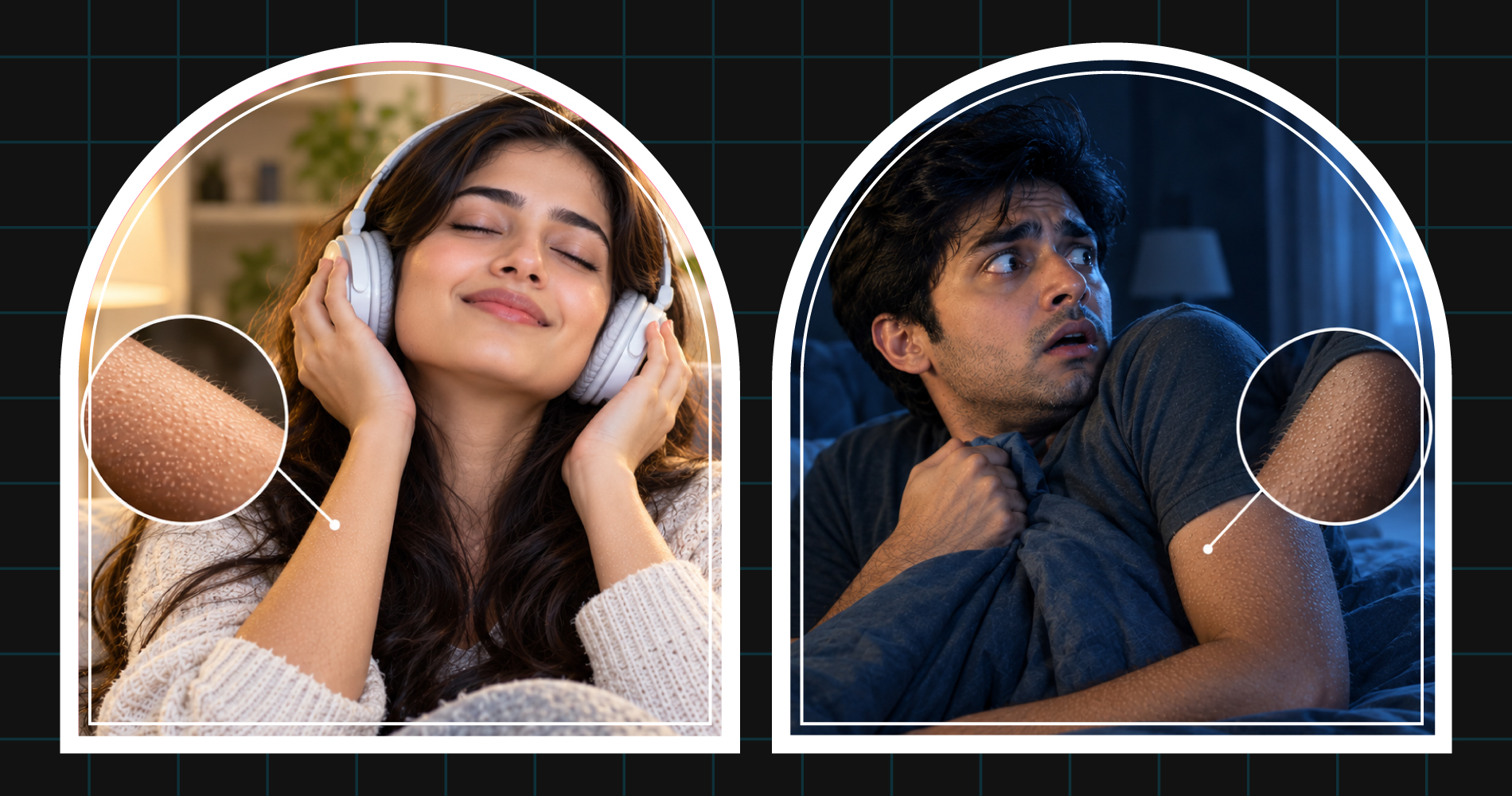
Have you ever been suddenly startled by a frightening sound? Have you ever felt a shiver run through your body while watching an emotional scene in a film? It may also have happened that, upon hearing a line from a favorite song, tiny bumps appeared on your skin.
All three experiences have one thing in common: the body responds without your conscious will. In everyday language, we call this goosebumps. Science calls this process piloerection, while in English it is known as goosebumps. Interestingly, cold or fear is not always necessary for goosebumps to appear. Joy, emotion, excitement, music, and even a deep memory can trigger the same response.
The small muscles present in our skin and the sympathetic nervous system together produce this change. When the muscles contract, the hairs stand upright and the skin around them rises slightly.
Research published in the scientific journal Cell in 2020 showed that the muscles that cause goosebumps, nerves, and hair follicle stem cells are interconnected. On the other hand, studies on music have found a connection between the experience of intense pleasure and the release of dopamine in the brain.
In this article, we will understand why goosebumps occur, how fear and music affect the body in different ways, what this response has to do with our evolution, and when this common experience may require medical attention.
Introduction: When the skin begins to signal our emotions
We usually believe that emotions are created only in the mind. When we feel happy, we smile. When we are afraid, the heart beats faster. When we are sad, tears may come to our eyes. But emotions are not limited only to the face or to thoughts. Our skin also becomes part of emotional changes.
When watching a scary movie, you may know that what is shown on the screen is not real. Even so, if there is a sudden loud sound, the body may startle. Similarly, the tune of a song can bring back memories from years ago. At times you feel sad, at times happy, and at times you become emotional without saying anything.
At such moments, some bodily reactions remain beyond our direct control. Goosebumps are one such reaction. But this raises a question: when fear and music are different experiences, why does the body respond to both in the same way?
To understand the answer, we must understand the system in the body that works without our will. Our brain is constantly receiving information from the outside world. The eyes see images. The ears hear sounds.
The skin senses temperature and touch. Based on these signals, the nervous system brings about changes in the body’s activities. For every change, we do not have to think and give an order.
You do not have to instruct your heart to keep beating. When you suddenly feel cold, the body begins several reactions on its own.
In the same way, the process that causes goosebumps also happens automatically. This is why, even if we want to, we cannot always stop goosebumps, nor can we produce them at will every time. Understanding this small reaction shows us how deeply the body and emotions are connected.
What are goosebumps, and how do the hairs on the skin stand up?
Although our skin appears simple from the outside, highly complex structures work within it. The skin contains hair follicles, small blood vessels, nerves, glands, and many types of cells.
When we say that the hairs have stood up, in reality a small muscle inside the skin has become active.
What does the arrector pili muscle do?
A small smooth muscle is attached to most hair follicles in our skin. Scientists call it the arrector pili muscle. When this muscle is in its normal state, the hairs remain in their natural direction. But as soon as it receives an appropriate nerve signal, it begins to contract.
This contraction pulls the hairs upward. At the same time, the skin around the hairs rises slightly. This raised surface appears like tiny bumps. The scientific name for this entire process is piloerection. No new bumps are formed on the skin. The structure around the already existing hair follicle temporarily changes its shape.
Contraction of the arrector pili muscle
Hair standing up and goosebumps appearing on the skin This process can happen very quickly. That is why, at times, a person first feels goosebumps and only afterward notices what caused them.
Can goosebumps appear on every part of the body?
Goosebumps are mainly visible on those areas where hair follicles and the muscles associated with them are present. We can easily see them on the arms, legs, neck, and back. However, this response is not equally visible on all parts of the body.
The reason for this may be hair density, skin texture, and the physical structure of that area. On some people’s arms, the small bumps are very clearly visible. Others feel only a slight shiver.
Why does the skin get goosebumps when we feel afraid?
Fear is an important emotional response of the body. Its main function is to draw our attention to a potential threat and, when necessary, prepare the body for action.
When we sense danger in a situation, the brain assesses it through several neural networks.
Parts such as the amygdala play a role in understanding threat and emotional significance. However, fear does not arise from only one part of the brain. It involves multiple brain regions and networks of the nervous system.
What is the fight-or-flight response?
When we feel afraid, the body often activates the fight-or-flight response. This response helps prepare us to confront the danger or move away from it. During this time, several changes may occur.
- The heart rate may increase.
- Breathing may become faster.
- Sweating may occur.
- Muscle tension may increase.
- Attention may become focused on the potential threat.
- Goosebumps may appear on the skin.
The Sympathetic Nervous System plays an important role in these responses. It is important to note that not all symptoms appear together in every frightening situation. The body’s response varies according to the situation and the individual.
The Role of the Sympathetic
- Nervous System One part of our Autonomic Nervous System is called the Sympathetic Nervous System.
- It helps control many involuntary activities of the body.
- When a threatening situation arises, this system activates different organs and tissues of the body.
- Sympathetic nerves present in the skin signal the arrector pili muscles to contract.
- This is why goosebumps can appear when we feel fear.
- According to the Cleveland Clinic, goosebumps are among the common responses associated with the activation of the Sympathetic Nervous System.
Do goosebumps appear with every fear?
No. Some people get goosebumps when they are suddenly startled. Some people sweat more during fear. Others may feel their hands tremble or experience stomach discomfort.
This variation is normal.
A person’s past experiences, current mental stress, the environment, and the intensity of the threat can all affect the body’s response.
Therefore, the absence of goosebumps is not proof of the absence of fear.
Likewise, the presence of goosebumps is not always a sign of fear.
5. Why do goosebumps appear while listening to music?
- Goosebumps caused by fear are somewhat understandable. But experiencing them while listening to music is a more interesting question.
- After all, how does a song prompt the body to produce a response that also appears in cold or dangerous situations?
- This is related to the process of listening to music, emotions, memory, and the brain’s reward system.
What are Music-Induced Chills and Frisson?
When music affects us very deeply, we sometimes feel a bodily response such as shivers, tingling, or goosebumps. Scientists call such an experience Music-Induced Chills or Frisson. Frisson is a French word, meaning something close to “trembling” or “shivering.” However, chills caused by music and goosebumps visible on the skin are not exactly the same.
A person may feel a shiver in the body while listening to a song, but no clear goosebumps may appear on the skin. On the other hand, some experiences do involve actual piloerection. That is why, when conducting scientific studies, researchers try to measure separately the experiences reported by people and the responses visible on the skin.
How does music directly affect the body?
When we listen to music, the ears convert sound into nerve signals. The auditory regions of the brain use these signals to understand pitch, rhythm, voice, and changing patterns of sound. But music is not limited to hearing alone. The brain also evaluates its emotional meaning.
A sudden change in a melody, the intensity of the sound, a familiar tune, or a personal memory can intensify our emotional experience. At certain moments, this experience becomes so profound that the autonomic nervous system is also activated. Then we may feel a shiver in the body or goosebumps.
Can every song give you goosebumps?
- Not necessarily. The effect of a song does not depend only on how popular it is or how loudly it is played.
- One person may have a deep emotional response to classical music. Another may be moved by an old film song.
- Someone may have such an experience while listening to a bhajan, qawwali, or folk music. The personal meaning of music is also important.
- A song connected to an old memory for you may be completely ordinary for someone else.
- Therefore, the answer to why goosebumps arise while listening to a song lies not only in the melody of the music, but also in the listener’s brain and experiences.
The Relationship Between Music, Dopamine, and the Brain Reward System
Why does music feel good to us?
- Scientists have been researching this question for a long time.
- Our brain uses networks associated with reward processing during food, social bonding, and other pleasurable experiences.
- Music can also influence these networks.
What is dopamine?
- Dopamine is a neurotransmitter.
- It plays a role in the exchange of signals between nerve cells.
- Dopamine is often described only as a chemical that gives pleasure, but this definition is incomplete.
- It is also associated with motivation, learning, reward prediction, and many aspects of behavior.
- Its role in the context of music is especially interesting.
The researchers examined the relationship between intense pleasurable emotions experienced while listening to music and dopamine release in the brain. They used brain imaging techniques such as PET and functional MRI. In the study, the scientists found that dopamine is released in brain regions associated with the striatum during the listening of extremely pleasurable music.
In particular, differences were observed in two regions:
- Caudate: appeared to be more associated with the expectation or anticipation of highly pleasurable moments in music.
- Nucleus Accumbens: showed a stronger association during the most pleasurable experience of music, that is, the peak emotional response.
- This led the researchers to explain that the enjoyment of music is not linked only to the moment when we hear our favorite note. The anticipation of that moment may also be important.
What does this mean?
Suppose you really like a song. You already know that, a few seconds later, its best part is going to come. Even before that part arrives, your attention and excitement may increase. As soon as that part begins, you may feel deep joy or a shiver.
This example helps explain why both expectation and reward are important in the experience of music. However, chills do not always mean that dopamine levels have increased. Scientific studies describe correlations found in groups. They do not fully explain every experience of any one individual.
What was revealed in the 2001 study?
Another study published in the Proceedings of the National Academy of Sciences (PNAS) examined brain activity during intense musical pleasure. The researchers found that the pleasurable chills produced by participants’ favorite music were associated with activity in brain regions related to reward and emotion.
In the study, changes were also observed in heart rate, breathing, and some other physical indicators during the most intense experiences. This shows that the deep joy produced by music is not only a mental experience. It can also be accompanied by measurable changes in bodily activity.
Why does the same physical response occur in both fear and joy?
So far, we have seen that fear can also cause goosebumps, and music can as well. But the nature of these two emotions is different. Fear can alert us to avoid a threat. Music can connect us with pleasure, emotion, or nostalgia.
So why does the same bodily system become active in both situations?
The reason is that our autonomic nervous system does not respond only by judging emotions as good or bad. It is also linked to emotional arousal, that is, the intensity of emotional stimulation.
What is Emotional Arousal?
Emotional arousal is a state in which an experience increases the activity of the brain and body. Fear, excitement, surprise, sentimentality, and deep happiness are different emotions, but in all of them the body can become more active. For example, sudden good news can make the heart beat faster.
During a frightening event, the heartbeat can also increase. However, the emotional meaning of both experiences remains different. Similarly, the fact that goosebumps look the same does not prove that exactly the same process is taking place in the brain in both situations.
Are goosebumps associated only with intense emotions?
Scientists are also studying this question. Some research suggests that true emotional piloerection may appear especially when a person is deeply affected by an experience. In English, this state is called being moved. A person can be deeply moved by an emotional speech, a scene from a film, or meaningful music. Therefore, instead of seeing only fear or happiness separately, it is also necessary to understand the nature and intensity of the emotional experience.
8. What is the relation between goosebumps and our evolution?
Some reactions of the human body carry within them the story of millions of years of evolution. Goosebumps are one of these. Today, we get goosebumps when we feel cold, but their benefit in maintaining body temperature is very limited.
In contrast, in many animals with dense hair, this same reaction is more useful. The benefit of hair standing up in animals When the hair of an animal with dense fur stands up, the texture of its fur changes. This can help maintain a layer of air between the hairs.
This layer of air helps reduce the rate at which heat escapes from the body. In this way, piloerection can become part of the process of protection from cold. But its role is not the same in all animals.
Why do animals’ hair stand up at times of danger?
You may have seen a cat when it is scared or angry. Many times the hair on its back and tail stand up. This can make it look somewhat larger than its normal size. In some animals, this reaction is linked to making the body look bigger in the face of a potential threat.
However, in every species its purpose and effect can be different. Humans also get goosebumps when afraid, but we don’t have dense hair on our bodies. So, unlike an animal, the effect of making our size look bigger is very small.
Are goosebumps in humans an old response?
During evolution, the structure and density of hair on the human body underwent significant changes. But the small muscles attached to the hair follicles and the nervous system that controls them still exist today. Therefore, the goosebumps response during cold or emotional arousal continues.
We can understand this as an example connected to our evolutionary history. Even so, scientists do not consider it a completely inactive or useless process. There is an important reason behind this.
9. Is there a connection between goosebumps and hair growth as well?
Research published in the scientific journal Cell in 2020 revealed a new role for the structures associated with goosebumps. In this study, scientists examined the relationship between sympathetic nerves, arrector pili muscles, and hair follicle stem cells present in the skin.
What did the researchers find?
The study revealed that the muscles that make hair stand up do not only participate in piloerection. These muscles also help maintain structural connections with the sympathetic nerves present around the hair follicles.
Researchers found that these nerves can influence the activity of hair follicle stem cells through a neurotransmitter called norepinephrine. This mechanism can become more active when exposed to cold. NIH explained this study in its Research Matters article published on July 28, 2020. A large part of the research was based on mice.
Do goosebumps make human hair grow faster?
The answer to this question should be understood carefully. The study shows that there is an important biological relationship between the nerves present in the skin and hair follicle stem cells.
But this does not prove that deliberately staying in the cold or repeatedly getting goosebumps will make human hair grow faster.
At present, there is not enough clinical evidence regarding this in humans. Therefore, it would not be correct to consider goosebumps as a hair growth treatment. The importance of the research is that scientists can better understand skin repair and hair follicle biology.
10. Why do some people get goosebumps from music, while others don’t?
The same song can have a different effect on two individuals. One person becomes emotional while listening to music. The same song may seem normal to another person. Someone may feel a slight shiver in the body. Another may not feel any physical change. This difference is not only related to musical preference.
Differences in brain reward sensitivity
The brain’s reward networks do not work exactly the same way in all people. Scientists have found that the pleasure derived from music can vary greatly from person to person.
A study published in Current Biology in 2014 identified some healthy individuals who did not have difficulty understanding music, but derived very little pleasure from it.
Despite this, they could gain pleasure from other enjoyable activities. Scientists call this specific experience Specific Musical Anhedonia. This does not mean that such individuals lack emotions.
It only means that their reward response to music may be different.
Is not getting goosebumps from music a sign of illness?
No. Every person’s emotional experience of music is different. Not getting goosebumps from a song is normal and in itself is not evidence of any illness. It is also not necessary that a person who feels goosebumps from music is more sensitive, intelligent, or emotional than others.
Scientists are still trying to understand how individual differences develop between musical preference, auditory processing, and reward networks. A review published in Trends in Cognitive Sciences in 2026 also discussed individual differences in the pleasure derived from music and the related networks in the brain.
Can Goosebumps decrease by listening to the same song again and again?
Sometimes our response to a piece of music can change over time. On hearing it for the first time, some part may suddenly surprise you. On listening again, its impact may feel reduced.
But this does not always happen. If our emotional memories are attached to a favorite song, then even on listening to it repeatedly, it can be a deep experience. Therefore, there is no fixed rule for the Chills that come from music.
11. What is the difference between goosebumps, shivering and tingling?
In everyday language we consider many physical experiences to be the same. But from a scientific point of view, goosebumps, shivering and tingling are different responses.
Difference Between Goosebumps, Shivering, and Tingling
| Feature | Goosebumps | Shivering | Tingling |
|---|---|---|---|
| Meaning | Small bumps appearing on the skin | Involuntary shaking or trembling of the body | A pins-and-needles sensation |
| Main Process | Contraction of tiny muscles attached to hair follicles | Repeated, involuntary muscle contractions | Sensations associated with sensory nerve activity |
| Common Causes | Cold temperatures, fear, and strong emotions | Cold temperatures, fever, and chills | Nerve compression, temporary nerve irritation, or other underlying conditions |
| Physical Sensation | Small, raised bumps on the skin | Shaking or trembling of the body | Pricking, pins-and-needles, or a mild burning sensation |
| Do They Always Occur Together? | No | No | No |
When can the sudden appearance of goosebumps on the body be a matter of concern?
Repeated goosebumps without any clear reason
Goosebumps with fever or intense shivering
- If goosebumps occur along with fever, shivering, or weakness, the cause may be different from the body’s usual emotional response.
- During a fever, a person may feel cold even though the actual body temperature is elevated.
- In such a situation, one should not try to identify the illness based only on goosebumps.
- According to the Cleveland Clinic, medical attention may be necessary if chills occur along with extremely high temperature, difficulty breathing, chest pain, or other serious symptoms.

Emanual Massey is a healthcare, lifestyle, and beauty content writer with over 7 years of professional experience. He specializes in writing SEO-optimized, research-based articles on health, wellness, nutrition, skincare, beauty, and Ayurveda. His mission is to simplify complex topics into practical, reader-friendly content that empowers people to make healthier lifestyle choices. Passionate about continuous learning and evidence-based writing, Emanual creates informative and engaging blogs that combine accuracy, readability, and search engine optimization.