
Abstract
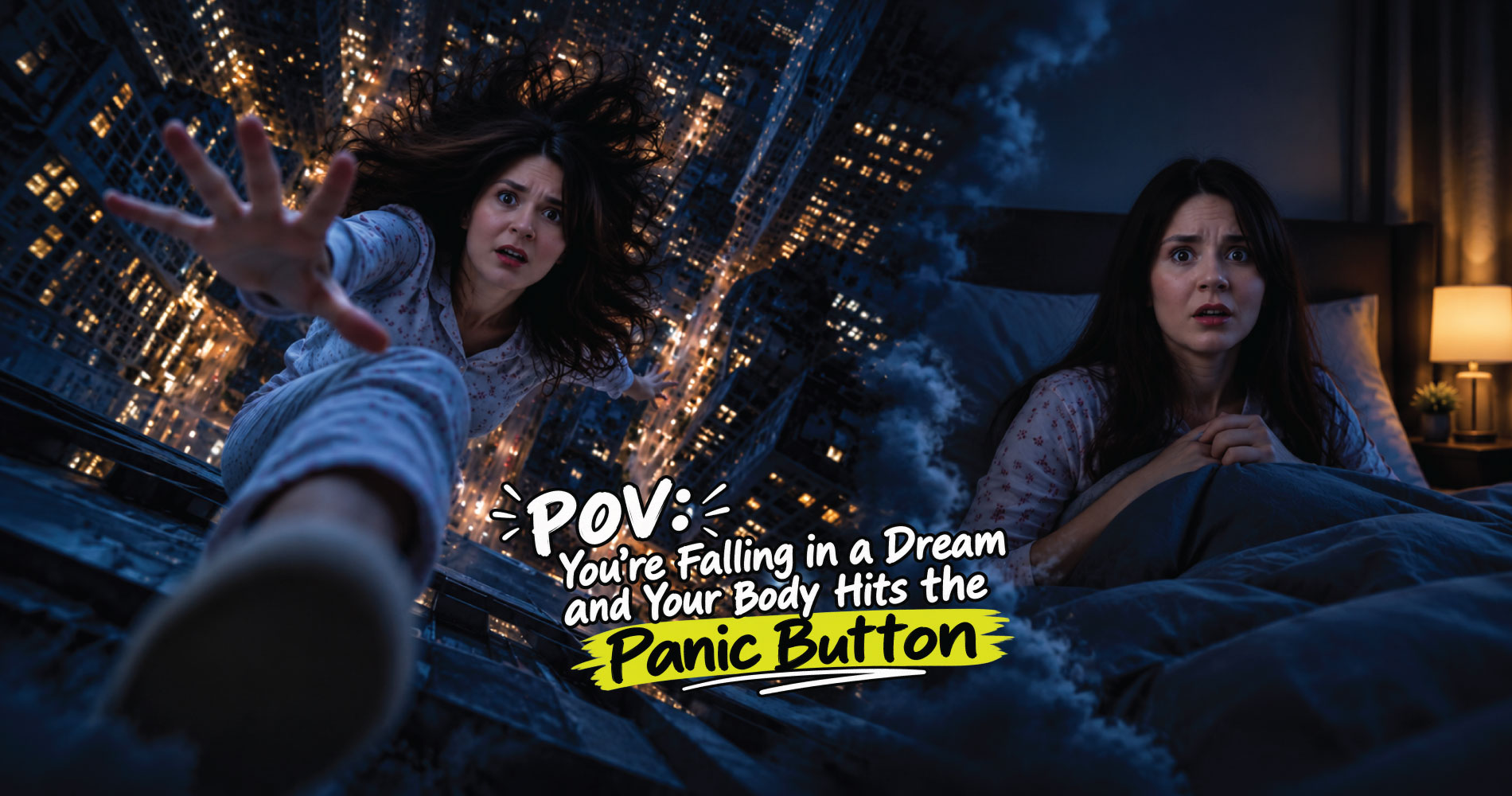
POV: You’re finally falling asleep, your dream suddenly turns into a free fall, and your body hits the emergency exit before you even realize what’s happening! One second, you’re peacefully drifting off. The next, you’re falling down a staircase, slipping off a cliff, or dropping into an endless void, only to wake up with a sudden jerk and a racing heart. Sounds familiar right? You’re definitely not alone.
This experience is often associated with hypnic jerks. They are also called sleep starts or hypnagogic jerks. These are sudden involuntary muscle contractions that usually occur during the transition from wakefulness to sleep. They may be accompanied by a sensation of falling, dream-like images, or a sudden feeling of fear. But why does this happen? Does your brain mistake sleep for a real falling event? Can stress, caffeine, or lack of sleep be linked to these jerks occurring more often? And does dreaming of falling indicate a deeper meaning?
Let us understand the science behind it, distinguish between popular beliefs and research-based facts, and learn practical ways to improve sleep. Because sometimes your brain comes up with the most dramatic plot twist just when you are least prepared for it!
Understanding why you feel like you are falling in your sleep
Imagine that after a long day you are lying in bed, resting. Your eyes are getting heavy and you are slowly drifting off to sleep. Suddenly, you feel as if you are falling from a height. Your leg jerks, your whole body jolts, or you wake up with a start. For a few moments, the experience feels extremely real. You may need to remind yourself that you are safely in your bed.
If you have ever wondered, “Why do I feel like I am falling when I am falling asleep?”, a common sleep-related phenomenon can help explain this experience.
What is the feeling of falling during sleep?
It is the sensation in which you feel as though your body is falling downward, slipping, losing balance, or suddenly moving through space while you are about to fall asleep. Sometimes it happens with a dream, and sometimes the body feels a jolt without any clear dream. As sleep begins, your awareness of the world around you changes. At this time, you may experience small images, incomplete thoughts, unusual bodily sensations, or a feeling of moving, even though you are actually lying still.
Understand an important distinction here: a dream of falling is a mental experience, while a sudden jerk of the body is a physical activity. These can occur together, but the presence of one does not prove that the other was caused by it.
What is a hypnic jerk?
A hypnic jerk, also called a sleep start or hypnagogic jerk, is a sudden and involuntary contraction of the muscles that occurs as you begin to fall asleep. It may affect one part of the body, such as a leg or an arm, or be felt in several muscles of the body.
Some people feel only a slight twitch, while others’ bodies move so abruptly that they wake up completely. Sometimes it may be accompanied by a sensation of falling or a dream-like image.
These jerks are common, and if they occur only occasionally and are not accompanied by any other problem, they usually do not require treatment. The exact process behind them is not yet fully understood, although researchers are studying the changes in nervous system activity that occur as sleep begins. Therefore, an occasional jerk while falling asleep is not, by itself, a sign that something is wrong.
Why do these two sometimes happen together?
Imagine that you are just about to fall asleep and you feel as if you are falling. Around the same time, your leg jerks suddenly and you wake up. Because the two events occur so close together, you may think that the dream caused the jerk. But a coincidence in timing alone does not prove a cause-and-effect relationship.
These two may be experiences associated with the process of falling asleep, or they may occur together even though neither directly causes the other. A hypnic jerk can happen without any feeling of falling, and a dream of falling can occur without any obvious physical jerk.
What if you have a dream of falling later in the night?
Hypnic jerks occur especially during the transition into sleep, whereas dreams of falling can also occur in the later part of the night, when you are already asleep. If you suddenly wake up from a long and vivid dream, that does not by itself mean that you experienced a hypnic jerk. The patterns of brain activity, awareness, and muscle activity differ across the various stages of sleep. Therefore, every instance of waking from a dream later in the night should not be understood as being the same as the jerk that occurs at the onset of sleep.
Why does your body suddenly jerk when you’re falling asleep?
Sleep may seem like a simple process from the outside, but during it, brain activity, muscle activity, and awareness of sensations continue to change. A hypnic jerk can occur during this transition.
1. Your brain is undergoing a transition between wakefulness and sleep
The brain does not move from a fully awake state to a fully asleep state in a single moment. It passes through different stages of sleep. N1 sleep is the lightest stage of non-rapid eye movement (NREM) sleep and represents the initial phase of entering sleep from wakefulness. During this time, awareness of the surrounding world begins to decrease, thoughts may become less organized, and sometimes minor sensations or involuntary movements can interrupt the process of falling asleep.
Hypnic jerks are usually associated with this early period. Researchers believe that changes in nervous system activity may contribute to these jerks, but the exact neurological process is still a subject of research.
2. Your nervous system may produce a sudden muscle response
Your nervous system controls muscle movements, sensations, and responses. While sleeping, the systems associated with awareness, movement, and alertness are changing their activity. One possible explanation is that during this transition, a small, involuntary muscle response may occur. Researchers have studied the connections between these jerks and the mechanisms related to body movements and the startle response. However, a definite cause has not been established for every hypnic jerk. You do not need to deliberately dream of moving or falling in order to feel a jolt.
3. Why does it feel like you are actually falling?
This experience can be confusing because the physical jerk and the sensation of falling occur at almost the same time. You feel as if you have started to fall, the body responds, and you wake up. One possible theory is that, during the onset of sleep, changes in muscle activity and in the sensations received from the body may be interpreted by the brain as movement or a loss of balance. Dream-like mental images may also accompany this experience.
However, this is still only a possible explanation, not a proven cause that can account for every sensation of falling. The fact that both events occur at the same time does not prove that the dream of falling caused the jerk.
Why does your brain make you dream about falling?
Dreams of falling are often associated with stress, fear of failure, or a loss of control over life. While these explanations may be interesting from a personal or cultural perspective, they are not considered established scientific causes of falling dreams.
Mental images formed during the onset of sleep
As you fall asleep, you may experience for a few moments images, sounds, sensations, or dream-like scenes. These are called hypnagogic phenomena, because they occur during the transition from wakefulness to sleep.
You may imagine yourself going down stairs, trying to reach something, slipping, or falling from a height. These images may be incomplete or unusual, yet they can seem so vivid that you wake up startled. The sensation of falling and hypnic jerks can occur together, but the exact relationship between them is not yet fully understood.
Can your brain misinterpret muscle relaxation?
According to a common theory, changes in muscle activity and bodily sensations while falling asleep may contribute to the feeling of falling. According to this hypothesis, the brain may interpret certain sensations as movement or loss of balance and produce a physical response.
However, this has not been proven to be the definite cause of falling dreams or hypnic jerks. It is one of several possible explanations.
What about the senses that detect your balance and body position?
The brain uses information from multiple sources to understand where your body is and how it is moving. Proprioception helps you sense the position of different parts of your body, while the vestibular system in the inner ear contributes to balance and spatial orientation. When awake, these systems work together with vision and other sensations.
However, it has not been established that confusion in the balance system during sleep is what causes falling dreams or hypnic jerks. Researchers are still trying to understand the processes behind these experiences.
Is there an evolutionary reason behind falling dreams?
A popular theory on the internet says that our ancestors slept in trees and that the brain developed the ability to give a sudden jolt to prevent them from falling. This sounds interesting, but it should not be presented as established science. There is no established evidence that hypnic jerks evolved specifically to prevent humans from falling out of trees while sleeping.
The reality is that hypnic jerks are recognized activities that occur during the onset of sleep, but the exact process behind them is not yet fully understood.
What can trigger hypnic jerks? Factors that may make them more frequent
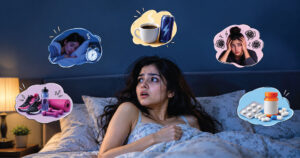
Sometimes hypnic jerks occur without any clear reason. However, medical sources and literature related to sleep medicine mention several factors that may be associated with them occurring more frequently or being felt more intensely. These factors do not affect everyone in the same way, and the presence of any one of them does not guarantee that you will experience the sensation of falling while falling asleep.
1. Sleep deprivation
Have you ever stayed up late scrolling through reels, watched an entire web series, or studied all night before getting up early for class the next morning? It may be that your sleep schedule is paying the price. Sleep deprivation can affect attention, mood, alertness, and a regular sleep routine. Fatigue is also counted among the possible factors associated with hypnic jerks.
If you do not consistently get enough sleep, it can be difficult to maintain a comfortable and regular bedtime routine. If you notice that jerks occur more often on days when you are tired, prioritize getting enough sleep. However, a single jerk does not prove that you are sleep-deprived.
2. Stress and anxiety
Your mind may be ready to log off, but your thoughts may still be racing about tomorrow’s deadline, unfinished work, awkward conversations, and every possible bad scenario.
Stress and anxiety can make it difficult to relax and fall asleep. They can also disrupt sleep, making experiences that occur as you are falling asleep feel more vivid. In medical descriptions, stress is considered a possible contributing factor to hypnic jerks.
Even so, dreaming about falling does not by itself mean that you are stressed or losing control of your life. You can experience hypnic jerks even while feeling completely calm.
3. Too Much Caffeine
Coffee before class, an energy drink in the afternoon, and another cup of coffee while working late at night, this may seem like part of your normal routine. But caffeine is a stimulant that can interfere with your sleep, especially if you consume it later in the day. Excessive caffeine intake is included among the potential factors associated with more frequent or more noticeable hypnic jerks.
Sensitivity to caffeine varies from person to person, and its effects can last for several hours. If you experience frequent jerks as you are falling asleep, pay attention to when you consume coffee, tea, energy drinks, or other sources of caffeine. Reducing caffeine later in the day may help some people relax. There is no single cutoff time for caffeine that works for everyone. Pay attention to your sleep and your sensitivity.
4. Doing vigorous exercise very close to bedtime
Exercise is beneficial for overall health and can promote good sleep. There is no need to avoid workouts because of concern about hypnic jerks. However, after very vigorous exercise right before sleep, some people may feel more energized, which can make it difficult for them to calm down and fall asleep.
If you have trouble sleeping after intense late-evening workouts or if the jerks feel more noticeable, try changing the timing of your workouts. Exercise itself is not harmful to sleep. The timing and intensity of the activity, as well as individual differences, can affect the ability to relax at bedtime.
5. Irregular Sleep Schedule
Staying up very late some nights, waking up very early on others, taking long naps during the day, and sleeping at different times each day can make your sleep routine irregular.
A regular sleep and wake schedule can help create a more stable sleep pattern.
Having an irregular sleep schedule does not necessarily mean that you will definitely experience hypnic jerks. However, maintaining a regular routine may help reduce sleep disruptions and fatigue, which have been associated with this phenomenon.
6. Medications and Other Factors
Some medical reports have linked certain medications to activities during sleep. For example, a small published case series described hypnic jerks in people taking certain Selective Serotonin Reuptake Inhibitors (SSRIs). These medications are used to treat a range of conditions, including depression and anxiety.
However, case reports do not show how often this happens or whether the medication is the cause in every case. If sudden jerks begin after starting a medication or changing its dose, speak with the healthcare professional who prescribed it. Do not stop the prescribed medication or change its dose on your own. Remember that not every physical activity that occurs at night is a hypnic jerk. There may be other causes behind persistent or unusual movements, which may require medical evaluation.
What happens in your brain when you drift off to sleep?
As sleep begins, the brain’s activity and your awareness of the surrounding world gradually change. You become less responsive to external stimuli, and your thoughts and sensations may also change.
Sleep includes NREM and REM stages, which repeat in cycles throughout the night. N1 is the lightest stage of NREM sleep and represents the initial transition from wakefulness into sleep. Hypnic jerks are commonly associated with this period.
Why do strange images suddenly appear in your mind?
Have you ever experienced this: you are almost asleep, and suddenly a strange image appears in your mind? Perhaps you begin imagining yourself walking through a familiar place, talking to someone, or suddenly falling from a height. Such images that arise during the onset of sleep can appear even without deliberate imagination. They may be brief, incomplete, or accompanied by unusual sensations.
However, not every image is a fully developed dream, and not every sensation of falling is produced in the same way.
Why can such a small event feel so dramatic?
A sudden jerk of the body as you are falling asleep can startle you. Some hypnic jerks may be accompanied by a brief increase in alertness, which can cause fear, a racing heartbeat, or a sudden awakening. When the sensation of falling and the physical jerk occur together, the experience can feel more dramatic.
Even so, researchers have not yet established a single complete neurological explanation that accounts for every aspect of this experience. A sensation feeling extremely real is not proof that a dangerous event has occurred. The intensity of an experience and its medical significance are not always the same.
Myths vs. facts: What the internet gets wrong about falling dreams
Dreams of falling are a popular topic in viral videos, dream interpretations, and late-night internet searches. But some explanations turn interesting theories into claims that seem scientifically proven.
Myth 1: Your soul is leaving your body
Fact: This is a spiritual interpretation, not an established scientific explanation for hypnic jerks.
Science can study the activities, sensations, and sleep processes associated with these experiences, but it has not been established that dreams of falling indicate the soul leaving the body.
Myth 2: Your brain thinks you are about to die and jolts you awake
Fact: There is no established evidence that hypnic jerks are a specific emergency response of the body to imminent death. Hypnic jerks are recognized movements that occur as sleep begins. There are possible explanations linked to changes in nervous system activity, but the exact process is not yet fully understood.
Myth 3: Dreams of falling always indicate stress
Fact: Stress can disrupt sleep and may be associated with more frequent hypnic jerks, but simply dreaming of falling does not prove a person’s emotional state. Many things can influence dreams. There is no scientifically proven universal dictionary that assigns a fixed meaning to every dream.
Myth 4: Every dream of falling is caused by a hypnic jerk
Fact: A dream of falling is an experience, while a hypnic jerk is a physical activity of the body. They can occur together, but not every dream of falling is accompanied by a hypnic jerk, and not every hypnic jerk is accompanied by a sensation of falling.
Myth 5: A hypnic jerk means you have a neurological disease
Fact: Occasional hypnic jerks are common and generally harmless. However, repeated episodes that continuously disturb sleep, also occur while fully awake, or appear along with other concerning symptoms should not be ignored as normal sleep starts without evaluation.
Myth 6: There is a guaranteed way to stop falling dreams forever
Fact: There is no proven method that guarantees falling dreams or hypnic jerks will never happen again. Improving sleep habits and controlling contributing factors may help some people, but this experience cannot always be prevented.
How can you reduce frequent sleep jerks and improve your sleep
You cannot control everything that happens as you fall asleep, but you can adopt habits that promote better sleep and may help reduce the factors associated with more noticeable hypnic jerks.
1. Give your body enough time to sleep
Prioritize getting enough sleep instead of repeatedly sacrificing it for work, study, or scrolling.
Most adults generally need about seven to nine hours of sleep each night, although this need can vary from person to person. If you are regularly sleeping significantly less than this, consider adjusting your sleep and wake times.
2. Keep your sleep schedule regular
Try to go to bed and wake up at about the same time every day, including weekends.
Your routine does not have to be perfect. The goal is to build a consistent habit that gives you enough rest and helps you wind down and sleep peacefully at night.
3. Keep track of your caffeine intake
If you regularly drink coffee, tea, or energy drinks, pay attention to how the timing of your consumption affects your sleep. Reducing caffeine later in the day can be helpful, especially if you have trouble falling asleep. However, do not assume that caffeine is responsible for every setback. Try to identify patterns between your habits and your sleep experiences.
4. Create a relaxing routine before bed
Your nighttime routine does not need expensive products or complicated rituals. Reading a book, listening to soothing music, doing light stretching, taking a relaxing shower, or stepping away from work before bed can be helpful.
If scrolling through stressful content makes you feel more alert, consider staying away from your phone for some time before sleeping. The goal is to create a relaxing environment, not to achieve a perfect routine every night.
5. Create a comfortable environment for sleep
A comfortable sleeping position, an appropriate room temperature, and a relatively quiet and dark environment can promote better sleep. These changes do not guarantee that hypnic jerks will be completely eliminated, but they can help you relax and maintain a regular sleep routine.
6. Do not let this experience become another cause for anxiety
Waking up suddenly after feeling as though you are falling can be upsetting. However, worrying excessively about whether it will happen again can increase stress at bedtime. If it happens only occasionally, remind yourself that hypnic jerks are usually harmless.
If it happens repeatedly, you may keep a simple sleep diary to record your bedtime routine, sleep duration, caffeine intake, and the timing of these episodes. This can help you identify patterns and provide useful information to a healthcare professional if needed.
When should you be concerned about sudden jerks during sleep?
Most occasional hypnic jerks do not require medical evaluation or treatment. However, not every nighttime movement can be considered a hypnic jerk. If these episodes occur in the following situations, speak with a healthcare professional:
- They occur so often that you begin to have difficulty sleeping.
- They repeatedly disturb your sleep or make you feel unusually tired during the day.
- They occur frequently even when you are fully awake.
- They are becoming more intense over time or are accompanied by other concerning symptoms.
- They appear as persistent or unusual movements, unlike the occasional jerks that happen as sleep begins.
A health expert can assess the timing and pattern of these activities, the symptoms associated with them, and the related medications, in order to determine whether another cause needs to be considered.
Do not assume that every nighttime activity is harmless simply because hypnic jerks are common. Similarly, the occasional feeling of falling does not necessarily mean that you have a medical problem. The context, frequency, and the impact on your sleep are important.
Conclusion: Your brain isn’t trying to prank you
The sudden jolt of the body while falling in a dream and waking up abruptly can feel as if your brain has decided to make its own horror movie. However, experiencing this occasionally is usually not something to worry about.
Hypnic jerks are recognized involuntary movements that occur while entering sleep. They may be accompanied by a sensation of falling or dream-like mental images, but scientists have not yet established a single definite explanation for why these experiences sometimes occur together.
Prioritize adequate sleep, maintain a regular routine, and if these episodes begin to happen frequently, pay attention to factors such as stress and caffeine. And remember that your dream of falling does not necessarily have to be a sign of something mysterious about your life. Sometimes the most useful answer is simply to understand what science knows, what remains uncertain, and when to seek help.
Disclaimer
This article is for general information and educational purposes only. It should not be considered a substitute for professional medical advice, diagnosis, or treatment. Hypnic jerks are generally normal, involuntary physical movements that occur during the transition from wakefulness to sleep. However, not every sensation of falling, every nighttime physical movement, or every sudden awakening has the same cause.
Fatigue, stress, lack of sleep, and caffeine intake may be associated with experiences that occur more frequently or more noticeably, but they do not explain every experience. Some explanations given for the sensation of falling are possible theories rather than scientifically proven conclusions.
Do not stop taking your prescribed medications or change their dosage based on the information in this article. If sleep-related physical movements begin to occur frequently, become more severe, happen even while fully awake, or significantly affect your sleep or normal daytime activities, consult a qualified health professional.
FAQs
1. Why do I dream of falling and suddenly wake up?
A dream of falling may occur with a hypnic jerk. A hypnic jerk is a sudden, involuntary muscle movement that happens while entering sleep. These two experiences can occur together, but researchers have not established that one always causes the other.
2. Are hypnic jerks normal?
Yes. Occasional hypnic jerks while falling asleep are common and generally harmless. They may include a slight muscle twitch, a sudden jolt of the body, or a feeling of falling.
3. Can stress or lack of sleep cause sudden jerks while falling asleep?
Stress, fatigue, lack of sleep, and excessive caffeine intake have been linked to more frequent or more noticeable hypnic jerks. However, these factors do not cause every episode, and jerks can also occur without any clear trigger.
4. What can I do to reduce the sensation of falling while falling asleep?
Get enough sleep, maintain a regular sleep schedule, monitor your caffeine intake later in the day, and establish a relaxing routine before bedtime. These steps can help control contributing factors, but they do not guarantee that the sensation of falling or hypnic jerks will stop completely.
5. When should I see a doctor for jerks during sleep?
Seek medical advice if these movements start happening frequently, consistently disrupt your sleep, also occur while you are awake, become more severe over time, or are accompanied by other concerning symptoms. A healthcare professional can assess whether these are normal hypnic jerks or whether further evaluation is needed.

Content Writer with 3+ years of experience turning ideas into words people want to read, share, and remember. I create research-backed social media and lifestyle content that blends storytelling, creativity, and audience insights to make every piece feel fresh, relatable, and engaging.